Oil prices slipped early Friday, pulling back from a one-week high, as traders balanced two competing narratives: the faint possibility of US-Iran diplomacy easing tensions in the Middle East, and the persistent reality of attacks that keep supply disruption risks firmly on the table.
Brent crude, the global benchmark, fell to $105.11 a barrel, while West Texas Intermediate (WTI), the main US benchmark, dropped to $92.61. Both had climbed to a one-week high just a day earlier, reflecting how quickly sentiment can shift in a market dominated by geopolitical headlines.
Diplomacy versus disruption
The market is being pulled in two directions. On one hand, there are signs that the US and Iran might be exploring a phased deal—reports have suggested discussions over the Strait of Hormuz, a critical chokepoint for global oil shipments. If diplomacy gains traction, it could reduce the risk of supply disruptions and keep shipping lanes open, which would be a relief for a market that has been on edge.
On the other hand, the region remains volatile. Ongoing attacks and counterattacks keep the threat of actual supply outages alive. Any escalation could quickly reverse the current price dip, which is why traders are not fully pricing in a peaceful resolution.
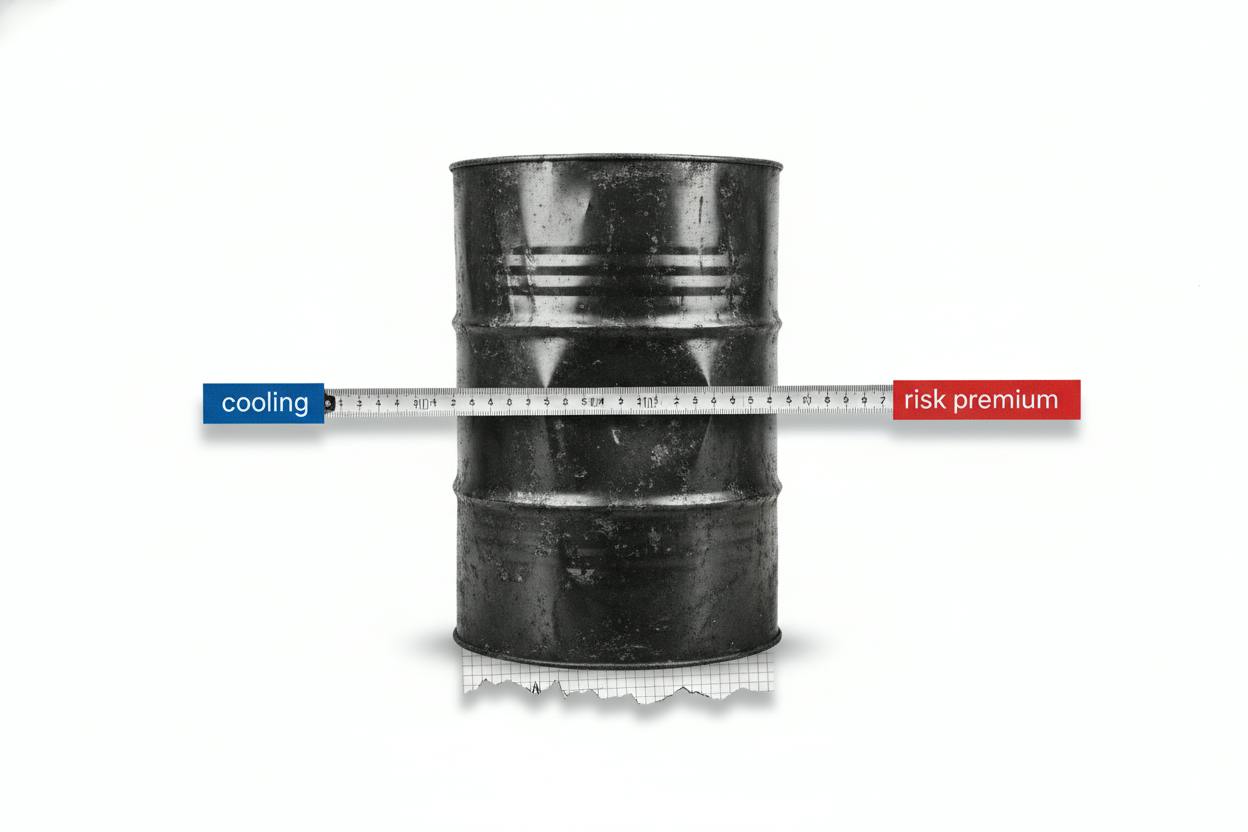
This tug-of-war is most visible in the widening gap between Brent and WTI. The spread—the difference in price between the two benchmarks—has grown to $12.50 a barrel. That is unusually wide. Normally, the spread reflects transportation and quality differences, but geopolitical risk tends to inflate it because Brent is more exposed to global supply disruptions, while WTI is more insulated by US production and infrastructure.
What the spread tells us
A wider Brent-WTI spread is a signal that the market is pricing in more risk for globally traded oil than for US domestic crude. For everyday investors, this matters because it affects the profitability of US oil producers and the cost of imported oil. When the spread widens, US producers can often fetch a relatively better price for their crude on the global market, but it also means that US consumers may see less relief at the pump if global prices stay elevated.
This week, the two benchmarks have moved in different directions: Brent was up about 1.7% for the week, while WTI was down roughly 7%. That divergence is a clear sign that the market is treating the two as different assets right now, with geopolitical risk weighing more heavily on the global benchmark.
What it means for investors
For investors, the key takeaway is that oil prices are likely to remain volatile as long as the Middle East situation stays unresolved. The diplomatic track is real but fragile, and any breakdown in talks could send prices sharply higher. Conversely, a breakthrough could lead to a quick unwind of the risk premium that has been built into prices.
Energy stocks and oil-linked ETFs will continue to swing with these headlines. Investors should be prepared for choppy trading and avoid making big bets based on a single day's move. The broader trend will depend on whether diplomacy can deliver tangible results, and whether supply disruptions actually materialize.
For those with diversified portfolios, the oil market's moves are a reminder of why energy exposure is often seen as a hedge against geopolitical shocks—but also why it can be a source of volatility. As always, it's wise to focus on long-term fundamentals rather than reacting to every headline.
In the coming days, traders will be watching for any official statements from Washington or Tehran, as well as any new attacks in the region. The reported talks over the Strait of Hormuz are a key development to monitor, as they could set the tone for prices in the near term.
Meanwhile, the broader market reaction to peace hopes has also been visible in other commodities, with gold and silver slipping as investors shifted their risk assessment. That suggests that the market is not entirely convinced that tensions will ease, but it is willing to price in the possibility.
For now, the oil market remains a story of two forces pulling in opposite directions. The next few weeks will likely determine which one wins out.