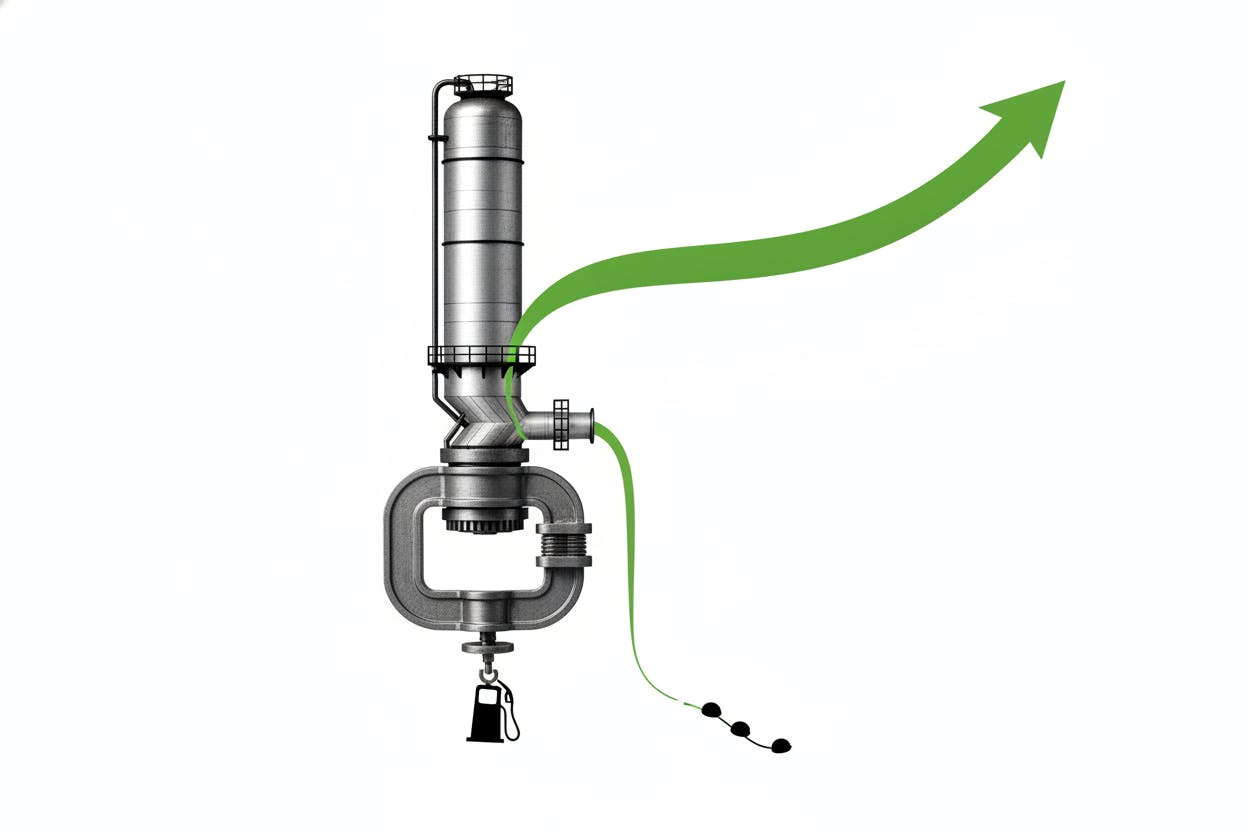
Poland's state-controlled energy giant Orlen delivered a stronger-than-expected second quarter, as wider refining and petrochemical margins more than offset pressure from a temporary government cap on retail fuel prices. The company reported EBITDA LIFO of 13.9 billion zlotys (about $3.5 billion), ahead of the 13.3 billion zlotys analysts had penciled in, according to Reuters.
What drove the beat?
The main engine was the downstream business. Refining margins — the difference between what it costs to buy crude oil and what refined products like diesel and jet fuel sell for — widened during the quarter. That's a familiar pattern when crude prices are volatile or when product demand outpaces supply. Petrochemical margins also improved, giving Orlen a second tailwind.
But not every part of the company had a good quarter. Orlen's retail network, which runs fuel stations across Poland and neighboring countries, saw its margins squeezed by a temporary cap on pump prices. Such caps are often introduced by governments to shield consumers from high energy costs, but they force fuel sellers to absorb part of the price increase. That weighed on the retail segment, even as the rest of the business hummed along.
The company's use of LIFO accounting — last in, first out — is worth understanding. It's a method that values inventory based on the most recent costs, which can create big swings in reported profit when oil prices move sharply. By reporting EBITDA on a LIFO basis, Orlen strips out those inventory valuation effects, giving investors a clearer look at the underlying operating performance. It's a common metric for oil and gas companies, though it can sometimes obscure the cash impact of inventory changes.
Why it matters for investors
For everyday investors, the key takeaway is that Orlen's core operations are generating solid cash flow, even in a period when one part of the business is being held back by government policy. The beat suggests that the company's refining and petrochemical assets are well-positioned to benefit from current market conditions.
However, the retail squeeze is a reminder that energy companies operating in regulated or politically sensitive markets face risks beyond the usual commodity price swings. Government interventions, whether price caps, windfall taxes, or export restrictions, can quickly alter the profit picture. Investors holding Orlen shares — or considering them — should keep an eye on political developments in Poland, as well as global refining margins.
The broader context is also important. Refining margins have been historically strong in recent years, partly because of reduced global refining capacity and shifting trade flows after the pandemic and geopolitical disruptions. But those margins can be cyclical, and a sudden economic slowdown or new refinery capacity could compress them again.
Orlen's diversified portfolio — which includes upstream oil and gas production, refining, petrochemicals, and retail — helps cushion the blow when any single segment underperforms. That's a structure many large European energy companies have adopted, and it's one reason Orlen has been able to post resilient results even when retail margins are squeezed.
What to watch next
Investors will likely focus on a few things in the coming months. First, how long the retail price cap remains in place and whether the government extends or adjusts it. Second, the trajectory of refining margins — if they stay elevated, Orlen could continue to beat expectations. Third, any updates on the company's strategy, including its transition toward lower-carbon energy, which could affect long-term valuation.
Orlen's beat is part of a broader pattern this earnings season, where companies with pricing power or favorable market conditions have topped forecasts. For example, Molson Coors also beat Q2 forecasts by leaning on price increases, and Parker-Hannifin raised its outlook on strong aerospace demand. The common thread: companies that can navigate cost pressures and demand shifts are being rewarded.
For Orlen specifically, the market reaction will hinge on whether the beat is seen as sustainable or a one-off driven by temporary margin strength. The company's ability to manage the retail cap while still delivering growth will be a key test of its operational resilience.
As always, it's worth remembering that a single quarter's beat doesn't guarantee future performance. Energy markets are notoriously volatile, and political factors can change quickly. But for now, Orlen's second-quarter numbers suggest the company is in a solid position to weather the challenges ahead.