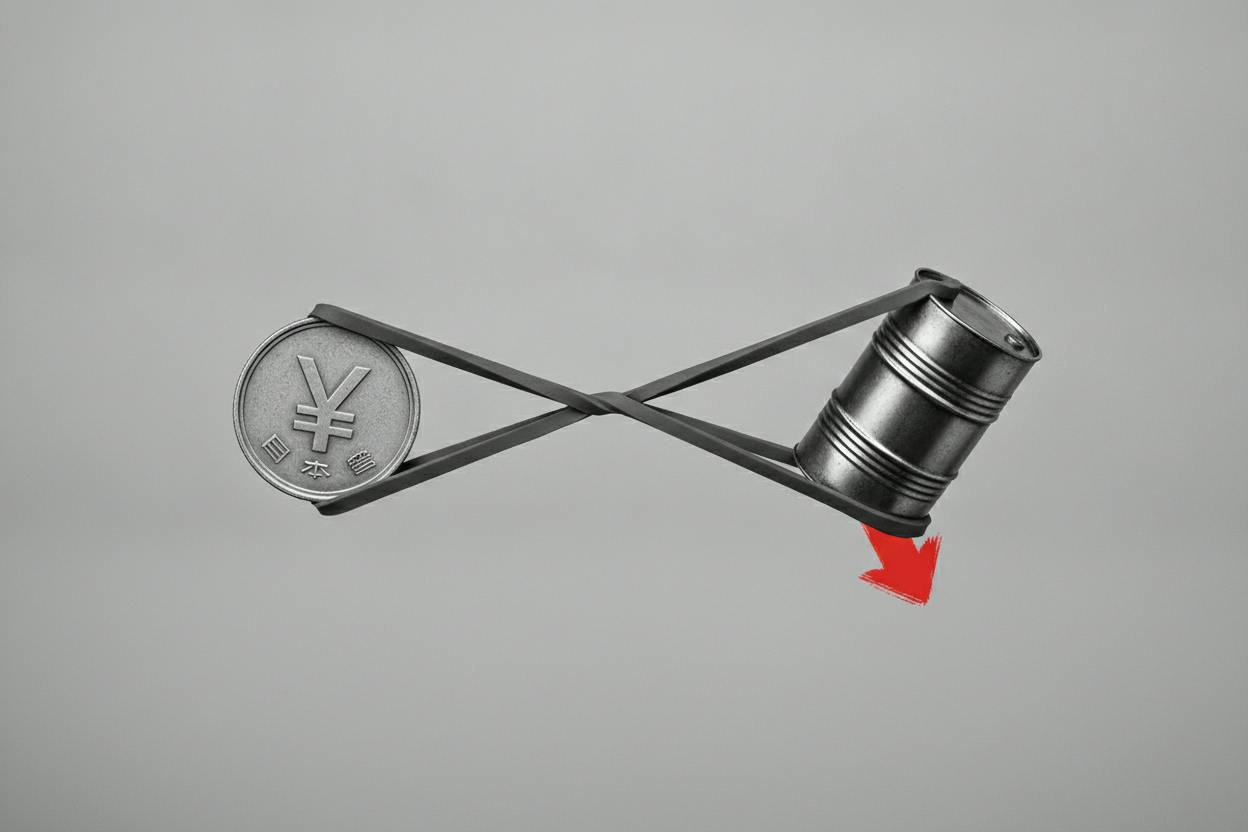
Rubber futures took divergent paths on Thursday, with Japan's benchmark edging higher on a softer yen while China's contract slipped in tandem with falling oil prices. The moves come a day before the Bank of Japan (BOJ) is widely expected to announce its latest monetary policy decision.
Yen weakness supports Osaka
On the Osaka Exchange (OSE), the February rubber contract closed 0.63% higher at 427.9 yen per kilogram. The gain was largely currency-driven: with the yen hovering near a two-week low of about 155.98 per dollar, yen-denominated futures become cheaper for overseas buyers holding dollars or other currencies. That dynamic can boost demand for Japanese contracts even when the underlying commodity's fundamentals are unchanged.
Rubber is traded on multiple exchanges around the world, each priced in its local currency. As a result, foreign-exchange movements can be just as important as supply and demand for the commodity itself. A weaker yen effectively discounts Japanese rubber for international buyers, while a stronger yen would have the opposite effect.
Shanghai slips as oil eases
In contrast, Shanghai's rubber contract declined, tracking a pullback in crude oil prices. Oil is a key input in synthetic rubber production, and cheaper crude can reduce the cost of the synthetic alternative, putting pressure on natural rubber prices. When oil falls, natural rubber often follows because buyers can switch to cheaper synthetic options.
The Shanghai market also tends to reflect domestic Chinese demand and inventory levels, which have been mixed in recent months. While auto sales and tyre production remain important drivers, the immediate focus was on the oil price slide.
Bank of Japan decision in focus
All eyes are now on Friday's BOJ meeting. The central bank has been gradually moving away from its ultra-loose monetary policy, and any signal about future rate hikes could significantly affect the yen. If the BOJ surprises with a more hawkish stance, the yen could strengthen, which would likely weigh on Osaka rubber futures by making them more expensive for foreign buyers. Conversely, a dovish tone could keep the yen weak and support Japanese prices.
For everyday investors, the key takeaway is that commodity prices are not just about the commodity itself. Currency moves and related markets like oil can create short-term divergences between exchanges. This is a reminder that global markets are interconnected, and events like a central bank meeting can ripple through asset classes as varied as currencies, energy, and agricultural raw materials.
What it means for investors
For those with exposure to rubber through futures, ETFs, or companies in the tyre and auto supply chain, the split between Osaka and Shanghai highlights the importance of monitoring both currency trends and oil prices. A weak yen can be a tailwind for Japanese rubber exporters, while falling oil can pressure natural rubber prices globally.
Investors should also watch the BOJ's decision for clues on the yen's direction. A stronger yen could hurt Japanese exporters and make yen-denominated commodities less attractive. On the other hand, if the BOJ maintains a cautious stance, the yen may stay weak, providing ongoing support for Osaka futures.
In the broader commodities complex, similar cross-currents are at play. For instance, palm oil prices recently stalled after hitting a 21-month high on weak export data, showing how demand and currency factors can quickly shift momentum. Likewise, copper's 10-week rally stalled as tariff uncertainty cooled prices, underscoring that geopolitical and trade policy risks remain a wildcard for commodities.
For now, rubber traders are likely to stay focused on the BOJ and on oil's next move. The divergence between Osaka and Shanghai may persist until one of those factors shifts decisively.