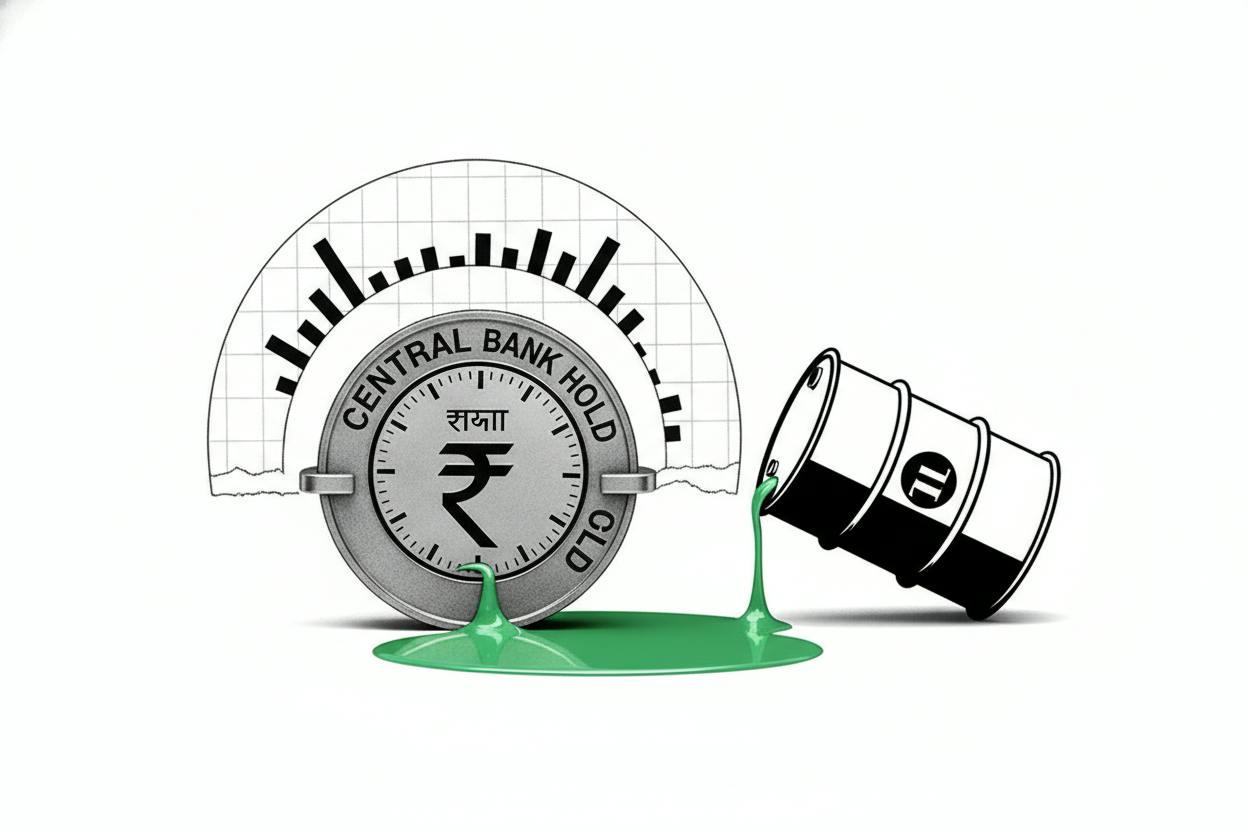
India's rupee opened slightly firmer against the US dollar on Tuesday, but currency traders are not reading too much into the move. According to Reuters, the rupee was indicated around 95.75-95.80 per dollar, a touch stronger than its previous close, as softer crude prices and a dip in long-dated US Treasury yields improved risk appetite across emerging markets.
The modest gain, however, is unlikely to turn into a sustained rally. Traders expect the currency to remain boxed in a 95-96 range for now, with two powerful forces pulling in opposite directions: oil prices hovering near $100 a barrel and an upcoming Reserve Bank of India (RBI) policy decision that could shape the rupee's path for weeks.
Why oil matters so much for the rupee
India is one of the world's largest importers of crude oil, and that makes the rupee unusually sensitive to energy prices. When oil climbs, Indian refiners and importers need more dollars to pay for the same barrels, which increases demand for the US currency and weighs on the rupee. When oil falls, that pressure eases.
With Brent crude trading near $100 a barrel, the import bill remains elevated. That persistent dollar demand from importers — companies locking in dollars to pay for future shipments — tends to cap any rupee rally. In other words, even when global conditions turn favourable, as they did overnight with softer oil and lower US yields, the structural demand for dollars keeps the currency from running too far.
The US Treasury yield move is also worth noting. Long-dated yields dipped, which typically narrows the interest-rate advantage that US assets hold over emerging-market ones. When that gap shrinks, global investors are more willing to hold riskier currencies like the rupee, at least at the margin. That helped lift sentiment at the open, but it is not enough on its own to change the broader trend.
The RBI's role: intervention and policy
The Reserve Bank of India is the other big variable. The central bank regularly intervenes in the foreign exchange market — selling dollars from its reserves when the rupee weakens too quickly, and sometimes buying when it strengthens sharply — to smooth volatility rather than to target a specific level. Traders are watching closely for any signs of that intervention, especially near the 96 mark, which has acted as a psychological line in the sand in recent sessions.
Beyond day-to-day intervention, the RBI's upcoming monetary policy decision is front and centre. Interest rates are a key driver of currency moves: higher rates tend to attract foreign capital seeking better returns, supporting the rupee, while lower rates can do the opposite. The central bank also has to balance its currency concerns against domestic inflation, which is itself influenced by oil prices. It is a delicate trade-off, and markets will parse every word of the policy statement for clues about the RBI's priorities.
As the rupee has come under pressure from oil above $100, the RBI has been seen steadying the currency, and that dynamic is likely to continue until crude prices retreat meaningfully or the policy outlook becomes clearer.
What it means for investors
For everyday investors, a range-bound rupee is not necessarily a problem, but it does have practical implications. If you hold US stocks, international funds, or any dollar-denominated assets, a weaker rupee boosts the value of those holdings when converted back into rupees. A stronger rupee does the opposite. With the currency expected to stay in a narrow band, those currency effects are likely to be modest in the near term — but they are worth keeping in mind if you are planning large overseas investments or remittances.
Import-heavy sectors are another area to watch. Companies that rely on crude oil as a raw material — paint makers, airlines, logistics firms, and parts of the chemicals industry — tend to see their margins squeezed when oil is expensive and the rupee is weak, because their input costs rise in local currency terms. Exporters, by contrast, can benefit from a weaker rupee, since their goods become more competitive abroad and their overseas earnings translate into more rupees. Information technology and pharmaceutical companies, which earn a large share of revenue in dollars, often fall into this category.
For bond investors, the RBI's policy decision matters directly. If the central bank signals a prolonged pause or a hawkish stance, short-term yields could stay elevated, offering better returns on fixed-income investments. If it leans dovish, bond prices could rise. Either way, the currency and rates are intertwined, and the RBI's tone will ripple across both markets.
Finally, keep an eye on the global backdrop. US Treasury yields, the dollar index, and crude oil prices will continue to drive the rupee's daily moves. Any sharp drop in oil — say, on demand concerns or a supply surprise — would give the rupee room to strengthen, while a spike above current levels would intensify the pressure. For now, the market's base case is a holding pattern: a firmer open, but a currency still very much on a leash.