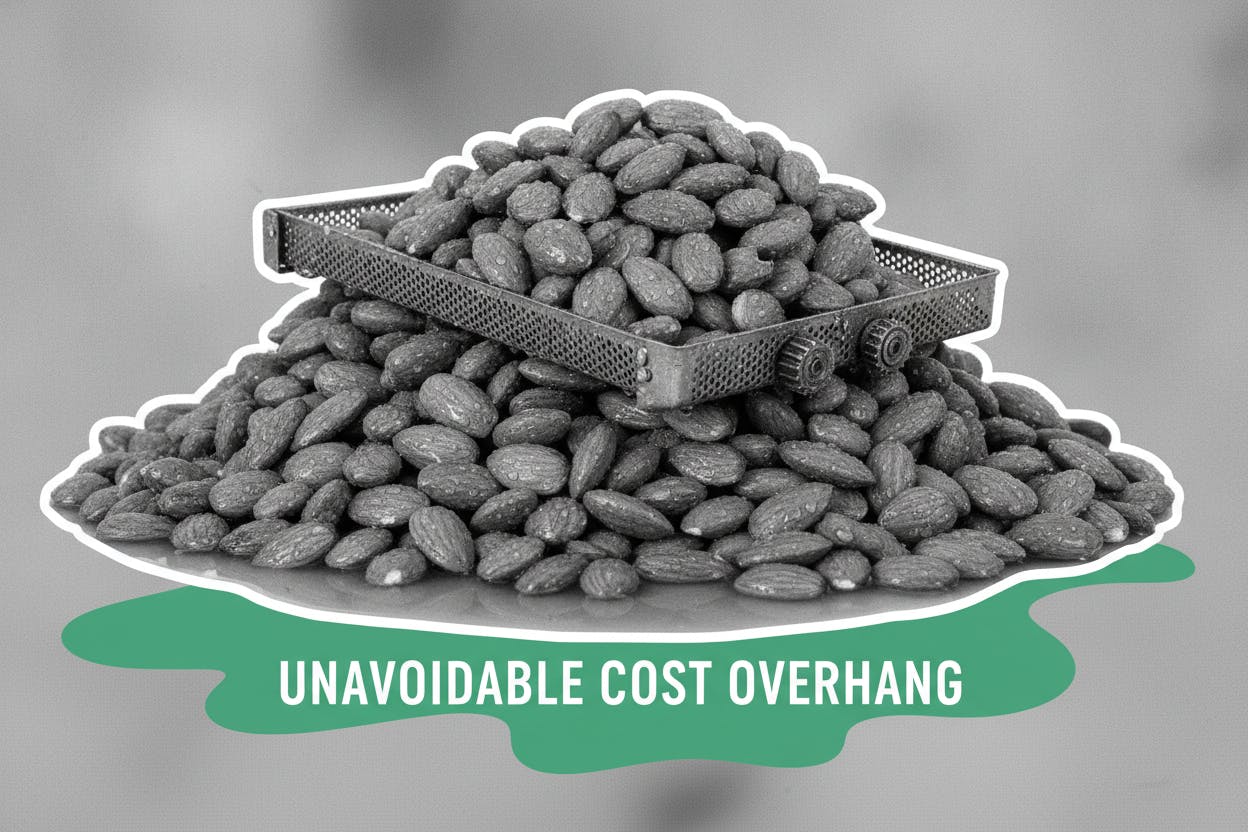
Australian almond grower Select Harvests has narrowed its 2026 crop guidance to between 28,800 and 29,600 tonnes, after an unusually wet late-February and early-March harvest added millions in extra costs. The company said the season still produced an “exceptional” crop, but the rain meant more drying, longer processing, and other one-off charges.
Those weather-related costs added another AU$7 million to second-half expenses, on top of the AU$6.9 million the company had already flagged at its half-year update. That brings the total weather hit for the second half to roughly AU$13.9 million, a significant drag for a business that depends on getting its crop to market efficiently.
What the wet weather means for the numbers
Almonds are harvested once a year, and the timing is critical. When rain falls during harvest, the nuts can absorb moisture, which means they need extra drying before they can be stored or processed. That slows everything down and adds energy and labour costs. In Select Harvests’ case, the company also had to deal with longer processing times and other one-off expenses tied to the weather.
The revised guidance of 28,800–29,600 tonnes is a tightening of the range the company had previously provided. It suggests that while the crop itself is still large, the wet conditions may have caused some losses or quality issues that trimmed the top end of expectations.
On the positive side, almond prices have inched up to AU$10.26 per kilogram. That’s a modest improvement, and it helps offset some of the cost pressure. But with costs rising, the net effect on profitability is still unclear.
Why this matters for investors
For everyday investors, the key takeaway is that weather is a recurring risk for agricultural companies like Select Harvests. Even a strong crop can be undermined by the cost of handling it under difficult conditions. The company’s ability to manage those costs and still deliver a decent margin will be closely watched.
Select Harvests is one of Australia’s largest almond producers, and its fortunes are tied to global almond prices, which have been under pressure in recent years due to oversupply. The slight uptick in prices to AU$10.26/kg is a small sign of stabilisation, but it’s far from a boom.
Investors should also note that the company has already absorbed a AU$6.9 million cost hit at the half-year stage, and now another AU$7 million has been added. That’s a meaningful increase in expenses for a company of this size, and it could weigh on full-year earnings.
Looking ahead, the market will be watching how Select Harvests manages its balance sheet and whether it can pass on higher costs through better prices. The company’s next earnings report will be the first real test of how the wet harvest has affected its bottom line.
Broader context: cost pressures across industries
Select Harvests is not alone in facing rising costs. Across the economy, companies are dealing with higher input prices, from energy to raw materials. For example, rising raw material costs have prompted downgrades in other sectors, and energy costs remain elevated in Europe. In Australia, services growth has held steady despite rising costs, but the pressure is clearly building.
For agricultural producers, weather is an additional variable that can amplify cost pressures. This is a reminder that investing in commodity-linked companies carries unique risks that go beyond the usual market fluctuations.
What to watch next
Investors will be looking for more details when Select Harvests reports its full-year results. Key questions include: How much of the weather-related cost will be recovered through higher prices? Will the crop quality hold up? And can the company maintain its dividend?
For now, the guidance update is a cautious signal. The crop is still large, but the cost overrun is a reminder that even good news can come with a price tag.