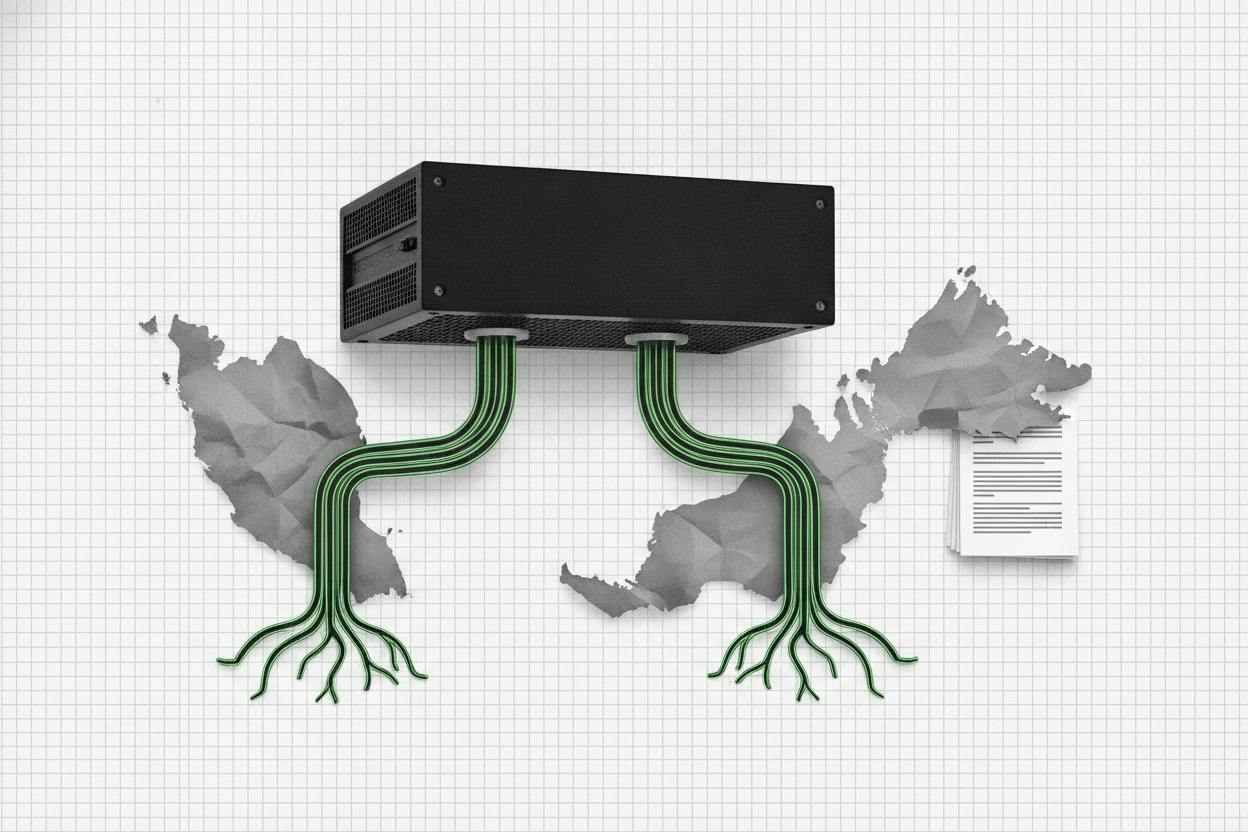
SoftBank, Grab and Sarawak's state-owned energy company PETROS have announced a $1.85 billion investment to build AI data-center capacity in Malaysia, with an ambitious goal of reaching 5 gigawatts (GW) across Sarawak and Peninsular Malaysia. The multi-year plan is the latest sign of the race to meet surging demand for AI computing in Southeast Asia.
What's in the deal?
The partners are structuring the investment as two separate build-outs, each with different lead investors. In Sarawak, the group is starting with $1 billion led by SoftBank: $800 million from the Japanese tech investor, plus $100 million each from Grab—a Southeast Asian ride-hailing and delivery firm—and PETROS. In Peninsular Malaysia, they've earmarked $850 million, funded mainly by Grab ($650 million) alongside SoftBank ($200 million).
This structure follows a common playbook in the data-center industry: start with seed capital and local partners, then try to attract "hyperscalers"—the biggest cloud and AI companies like Amazon, Microsoft, and Google—whose long-term contracts can justify much larger rounds of financing to expand capacity toward that 5-gigawatt target.
Why 5 gigawatts matters
To put the scale in perspective, 5 gigawatts is a massive amount of data-center capacity. A single large data center might use tens of megawatts, so 5 GW could power dozens of facilities. The headline $1.85 billion sounds large, but it's small relative to what it typically takes to build out several gigawatts of AI-ready data centers. Construction costs for such projects often run into the billions per gigawatt, meaning the initial investment is just a down payment.
The real question is whether the projects can land hyperscaler pre-commitments. Those contracts turn future revenue into something banks and infrastructure investors are willing to fund. In other words, the growth path usually runs from signed capacity deals to easier access to "project finance"—loans backed by the project's expected cash flows—and then to follow-on construction.
What it means for investors
For investors, the key signal won't be the initial check size; it'll be how quickly Sarawak and Peninsular Malaysia translate the plan into named, long-dated customer bookings and a credible timeline to scale. If hyperscalers sign on, the projects could attract much larger rounds of financing, potentially boosting the partners' valuations. If not, the 5-gigawatt ambition may remain just that—an ambition.
SoftBank's involvement is notable given its recent focus on AI infrastructure. The company has been a major investor in AI-related ventures, and its earnings have been closely watched for clarity on its AI funding strategy. This deal adds to SoftBank's AI footprint, though it's a relatively small commitment compared to its other investments.
For Grab, the investment marks a significant diversification beyond ride-hailing and delivery into the capital-intensive world of data centers. It's a bold move that could pay off if AI demand continues to grow, but it also carries execution risks.
PETROS, as the local partner, brings crucial on-the-ground knowledge and access to energy resources—a key factor in data-center development, since AI facilities are power-hungry. This partnership mirrors other efforts in the region to attract AI investment, such as chip ETFs surging on AI news, showing how AI infrastructure is becoming a global theme.
The bigger picture
Malaysia is positioning itself as a regional AI hub, and this deal is a vote of confidence in that strategy. The country's relatively low energy costs and strategic location make it attractive for data-center operators. However, the sector is competitive, with other Southeast Asian nations like Singapore and Indonesia also courting AI investment.
For everyday investors, this story is less about the immediate numbers and more about the trend: AI infrastructure is being built out rapidly across the globe, and companies that can secure long-term customers will be the winners. The broader market has been reacting to AI-related news, and this deal is another data point in that narrative.
As with any large infrastructure project, there are risks: construction delays, cost overruns, and the possibility that AI demand doesn't grow as fast as expected. But the partners are betting that the need for AI computing will only increase, and they're putting their money where their mouth is.