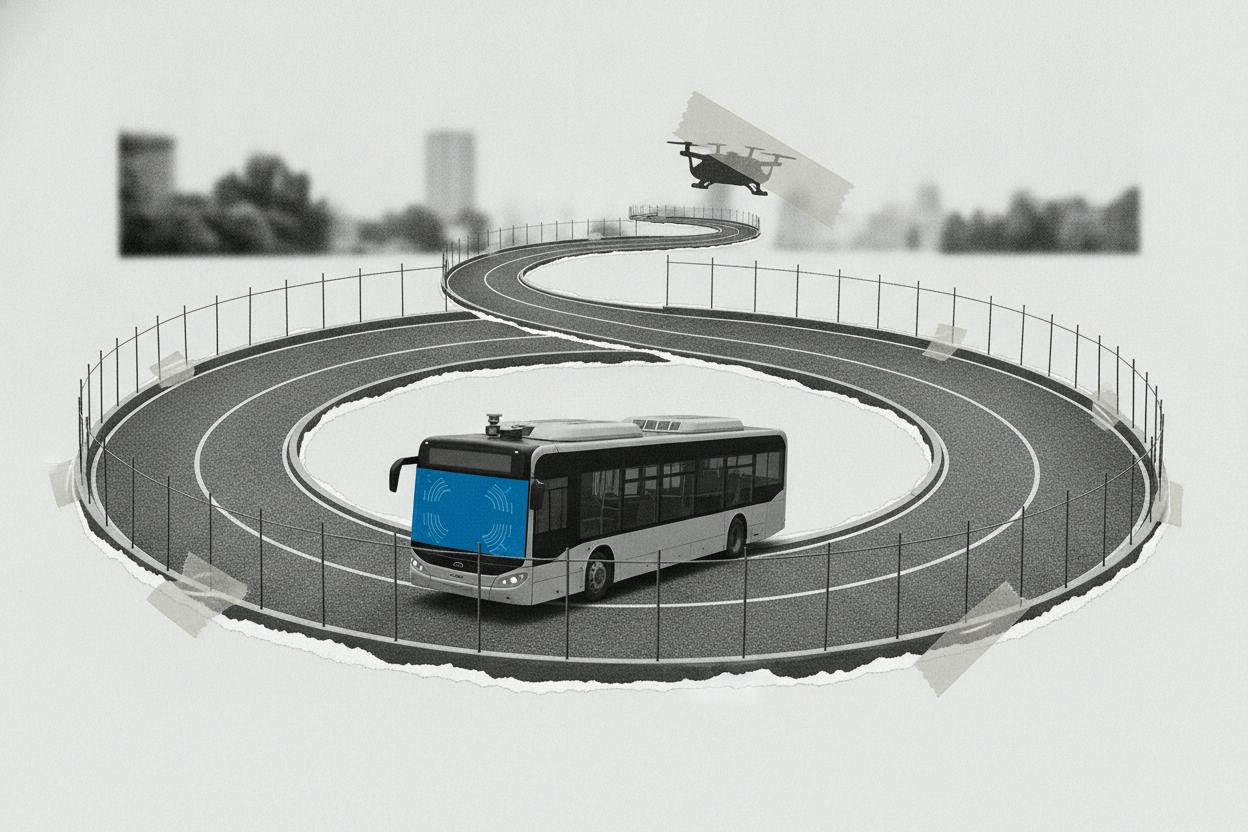
Malaysian property developer Sunway Group is turning its own real estate into a live laboratory for autonomous transport. The company is trialing driverless electric buses from WeRide on its bus rapid transit (BRT) line, and it is also exploring partnerships to bring autonomous delivery vehicles and even air-taxi-style aircraft to its developments, according to a report by The Star.
The moves are a concrete example of how self-driving technology is likely to roll out in the real world: not as a sudden wave of robotaxis on every city street, but as carefully controlled pilots in defined areas where the rules are predictable.
What Sunway is testing
Sunway says it plans to acquire and trial two fully electric autonomous buses from WeRide, a Chinese autonomous driving company, on the BRT-Sunway Line. That corridor runs through Sunway's integrated township near Kuala Lumpur, connecting residential, commercial and educational areas.
Beyond moving people, Sunway is exploring a tie-up with Neolix, a maker of autonomous logistics vehicles. The idea is to test and potentially distribute those self-driving delivery vans in Malaysia, extending automation from passenger transport to moving goods around large sites like campuses, industrial parks and mixed-use developments.
The company is also looking at AutoFlight's eVTOL (electric vertical take-off and landing) aircraft. These are essentially air taxis, and while they are further from commercial reality than ground vehicles, Sunway's interest signals that it sees its properties as a potential launch pad for a range of futuristic transport options.
Why the location matters
The common thread in all these trials is the setting. Sunway's integrated townships and the BRT corridor are relatively controlled environments. They have fixed routes, predictable stops, and managed access. That makes it easier to validate safety and operations than on open city streets, where a vehicle must contend with unpredictable pedestrians, cyclists and erratic drivers.
This is a well-understood pattern in the autonomy industry. Companies often start with geofenced deployments, where the vehicle is limited to a specific area, so it faces fewer surprises and can be monitored and improved quickly. If the pilots work, Sunway could use its real estate footprint to scale the technology faster than a standalone mobility startup could, because it controls the infrastructure and the customer base.
For investors, this highlights why closed-loop routes are likely to be autonomy's first real business model. The market often talks about self-driving as a single leap to fully autonomous robotaxis everywhere. In practice, early commercial wins usually come from these contained deployments, where operators can standardize pickup points and traffic rules.
What it means for investors
For Sunway, the trials are a way to add a high-tech sheen to its property portfolio and potentially create new revenue streams. If autonomous shuttles and delivery vehicles become a reliable part of its townships, it could make those developments more attractive to residents and businesses, and possibly even sell or lease the technology to other developers.
For the broader market, the news is a reminder that autonomous vehicle adoption will likely be gradual and location-specific. Malaysia, like many emerging markets, is still building out infrastructure, and that could be an advantage. New developments can be designed with autonomy in mind from the start, rather than retrofitting existing cities.
Investors should also note that these are early-stage trials. Two buses is a small pilot, and there is no guarantee the technology will scale commercially. The eVTOL air taxi concept is even more speculative, with regulatory hurdles and battery limitations still to overcome. But the direction of travel is clear: companies with control over physical spaces are positioning themselves to be the first to deploy autonomous vehicles at scale.
For everyday investors, the takeaway is that self-driving is not a single event but a series of incremental steps. Watching how these controlled-environment pilots progress can offer clues about which companies are serious about autonomy and which are just making headlines.
Sunway's move also comes against a backdrop of Malaysia's broader economic story. The country has seen growth cool to 5.3% in the third quarter, with services and exports still doing the heavy lifting. Autonomous transport could be a small part of the next wave of productivity gains, but it is far from a sure thing.
For now, the most realistic near-term impact is on Sunway's brand and its ability to attract tech-savvy tenants and partners. The financial payoff, if any, is likely years away. Investors should treat these trials as a signal of ambition rather than a promise of immediate profits.