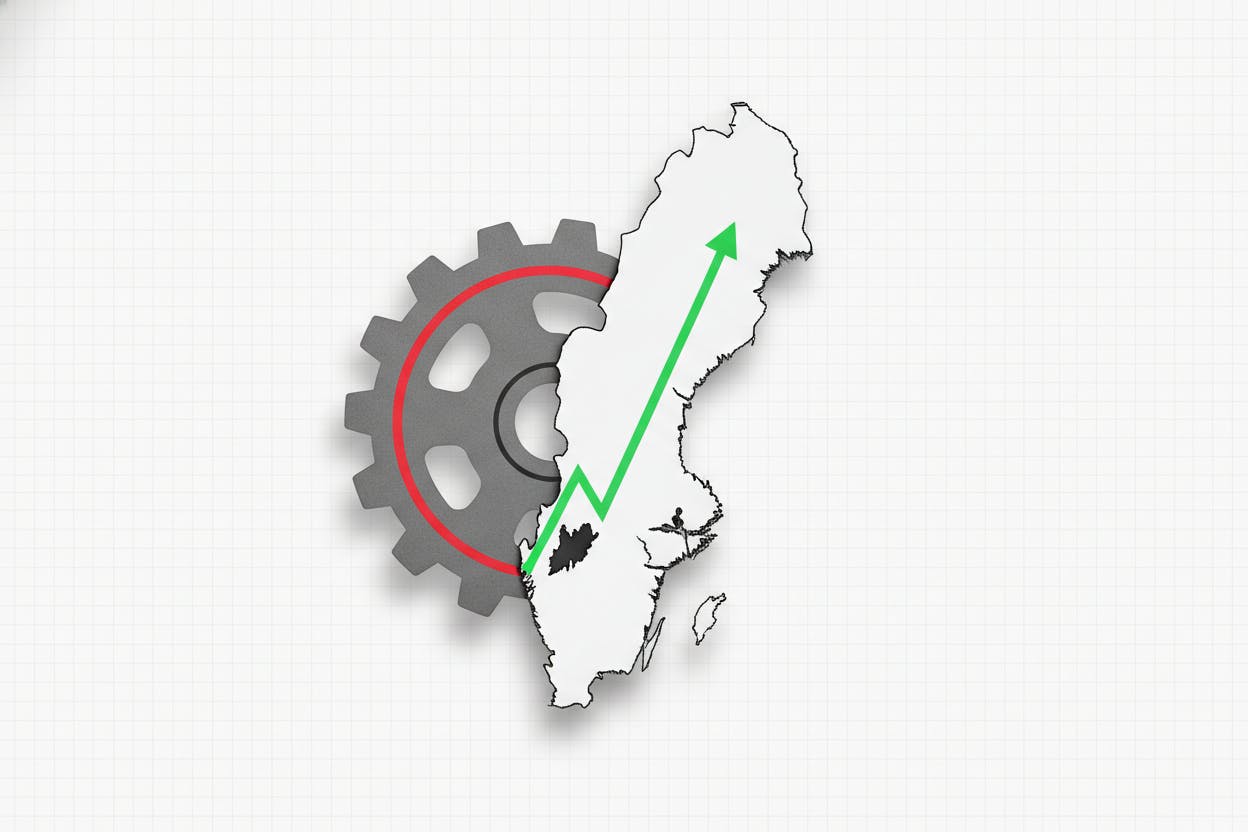
Sweden's economic mood brightened in June, with the National Institute of Economic Research (NIER) reporting that its broad sentiment barometer climbed to 101.7 from 99.9 in May. The reading, which marks the first time the index has been above the 100 threshold since early this year, was driven largely by a surge in manufacturing confidence—the strongest since December 2022. Consumer confidence also edged up to 93.6 from an upwardly revised 92.8, suggesting households are feeling slightly more optimistic about the economy.
But beneath the headline improvement, the survey revealed a persistent challenge: companies are still planning to raise prices at an above-normal rate. The share of firms expecting to increase prices over the next three months remains elevated, and manufacturing is the only sector where those plans are significantly above normal. That signals that the pipeline of inflation pressures hasn't fully eased, even as Sweden's headline consumer price inflation has fallen below the Riksbank's 2% target.
Manufacturing Leads the Recovery
The manufacturing sector's confidence jump is notable because it suggests that industrial activity may be firming up after a prolonged period of weakness. Factories are often a leading indicator for the broader economy, and the NIER data aligns with other signs that global supply chains and demand are stabilizing. However, the same factories are also reporting higher input costs, partly driven by elevated oil and gas prices, which could eventually feed into consumer prices.
The "hard" inflation data backs this up: Sweden's producer prices rose 1.3% in May from April and were up 6.6% year-on-year. That's a sharp increase that reflects not just energy costs but also broader commodity price pressures. For context, producer price inflation tends to lead consumer price inflation by several months, as companies pass on higher costs through supply chains. That lag means the current producer price spike could show up in consumer inflation later this year, complicating the Riksbank's policy calculus.
The Riksbank's Dilemma
The Riksbank, Sweden's central bank, held its key interest rate at 1.75% at its June 17 meeting, but its forward guidance was notably cautious. The bank described the outlook as "fifty-fifty" on whether rates might need to rise again by the end of the year. That's an unusually open-ended stance for a central bank, and it reflects the tension between below-target consumer inflation and the still-hot producer price pipeline.
Nordea, one of the Nordic region's largest banks, has argued that the current goods inflation partly reflects easy year-ago comparisons—meaning that some of the price increases are a statistical artifact of low base effects rather than a new inflationary wave. If Nordea is right, the producer price spike may fade as those base effects roll off. But if the pressure persists, the Riksbank could be forced to raise rates again, which would be a surprise to markets that had been pricing in a prolonged pause.
What It Means for Investors
For investors, the key takeaway is that the Riksbank's next move hinges on whether producer price inflation translates into consumer price inflation. The manufacturing sector's pricing plans are the most closely watched indicator here, because factories often pass on higher costs with a lag as contracts reset and inventories clear. If the share of firms planning price increases remains elevated in the coming months, it could signal that consumer inflation will tick up again, potentially forcing the Riksbank to raise rates.
That would have direct implications for Swedish bond markets. Short-dated government bonds—those with maturities of two years or less—are most sensitive to near-term policy expectations, so any shift in the Riksbank's stance would show up first in that part of the yield curve. A rate hike would also likely strengthen the Swedish krona, as higher rates attract foreign capital. Conversely, if inflation stays subdued, the krona could weaken against currencies like the euro or the dollar, especially if other central banks are more hawkish.
The broader context matters too. Sweden's economy is export-oriented, so global demand—especially from Europe and China—plays a big role in manufacturing confidence. Recent data from other regions has been mixed: India's gold premium has returned as a price dip sparks buying, while China's demand lags, and the yuan has headed for its biggest weekly drop since March as a strong dollar pressures the PBOC. These global trends could influence Sweden's export prospects and, by extension, the Riksbank's inflation outlook.
For everyday investors, the message is to watch the producer price data and the Riksbank's commentary closely. If producer inflation continues to run hot, it could mean higher borrowing costs for Swedish households and businesses, which would weigh on stocks and real estate. But if the pressure fades, the Riksbank may be able to keep rates steady, supporting a recovery in risk assets. As always, the key is to focus on the data, not the headlines.