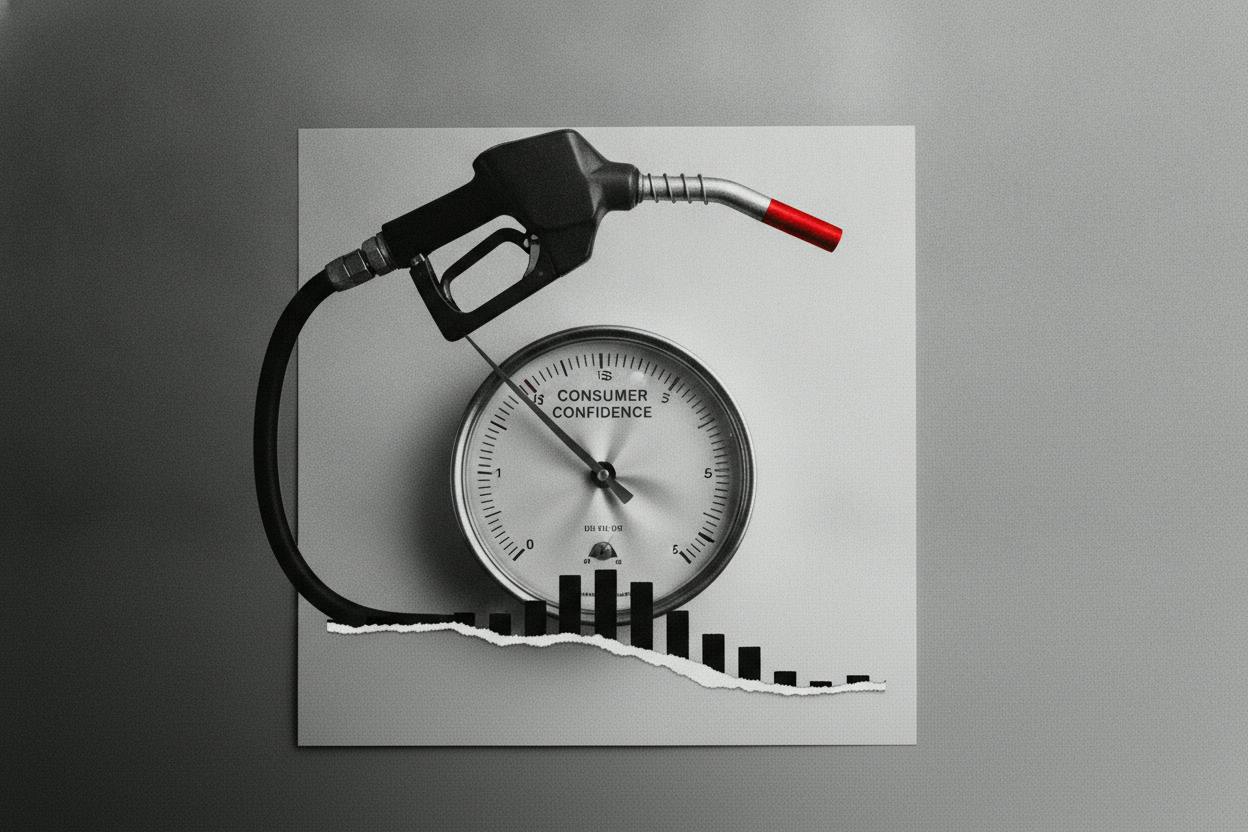
American households are feeling gloomier about the economy. The Conference Board's consumer confidence index fell to 81.9 in September, a reading that ranks among the weakest in more than a decade. The survey showed households growing more anxious about prices, interest rates, and the outlook for jobs.
Consumer confidence is a closely watched gauge because it reflects how people feel about their finances and the broader economy. When confidence drops, households often pull back on discretionary spending — the money they spend on things like dining out, travel, and big-ticket items. Since consumer spending drives roughly two-thirds of US economic activity, shifts in sentiment can ripple through the entire economy.
Why confidence is slipping
The September reading reflects a combination of pressures that have been building for months. Inflation has cooled from its peak, but prices for everyday essentials remain well above where they were a few years ago. Meanwhile, the Federal Reserve has kept interest rates elevated in its effort to bring inflation down, which makes borrowing more expensive for mortgages, credit cards, and auto loans.
The job market, long a source of strength, is also showing signs of cooling. Hiring has slowed and unemployment has edged up from its historic lows, even though it remains relatively low by historical standards. When workers feel less secure about their jobs, they tend to save more and spend less — a shift that can become self-reinforcing if it spreads.
It's worth noting that confidence surveys and actual spending don't always move in lockstep. Consumers have repeatedly reported feeling pessimistic while continuing to open their wallets, supported by savings built up during the pandemic and solid wage growth. That gap between what people say and what they do is one reason economists treat sentiment data as a useful signal rather than a definitive forecast.
What it means for investors
For ordinary investors, a weak confidence reading matters for a few reasons. First, it feeds into the broader debate about whether the US economy is heading for a soft landing — where inflation cools without a recession — or something bumpier. If consumers genuinely cut back, corporate earnings could come under pressure, particularly for companies that depend on discretionary spending.
Second, sentiment data influences how markets think about interest rates. A weaker consumer can be a sign that the economy is slowing, which might encourage the Fed to consider lowering rates sooner. Lower rates tend to support stock valuations and bond prices, but they can also signal that growth is faltering — a trade-off markets often wrestle with.
Third, the reading adds to the case for diversification. When the outlook is uncertain, spreading investments across asset classes — stocks, bonds, and cash — helps cushion against any single scenario playing out. Investors with long time horizons should remember that sentiment surveys are snapshots, not predictions, and that markets have historically rewarded patience through economic cycles.
Related reading: consumer sentiment and inflation expectations, and how Treasury yields and confidence interact.
What to watch next
Investors will want to keep an eye on upcoming data that could confirm or contradict the confidence reading. Retail sales figures, jobs reports, and inflation updates will all help paint a clearer picture of whether households are merely grumpy or actually tightening their belts. The Fed's next policy meeting will also be key, as officials weigh the risk of keeping rates too high for too long against the risk of cutting too soon.
For now, the September confidence number is a reminder that the US consumer — the engine of the economy — is under strain. That doesn't mean a downturn is inevitable, but it does mean investors should stay informed and avoid making big bets based on any single data point.