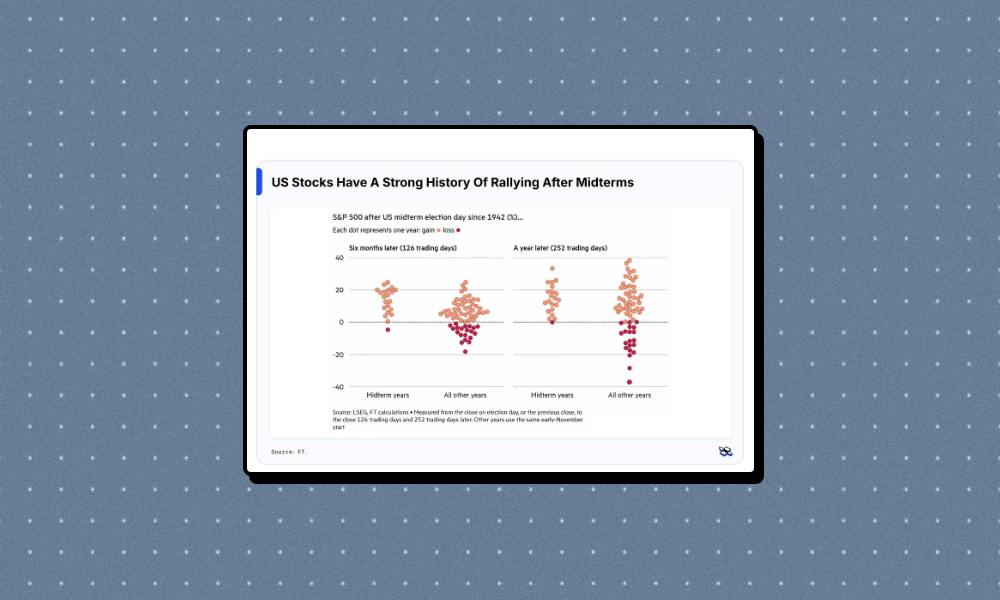
Wall Street has a winning streak to defend. The S&P 500 has risen in the six months following every US midterm election since 1950, with investors historically breathing a sigh of relief once the political uncertainty cleared. But this year, keeping that streak alive might be easier said than done.
Why midterms have been good for stocks
The pattern is one of the most reliable in market history. Since 1950, the S&P 500 has posted gains in the half-year after every midterm vote. The logic is straightforward: midterms often result in a divided government, which reduces the chance of major policy surprises. Investors also tend to welcome the end of campaign-season rhetoric and the clarity that comes with knowing the new balance of power.
That historical tailwind has been a comforting thought for investors in previous cycles. But this year, the setup looks different.
This year's market has already run ahead
For starters, US stocks have already had a pretty good run. The S&P 500 has racked up double-digit gains in 2026, a far cry from previous midterm years when markets typically struggled before election day. The index's biggest drop this year was just 9%, compared with a historical average of 18%.
In other words, the market has not experienced the kind of pre-midterm jitters that often set the stage for a post-election rebound. When stocks have already climbed a lot, there is less room for the usual relief rally to push prices higher.
That dynamic is playing out against a backdrop of other uncertainties. Currency markets have been on edge, with the dollar wavering as midterm races stay tight. Overseas, investors are watching events like the Hormuz strikes lifting oil prices, which could feed into inflation concerns.
What could derail the streak?
Several factors could complicate the post-midterm picture. First, valuations are higher than they were at many previous midterms, meaning the market has less margin for error. Second, the Federal Reserve's path on interest rates remains a key variable. If inflation proves sticky, the central bank may keep rates higher for longer, which tends to weigh on stock prices.
Third, there is the risk of a policy surprise. While divided government often calms markets, a clear sweep by one party could lead to more aggressive policy changes—either fiscal stimulus or regulatory shifts—that investors may not have priced in.
Tech stocks, which have led much of the 2026 rally, could be particularly sensitive. Concerns about AI oversight have already caused some jitters, and any post-election policy moves on technology could add to volatility.
What it means for investors
For everyday investors, the key takeaway is not to assume history will repeat itself. The post-midterm rally is a real pattern, but it is not a guarantee. Markets are forward-looking, and much of the good news may already be baked into prices.
That doesn't mean investors should panic or make drastic changes. Rather, it's a reminder to stay diversified and avoid making big bets based on a single historical trend. As always, time in the market tends to beat timing the market.
Investors will be watching a few things in the coming weeks: the final election results, any early policy signals from the new Congress, and the next round of economic data. The Bank of England's rate decision and other central bank moves will also be on the radar, as they can influence global sentiment.
In the end, the midterm streak is a nice piece of market trivia, but it's not a strategy. The next six months will be shaped by fundamentals—earnings, inflation, and interest rates—more than by election-day history.