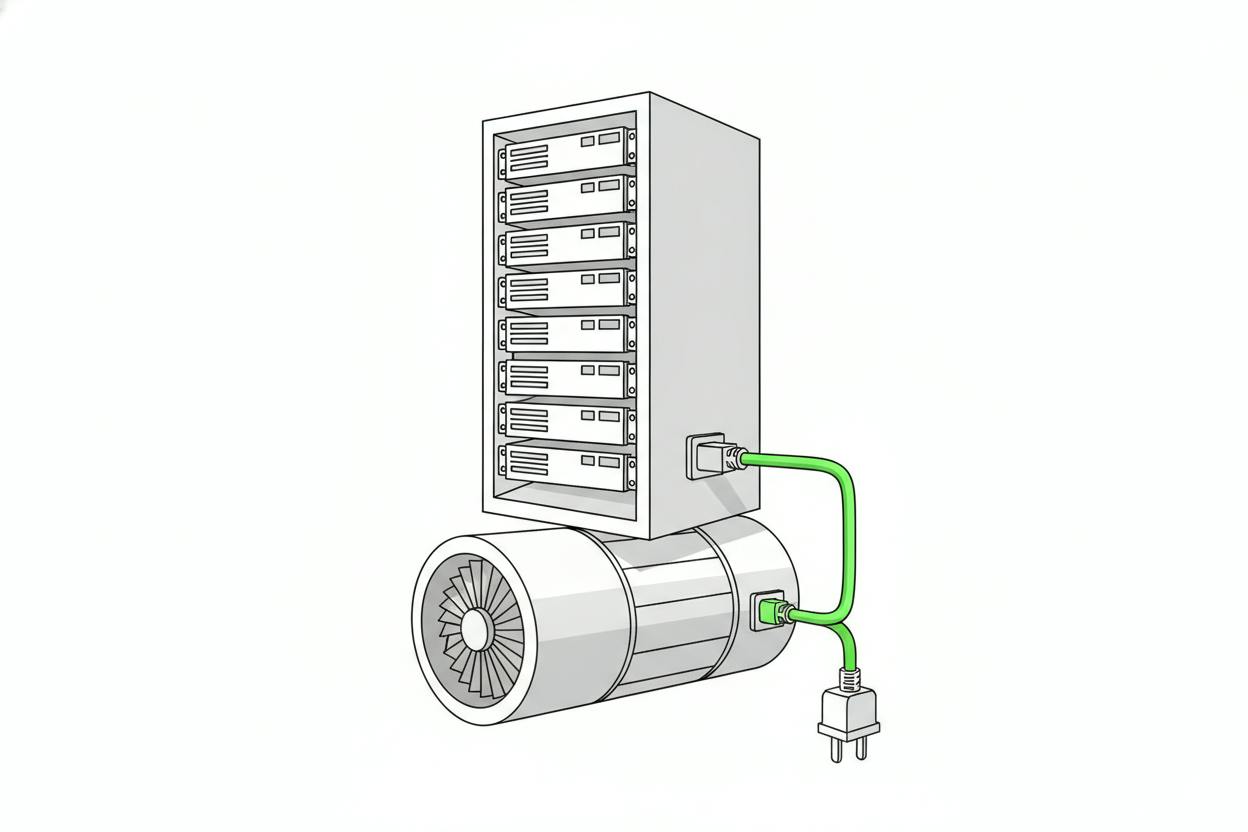
Venture Global, a company best known for exporting liquefied natural gas (LNG), is now trying to solve a different kind of bottleneck: getting reliable electricity to artificial intelligence data centers quickly. The company has signed equipment agreements with GE Vernova and Baker Hughes that could add up to 16 modular gas-fired “power island” units, according to a note from UBS. The investment bank sees this as a path toward as much as 10 gigawatts (GW) of compute capacity over time.
For everyday investors, the story is about more than just building power plants. It’s about how the AI boom is creating a race to secure electricity, and how companies that can deliver it fast may be able to charge a premium.
What are ‘power islands’ and why do they matter?
A “power island” is a self-contained power generation unit, typically a gas turbine paired with a generator, that can operate independently of the main electric grid. In this case, each unit would have a capacity of 720 megawatts (MW). The equipment also includes the systems needed to connect and control the units.
Venture Global already has an existing fleet of 4.5 GW of power generation. Adding up to 16 more units would significantly expand that capacity. But the key advantage, according to UBS, is the ability to build generation on-site in chunks, rather than waiting years for grid upgrades and interconnection approvals.
Data center operators care as much about certainty as they do about price. A power outage can cost far more than swings in natural gas prices. By generating electricity behind the meter—directly at the customer’s site—Venture Global could sidestep the grid queue and offer a faster, more reliable solution.
This “time-to-power” angle is crucial. In the AI race, every month of delay can mean lost revenue and lost competitive advantage. Companies that can deliver power quickly may be able to charge a premium for speed and reliability.
What does this mean for Venture Global’s stock?
Despite the potential, UBS kept its price target at $21 per share, while the stock traded around $12.06, down 3.56% on the day. That gap suggests investors want clearer proof that the AI power plan will translate into contracted cash flow, not just megawatts.
The expansion hinges on contract-backed cash flow. For Venture Global to turn this into a steady revenue stream, it needs long-term agreements with AI infrastructure customers that lock in payments for capacity over many years. Without those signed deals, the 10 GW compute pathway may be treated as optional upside rather than a base-case business line.
UBS frames the buildout as a path toward 10 GW of compute capacity, but that depends on pairing the hardware with contracts that pay for firm power availability. In other words, the company needs to prove that it can sell the power it generates, not just build the plants.
What it means for investors
This story isn’t just about scale; it’s about how the AI boom is reshaping the energy landscape. Data centers are hungry for electricity, and traditional grid connections are often slow and expensive. Modular, on-site generation could be a faster alternative.
For Venture Global, this could change how investors view the company: less like a single-track LNG developer, more like a builder of a contracted power platform with steadier, service-like revenues. But until signed deals with AI infrastructure customers show up, markets may remain skeptical.
Investors should also watch how this plays out against the broader backdrop of AI-related power demand. Other companies are also trying to secure power for data centers, and the competition is heating up. For example, CoreWeave's power deals have eased some AI funding fears, according to Bank of America. And global chip stocks have slid on rate fears and AI funding worries, showing how sensitive the sector is to financing and power availability.
For now, the market is taking a wait-and-see approach. The potential is real, but so is the uncertainty. As always, it’s important to remember that no investment is without risk, and this is a speculative growth story that depends on execution and contract wins.
In the meantime, investors can keep an eye on Venture Global’s progress in signing those long-term contracts. If the company can secure them, the 10 GW vision could become a reality. If not, the stock may continue to trade at a discount to UBS’s target.