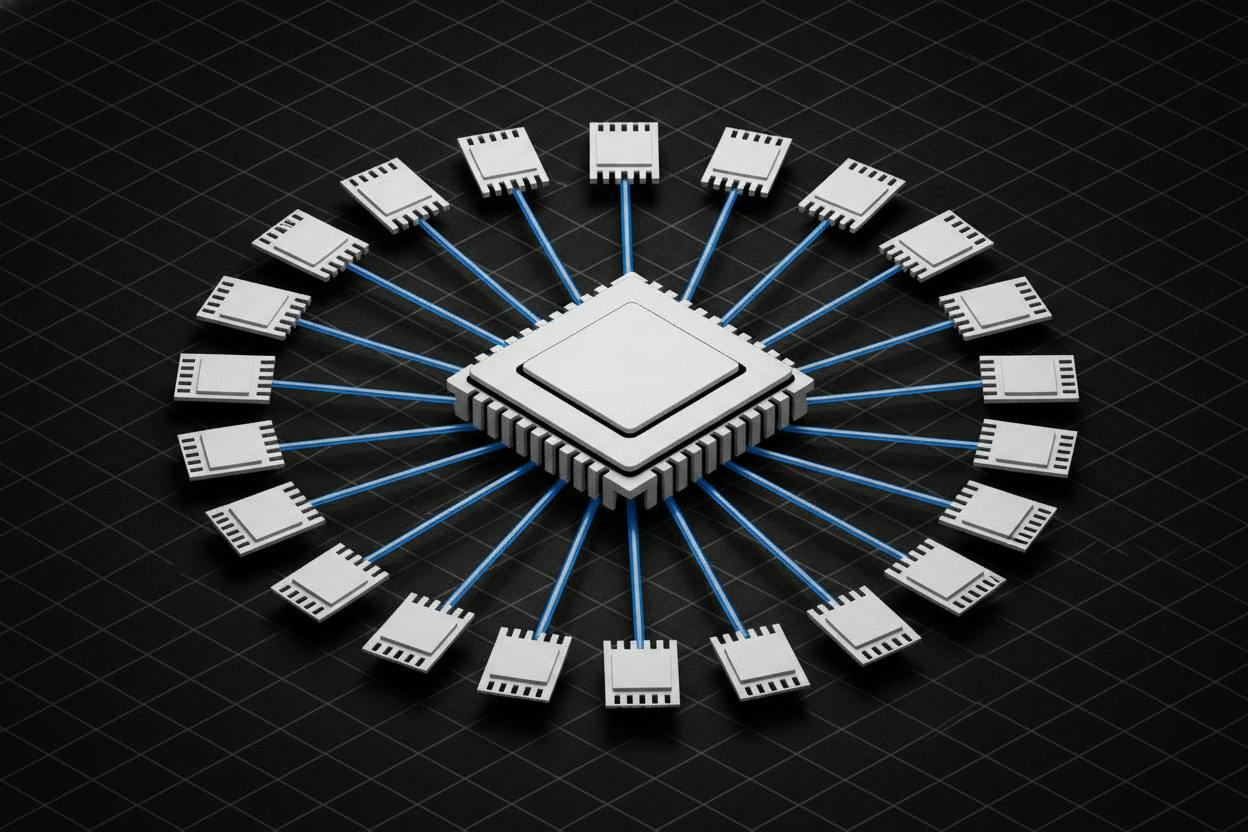
San Francisco-based chip startup Volantis has raised $88 million to replace the short-range electrical connections inside AI servers with laser-based links, a move the company says could let a single graphics processing unit (GPU) connect to as many as 220 memory chips. The funding round highlights a growing race to solve one of the most stubborn bottlenecks in artificial intelligence hardware.
What is the problem Volantis is trying to solve?
AI accelerators from Nvidia and Advanced Micro Devices often hit a simple wall: the computing cores can only work as fast as they can fetch data from memory, where the model and its “working set” sit. The industry’s fix has been high-bandwidth memory (HBM) stacked right next to the GPU, but today’s electrical connections are so short that even top-end designs typically pair only about eight HBM chips per GPU.
That limitation means GPUs spend a lot of time waiting for data, which slows down training and inference tasks and leaves expensive silicon underutilized. Volantis aims to break through that by using VCSEL-based optical links—the same kind of laser technology found in iPhone face scanners—to carry data over longer distances inside a server. By replacing electrical traces with light, the company says a single GPU could connect to far more memory chips, potentially easing the data bottleneck.
How does the technology work?
VCSEL stands for vertical-cavity surface-emitting laser, a type of semiconductor laser that emits light from the top surface. They are already used in data centers for short-range optical communication and in consumer devices like smartphones for facial recognition. Volantis is applying that proven technology to the memory-GPU link, a move that could allow memory to be placed further away from the compute cores without sacrificing speed.
The company’s claim of 220 memory chips per GPU is a dramatic leap from the current eight, but it remains to be seen whether the technology can deliver in real-world systems. Optical links have been used in networking for years, but integrating them into the tight, power-hungry environment of an AI server is a different challenge.
Why this matters for AI hardware
The demand for AI compute has exploded, and companies like Nvidia and AMD are selling every chip they can make. But the memory bottleneck is a growing concern as models get larger and more complex. If Volantis’s approach works, it could allow AI servers to handle bigger models or run them faster, potentially reducing costs for cloud providers and, ultimately, for businesses that rely on AI services.
Volantis is not alone in this pursuit. Other startups are also exploring laser-based interconnects for AI chips, and the broader industry is investing heavily in optical I/O as a way to scale beyond the limits of electrical wiring. For investors, the funding round is a sign that venture capital sees a real market opportunity in solving this problem.
What it means for everyday investors
For most people, this news is not a reason to rush out and buy a specific stock. Volantis is a private company, so its success or failure won’t directly show up in your portfolio. But the story is part of a larger trend: the AI boom is not just about the chips themselves, but also about the infrastructure that supports them. Companies that can improve the efficiency of AI hardware—whether through memory, interconnects, or cooling—could become valuable players in the ecosystem.
Investors should also note that the AI hardware market is highly competitive. Nvidia and AMD dominate the GPU space, and any new technology that threatens to disrupt their designs would face significant hurdles. Still, the fact that Volantis raised $88 million suggests that investors believe there is room for innovation beyond the big names.
For those watching the sector, the key will be whether Volantis can move from prototype to production and whether its technology gets adopted by major server makers. The company’s claim of 220 memory chips per GPU is ambitious, and the industry will be watching closely to see if it holds up in practice.
In the meantime, the broader market for AI hardware continues to grow, with other startups also raising funds for laser-based chip interconnects and AI chip startups attracting billion-dollar valuations. The race to make AI faster and more efficient is far from over, and Volantis’s funding is just the latest sign that investors are betting on new approaches to keep the momentum going.