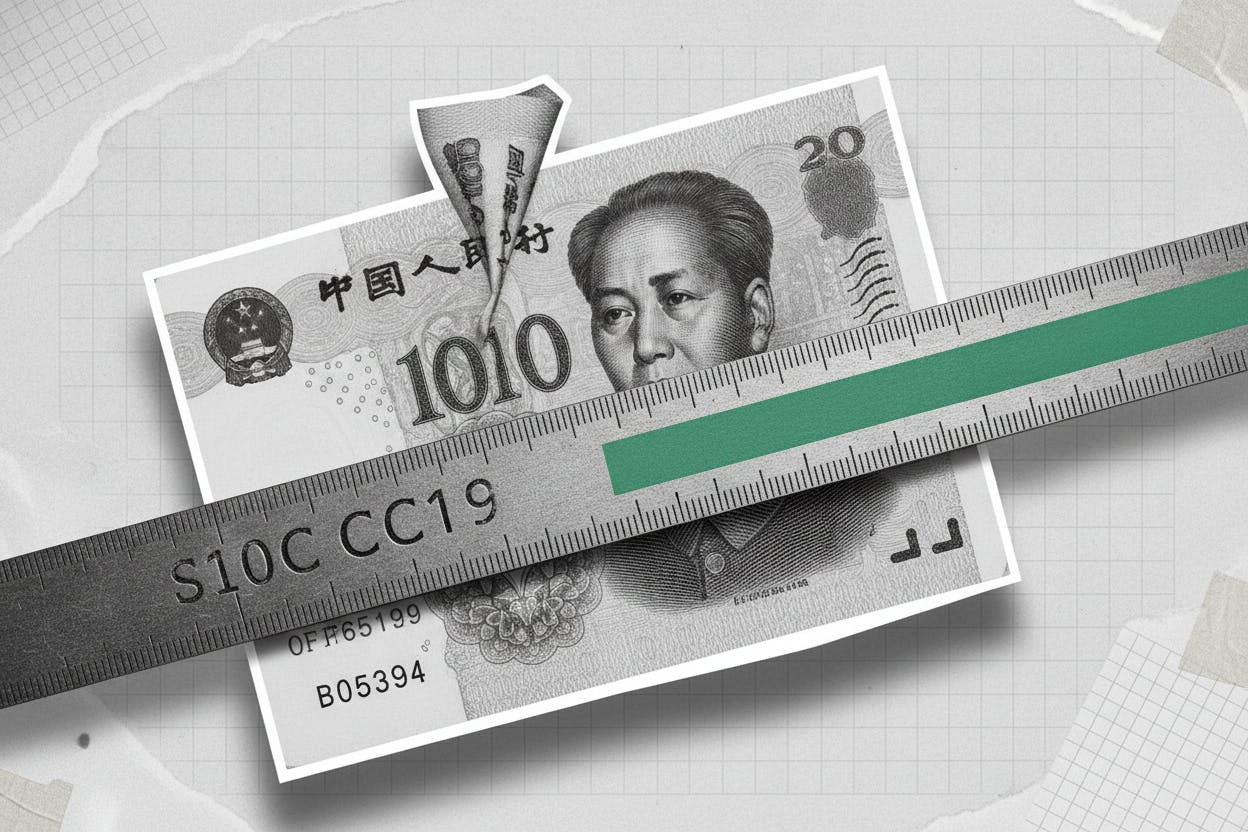
The Chinese yuan climbed to its strongest level in more than three years this week, trading around 6.7484 per dollar. But the People's Bank of China (PBOC) quickly signaled its discomfort with the pace of the rally by setting a daily midpoint that was weaker than markets had expected.
China operates a managed currency system. Each morning, the PBOC sets a midpoint, or fixing, for the yuan against the dollar. The currency is then allowed to trade within a 2% band around that level. Because the fixing is set by the central bank, it is one of the clearest signals of official policy intent.
On Friday, the PBOC fixed the midpoint at 6.7894 per dollar. According to Reuters, that was about 581 pips weaker than the bank's own model estimate of 6.7313. A pip is a tiny unit of change in a currency pair, and a gap of this size is notable. It effectively told the market: the yuan has risen enough for now.
The onshore yuan, which trades in mainland China, had strengthened to as much as 6.7484 per dollar earlier in the session. That is the highest level since mid-2021. The move was driven largely by broad dollar weakness, as traders bet that the U.S. Federal Reserve may be nearing the end of its rate-hiking cycle. A softer dollar naturally lifts other currencies, including the yuan.
Why the PBOC is pushing back
Beijing has long preferred a stable, predictable currency. A rapidly appreciating yuan can hurt Chinese exporters by making their goods more expensive overseas, and it can also complicate monetary policy. By setting a weaker fixing, the PBOC is trying to slow the yuan's ascent without intervening directly in the market.
This is not an unusual move. Central banks in Asia have a history of leaning against sharp currency moves, whether up or down. The PBOC has used the fixing mechanism before to cool speculative pressure. The message is clear: Beijing wants to avoid a one-way bet on the yuan.
The broader context matters too. China's economy has been struggling to regain momentum, with factory and services activity shrinking again in July as demand weakens. A stronger currency would only add to the headwinds facing exporters, who are already dealing with soft global demand. By nudging the fixing lower, the PBOC is trying to keep the yuan competitive.
What it means for investors
For everyday investors, the yuan's level matters in a few ways. If you hold U.S. dollar assets, a stronger yuan means your dollar-based investments are worth less in yuan terms. Conversely, if you invest in Chinese stocks or funds, a stronger yuan can boost returns when converted back to dollars.
The PBOC's pushback also signals that Beijing is wary of letting the currency run too far, too fast. That could temper some of the enthusiasm in Chinese markets, which have been supported by hopes of a U.S. rate cut and a weaker dollar. The Hang Seng index edged up recently as investors weighed mixed signals from the Fed and China's spending pledges, but currency policy is another factor to watch.
For now, the yuan is likely to stay range-bound. The PBOC has shown it can influence the pace of appreciation, and traders will be watching the daily fixings for further clues. If the dollar continues to weaken, the PBOC may keep setting weaker-than-expected midpoints to manage the yuan's rise.
The bigger picture
The yuan's strength is part of a broader trend of dollar weakness. The dollar firmed recently as a Fed split and geopolitical tensions shifted market focus, but the longer-term direction still points lower if the Fed cuts rates. That would support emerging-market currencies, including the yuan.
However, Beijing's intervention shows that it will not simply let market forces dictate the currency's path. The PBOC has multiple tools at its disposal, from the fixing to direct market operations, and it has shown a willingness to use them.
For investors, the key takeaway is that the yuan's rally has limits. While a stronger currency can be a sign of confidence, Beijing's pushback is a reminder that policy goals—like supporting exports and maintaining stability—often take precedence over market momentum. Expect more of the same tug-of-war in the coming weeks.