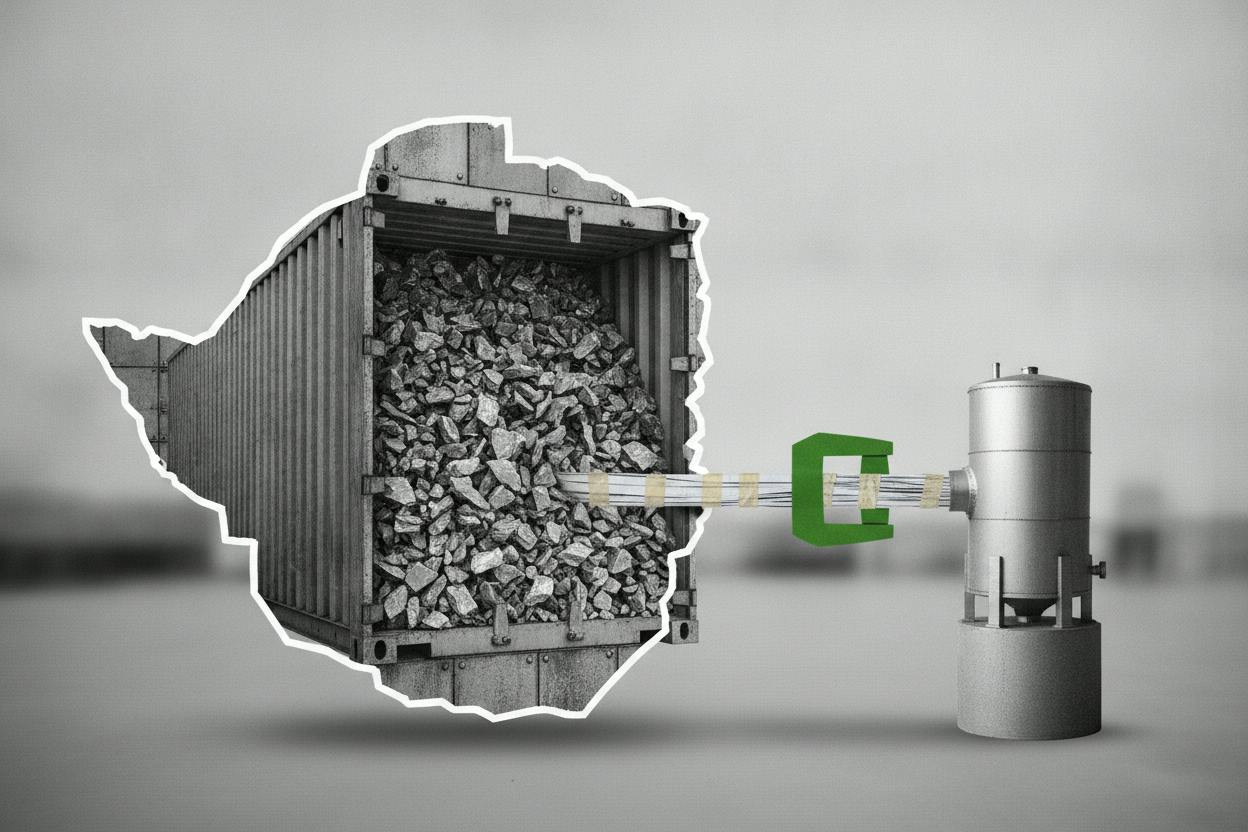
Zimbabwe's lithium miners are pressing the government to push back a planned January 2027 ban on exports of lithium concentrate, warning that the current timeline could leave a mountain of unsold material piling up in warehouses.
A survey commissioned by the Chamber of Mines estimates that if the ban goes ahead as scheduled, as much as 1.4 million tons of concentrate could be stranded by the end of 2027. That's because domestic processing capacity is still being built, and miners say it won't be ready in time to absorb the output.
Why Zimbabwe wants to stop exporting concentrate
Zimbabwe, described by Reuters as Africa's top producer of lithium, is trying to move up the value chain. Instead of shipping semi-processed concentrate, the government wants to export more refined "lithium salts" — products that command higher prices and support local industry.
The country only began exporting lithium sulphate in April, after Zhejiang Huayou Cobalt, a Chinese battery-materials firm, commissioned what it called Zimbabwe's only lithium salt plant. From April through September, exports of lithium sulphate totaled 33,807 tons.
Lithium sulphate can be further refined into chemicals used in electric vehicle batteries, so scaling up production is central to Zimbabwe's strategy. But the transition is proving tricky.
The timing problem
Miners argue the timeline is too tight. The Chamber of Mines-commissioned survey expects concentrate output to reach 2.3 million tons in 2027. Meanwhile, an industry report cited by Reuters sees lithium sulphate capacity at 208,000 metric tons that year — a fraction of what would be needed to process all that concentrate.
The group is pushing for a July 2027 start date instead, giving projects linked to Sinomine and Sichuan Yahua, two Chinese miners, more time to finish new processing facilities at their Zimbabwean sites.
If the export ban arrives before enough conversion capacity is online, the immediate effect is less "value-add" and more stranded inventory: product that can't be sold abroad and can't yet be processed at scale locally.
What it means for investors
For markets, a 1.4 million-ton stockpile would turn Zimbabwe's export ban into a cash flow problem first. When miners can't export concentrate and domestic plants can't yet absorb it, unsold material piles up, and cash gets trapped in warehouses while storage and handling costs rise.
That can pressure financing and push operators to slow output or postpone spending until processing catches up. For projects tied to Zhejiang Huayou Cobalt's local unit, Sinomine, and Sichuan Yahua, a timing mismatch could mean a bumpier ramp-up and more uneven export receipts for Zimbabwe well before the country's 2027 sulphate capacity is fully in place.
Investors in lithium miners and battery-materials companies should watch how Zimbabwe resolves this. A delay would ease near-term cash flow concerns but could slow the country's value-add ambitions. An on-time ban, by contrast, risks creating a glut of concentrate that depresses prices globally — a factor that could ripple through the broader lithium market, which has already seen volatility as EV demand fluctuates.
For context, other lithium producers are also grappling with supply-demand imbalances. In the U.S., Lithium Americas recently raised cost estimates for its Thacker Pass project, highlighting the capital intensity of new lithium projects. Meanwhile, new lithium futures contracts are launching in China, giving producers and buyers more tools to hedge price risk.
The outcome in Zimbabwe will be a test of how quickly a resource-rich country can climb the processing ladder without choking off its own export revenue. For now, miners are betting that a little more time is all they need.



