The artificial intelligence boom is not just reshaping technology—it's rewriting the rules of capital markets. The latest sign: Anthropic, the AI startup behind the Claude chatbot, is preparing for a stock market debut that could raise more than $100 billion, a figure that would smash fundraising records and underscore the immense appetite for AI-related investments.
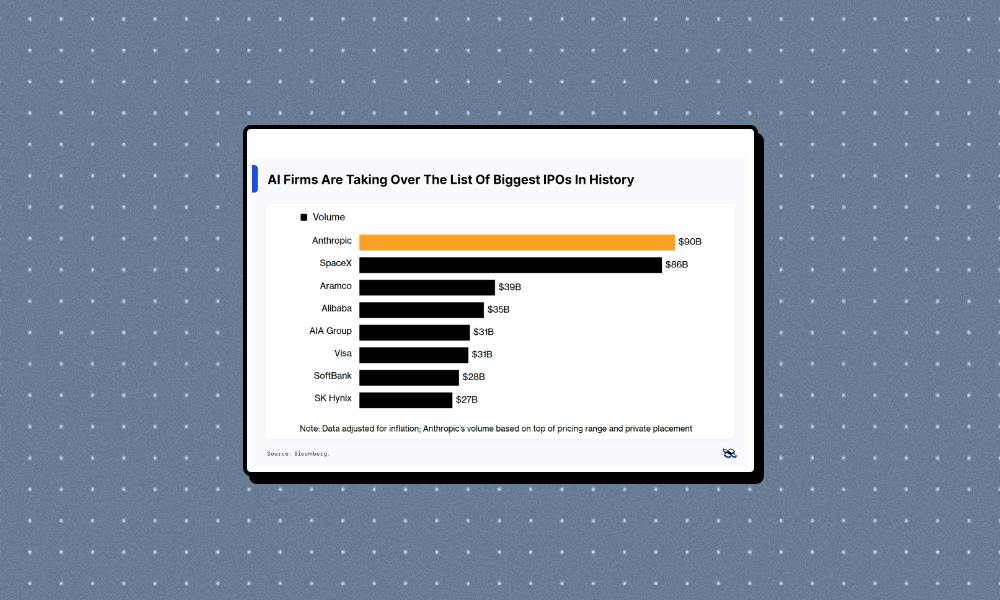
According to reports, Anthropic is set to list on Thursday, with plans to raise approximately $90.4 billion through a combination of its initial public offering (IPO) and a private placement. That amount alone would comfortably exceed the $86.2 billion raised by SpaceX in its listing earlier this year, which had been the largest fundraising event of 2026. And if demand proves strong enough for bankers to exercise their option to sell additional shares once trading begins, Anthropic's total haul could surpass the $100 billion mark.
The scale of this deal is difficult to overstate. For context, the largest IPO in history before this year was Saudi Aramco's $29.4 billion listing in 2019. Anthropic's potential raise would be more than three times that, and it would dwarf the combined proceeds of most annual IPO markets in previous years.
Why is Anthropic raising so much?
Anthropic is one of the leading players in the race to develop advanced artificial intelligence. Its Claude models compete directly with OpenAI's GPT series and Google's Gemini. The company has been a major beneficiary of the surge in corporate spending on AI infrastructure, with businesses across industries seeking to integrate generative AI into their operations.
But AI development is extraordinarily capital-intensive. Training large language models requires massive computing power, which means billions of dollars in spending on specialized chips, data centers, and energy. Anthropic, like its rivals, has been burning through cash at a rapid pace, and the funds raised from this debut are expected to fuel its next phase of growth.
The company's decision to combine an IPO with a private placement is notable. In a traditional IPO, a company sells shares to the public, and the proceeds go to the company (primary offering) or early investors (secondary offering). A private placement, in this context, typically involves selling shares to a select group of institutional investors before the public listing. By doing both, Anthropic can lock in a large amount of capital while also creating a public market for its shares.
This approach is becoming more common among high-profile tech companies, as it allows them to raise enormous sums without relying solely on public market demand. It also gives early investors a chance to cash out some of their holdings, which can be attractive given the long wait for liquidity in the private markets.
A record year for fundraising
Anthropic's debut is the latest milestone in what is already a record year for equity fundraising in the United States. The AI boom has fueled a wave of IPOs and secondary offerings, as companies rush to capitalize on investor enthusiasm for anything related to artificial intelligence.
Earlier this year, SpaceX's listing raised $86.2 billion, which at the time was the largest fundraising event ever. That record may now stand for only a few months. The fact that two companies can raise such staggering sums in a single year highlights the extraordinary liquidity in the markets and the willingness of investors to back ambitious, high-growth ventures.
This trend is not limited to the US. Globally, tech companies are tapping public markets at a pace not seen since the dot-com era. However, the scale of these deals is unprecedented, and it raises questions about whether the market can sustain such enthusiasm.
What it means for investors
For everyday investors, Anthropic's debut is significant for several reasons. First, it offers a rare opportunity to own a piece of one of the most prominent AI companies. Until now, Anthropic was only accessible to venture capital funds and large institutional investors. The IPO will allow retail investors to buy shares through their brokerage accounts.
However, investing in a company like Anthropic comes with substantial risks. The company is not yet profitable, and its future depends on its ability to maintain a competitive edge in a rapidly evolving field. The AI market is highly competitive, with deep-pocketed rivals like Microsoft-backed OpenAI and Google's DeepMind. Any misstep could lead to a sharp decline in the stock price.
Moreover, the sheer size of the raise means that Anthropic will have a large cash cushion, but it also means that early investors and employees will be selling a significant number of shares. This could create selling pressure in the months after the listing, as is common with large IPOs.
Investors should also consider the broader implications. The success of Anthropic's debut will be seen as a barometer for the AI trade. If the stock pops on the first day, it could boost sentiment across the sector. If it stumbles, it might signal that the market is becoming saturated with AI offerings. As noted in our earlier coverage, Nvidia earnings and Anthropic IPO set to test AI trade this week, and the outcomes will be closely watched.
Another factor to watch is the reaction of other AI-related stocks. Companies like Nvidia, which supplies the chips that power AI models, have been major beneficiaries of the AI boom. Analysts expect Nvidia to deliver another beat-and-raise quarter, and a strong showing from Anthropic could reinforce that optimism.
For those considering participating in the IPO, it's important to remember that IPOs are often volatile in the first few days of trading. The price can swing dramatically as the market discovers the true value of the company. It's also worth noting that the private placement portion of the deal may involve large blocks of shares being sold to institutions, which could affect the supply-demand dynamics.
Ultimately, Anthropic's debut is a landmark event that highlights the transformative power of AI and the enormous sums of capital flowing into the sector. Whether it marks the peak of the AI bubble or the beginning of a new era of technological innovation remains to be seen. But for now, it's a story that every investor should follow closely.