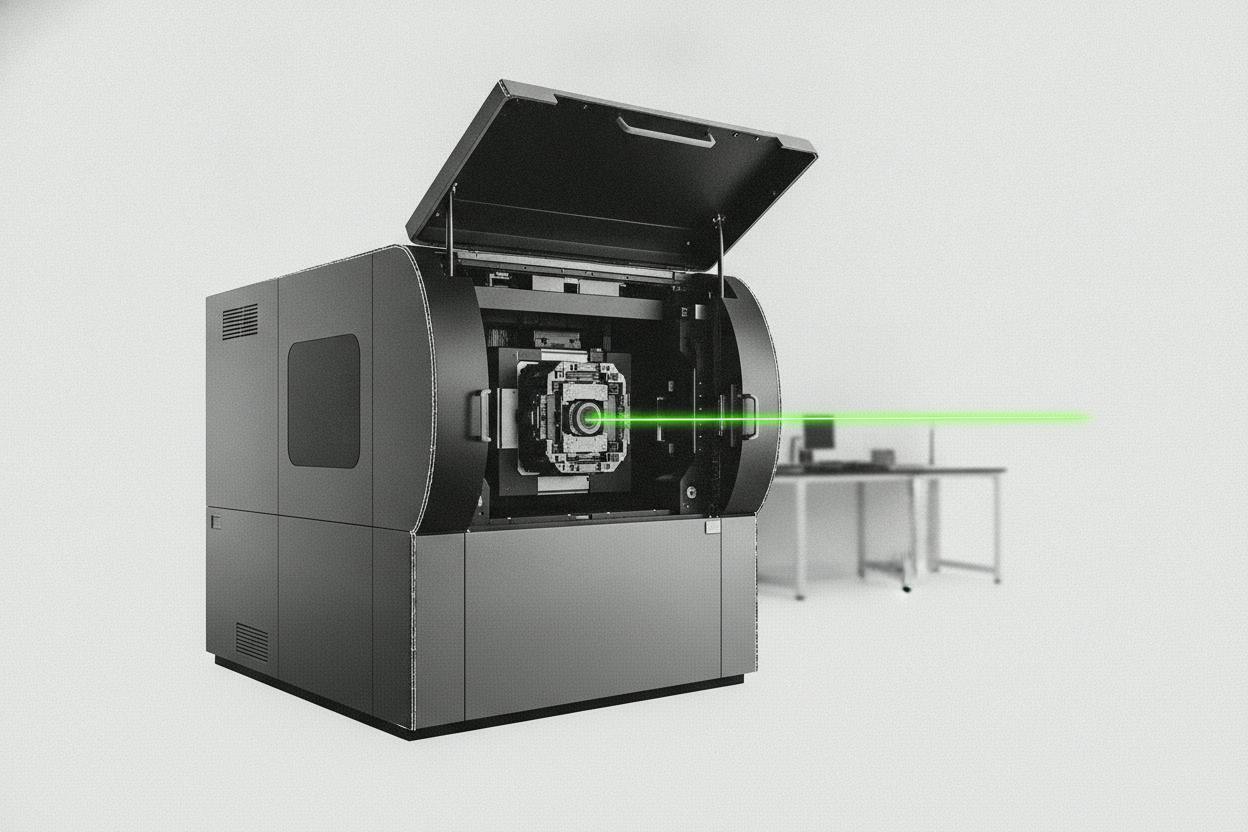
ASML, the Dutch company that dominates the market for advanced chipmaking equipment, and its longtime optics partner Carl Zeiss have floated a possible successor to today's extreme ultraviolet (EUV) lithography machines. In a peer-reviewed paper published in October, engineers from both firms describe a “Hyper NA” system that could print features as small as 5 nanometers—while reusing much of the existing EUV technology.
The proposal is significant because it suggests a path forward for the semiconductor industry without requiring a complete overhaul of the machinery that currently produces the world's most advanced chips. But ASML has not committed to building the tool, and the engineers themselves note it could take around a decade to bring to market.
What is Hyper NA?
To understand Hyper NA, it helps to know a bit about how chipmaking works. Lithography machines use light to project circuit patterns onto silicon wafers. The “NA” in Hyper NA stands for numerical aperture, a measure of how well a lens can capture and focus light. A higher NA means finer details can be printed.
Today's most advanced EUV machines use a numerical aperture of 0.33, while ASML's next-generation “High-NA” systems, already in development, push that to 0.55. Hyper NA would go even further, potentially reaching an NA of 0.75 or higher, allowing for the 5-nanometer features mentioned in the paper.
The key claim from the engineers is that Hyper NA could reuse much of the current EUV setup, including the light source, which they say “can be reused as is.” That's a big deal because chip factories hate disruptive tool changes. Every new platform requires months of qualification, reliability testing, and process tuning before it can run at high volume. If Hyper NA can build on existing infrastructure, it could lower the cost and risk of adoption.
Why this matters for chipmakers
The semiconductor industry is constantly pushing to make chips smaller, faster, and more energy-efficient. The transition from one lithography generation to the next is one of the most expensive and complex parts of that process. ASML's EUV machines cost hundreds of millions of dollars each, and chipmakers like TSMC, Samsung, and Intel invest billions in new fabs to use them.
If Hyper NA becomes a reality, it could extend the life of EUV technology and delay the need for entirely new approaches, such as “Beyond EUV” or other next-generation techniques. That would be welcome news for chipmakers, who are already grappling with soaring costs and technical hurdles.
But the timeline is long. The engineers say Hyper NA could be a 10-year project, meaning any commercial deployment would likely be in the mid-2030s at the earliest. By then, the industry may have moved on to other solutions, or Hyper NA could become the bridge to them.
What it means for investors
For investors, the Hyper NA proposal is a reminder of ASML's central role in the semiconductor supply chain. The company holds a near-monopoly on EUV lithography, and its technology is critical to producing the most advanced chips used in smartphones, data centers, and artificial intelligence applications.
The fact that ASML is exploring Hyper NA suggests it sees a long runway for EUV technology, which could support its revenue growth for years to come. However, the lack of a formal commitment means investors shouldn't expect any immediate impact on earnings. The company's current focus remains on ramping up High-NA systems, which are already being shipped to early customers.
For everyday investors, the takeaway is more about the broader trend than any single product. The semiconductor industry's relentless push for smaller, more powerful chips is a key driver of demand for companies like ASML, as well as for the materials and equipment suppliers that support it. While Hyper NA is still a concept, it underscores the long-term nature of innovation in this sector.
In the meantime, investors can watch for other developments in the chipmaking world, such as mining projects that supply raw materials or power projects that support data centers. But for now, ASML's next big bet remains a decade away.