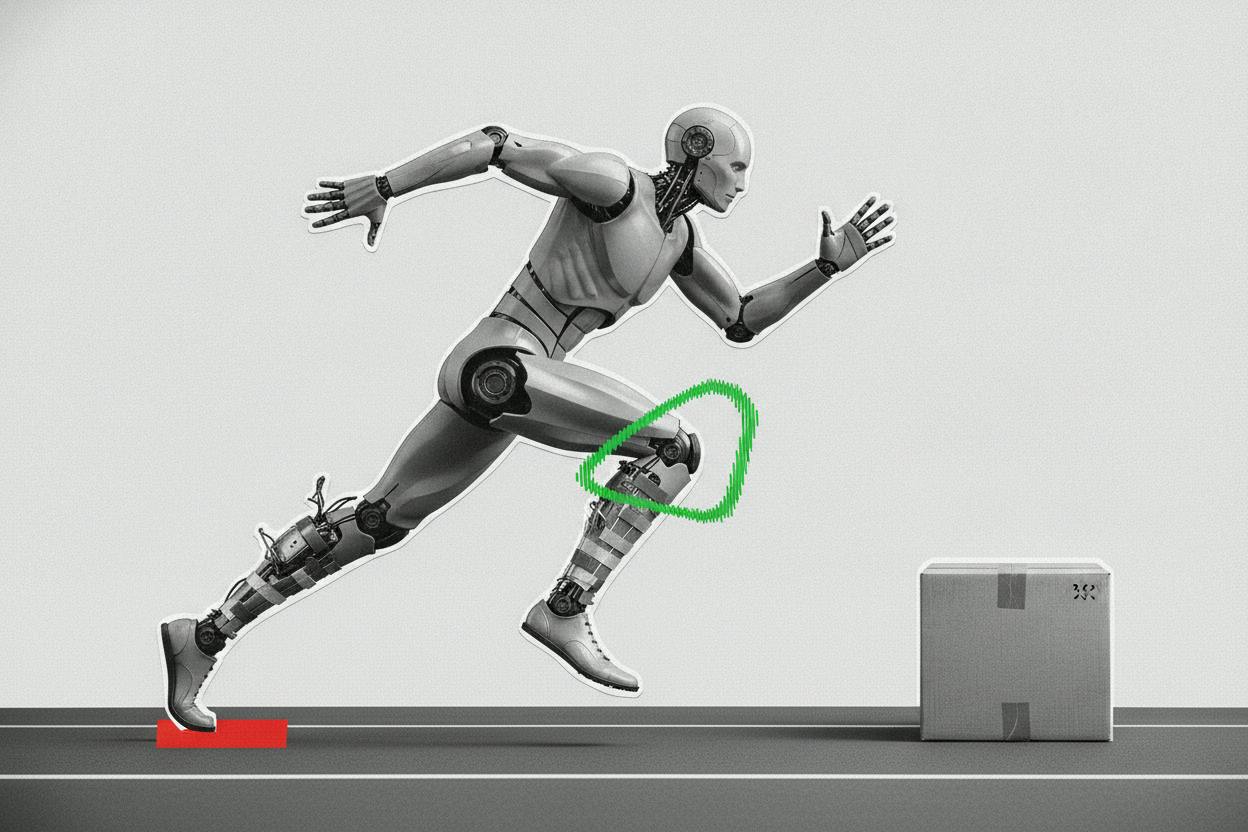
At the World Humanoid Robot Games in China, TianGong Ultra sprinted 100 meters in 8.64 seconds, a time that would make any track coach take notice. But the team behind the robot says the headline-grabbing speed is not the real prize. The actual challenge, they explain, is turning a flashy performance into a machine that can work safely and dependably in the real world.
More than a sprint
The 8.64-second run is impressive, but it was just one moment in a competition that stretched over days. According to reports from Reuters, the event was less about a single finish line and more about endurance. Robots stumbled, crashed, and sometimes had to be swapped out for backup units. Engineers spent hours repairing and tweaking software between rounds, trying to keep the machines upright and moving.
TianGong Ultra improved its time by changing its “running strategy” between heats and refining its start. But the team was candid about a bigger problem: results are hard to reproduce. Even robots that look identical on the assembly line behave differently once you push them near their limits. Tiny variations in motors, sensors, or joints become glaring when a machine is running at full speed.
Why reliability matters more than speed
For humanoid robots to move from novelty to everyday tools, they need to do more than run fast. They have to handle unpredictable environments—uneven floors, unexpected obstacles, and the chaos of a warehouse or hospital corridor. A robot that can sprint but falls over at the first bump is not useful.
This is a familiar challenge in robotics. Companies in this space often spend years perfecting a single task, only to find that scaling up to real-world conditions introduces new problems. The gap between a controlled demo and a reliable product is wide, and it is where many promising robots stumble.
The push for humanoid robots is part of a broader trend in China, where the government and private investors are pouring money into advanced manufacturing and automation. The country has also been tightening rules around humanoid robot startups going public, a sign that regulators want to see more than hype before companies list. That focus on fundamentals aligns with what TianGong Ultra's team is saying: the real value is in reliability, not just spectacle.
What it means for investors
For everyday investors, the story is a reminder that robotics is still an early-stage industry. Headlines about record speeds or viral videos can be exciting, but they do not always translate into profitable businesses. The companies that succeed will likely be those that solve the hard engineering problems of durability, safety, and repeatability—not just the ones that grab attention.
Investors should watch how these robots perform in real-world trials, not just in competitions. Look for companies that are testing their machines in factories, logistics centers, or hospitals, and that have clear plans for maintenance and support. The ability to produce robots consistently, with minimal variation, is a key indicator of long-term viability.
China's broader push into robotics and semiconductors is also worth noting. The country has been increasingly relying on semiconductors to drive its trade engine, and robotics is a natural extension of that strategy. But as with any emerging technology, there will be winners and losers. The robots that win the race to market may not be the fastest—they will be the ones that work every day without breaking down.
In the meantime, TianGong Ultra's 8.64-second run is a useful benchmark. It shows what is possible when engineers push the limits of hardware and software. But as the team itself admits, the real work is just beginning. Turning a sprint into a steady job is the hardest part of the race.