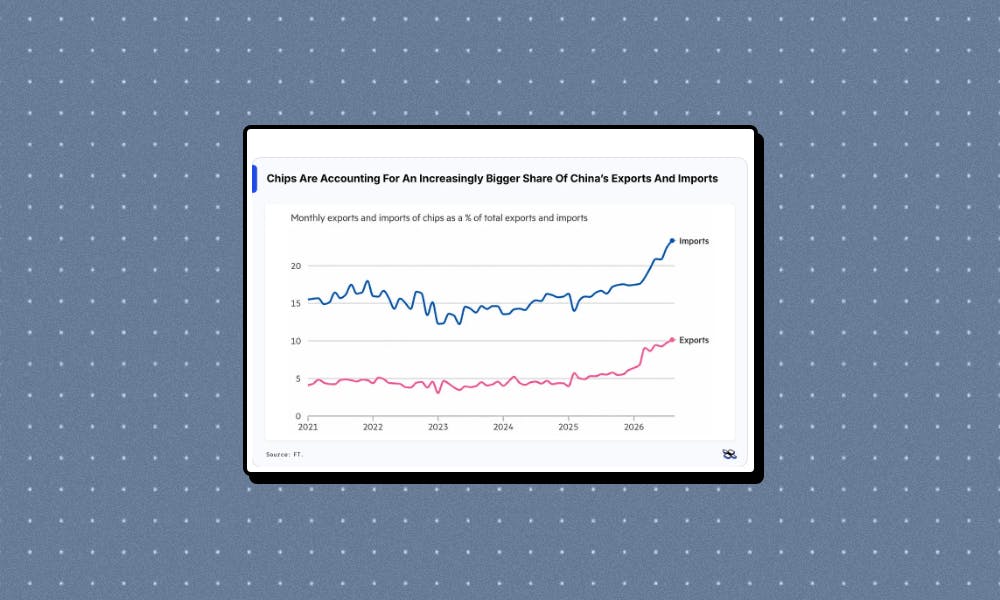
China's trade machine continues to hum, and semiconductors are increasingly the engine under the hood. Official data released this week showed exports rose 25% in August from a year earlier, slightly below the 25.9% economists had expected but a solid acceleration from July's 23.9% pace. Imports also climbed, up 28.2%, helped by pricier semiconductors and oil, though that missed the 31% forecast.
The headline numbers are strong, but the composition is what's catching investors' attention. High-end hardware, especially semiconductors and other tech gear, is becoming a bigger slice of both what China ships out and what it brings in. The driver, as with so much of the global economy right now, is artificial intelligence.
AI demand reshapes China's trade
The boom in AI has created voracious demand for chips that power data centers, cloud computing, and machine-learning models. That demand is showing up directly in China's trade figures. On the export side, Chinese manufacturers are shipping more advanced chips and electronic components to meet global orders. On the import side, China is buying more semiconductors—many of them high-end chips it can't yet produce domestically—to feed its own tech assembly lines.
This is a notable shift. For years, China's export story was dominated by consumer goods, clothing, furniture, and, more recently, electric vehicles. Now, chips are muscling their way into the mix. The trend mirrors what's happening across the tech supply chain: AI memory demand is pushing up gadget prices, and companies like Computacenter are raising profit outlooks on the back of AI data center demand.
The chip trade is also a reminder of China's complex position in the global semiconductor industry. While it has made strides in mature chipmaking, it still relies heavily on imports for the most advanced chips, especially those used in AI applications. That reliance shows up in the import data, where pricier semiconductors helped push the overall import figure higher.
What's behind the numbers
August's export growth of 25% is a strong reading, even if it came in a touch below expectations. The acceleration from July suggests global demand remains resilient, particularly for tech products. Economists watch these numbers closely because China is the world's largest exporter of goods, and its trade data offers a window into global consumer and business spending.
Imports, meanwhile, rose 28.2%, helped by higher prices for semiconductors and oil. The miss versus the 31% forecast is unlikely to cause much concern, as the overall trend remains robust. But it does highlight how much China's import bill is tied to commodity prices and the cost of high-tech components.
For context, China's trade surplus—the gap between exports and imports—remains large, though the exact figure for August wasn't in the brief. The broader picture is that China's factories are busy, and the global appetite for Chinese goods, especially tech, shows no sign of fading.
What it means for investors
For everyday investors, the key takeaway is that AI demand is not just a story about a few big tech companies. It's reshaping global trade flows, and China is right in the middle of it. Companies that make chips, assemble electronics, or supply the equipment used in semiconductor manufacturing are likely to see continued demand.
That's evident in recent earnings and outlooks. IQE swung to a £6m profit as AI data centers boosted chip demand, and ASML is pushing bigger masks for High NA EUV to handle AI chips. These are just two examples of how the AI chip boom is rippling through the supply chain.
For investors, this means paying attention to companies with exposure to semiconductor demand, whether they're chipmakers, equipment suppliers, or even firms that benefit from higher memory prices. But it's also a reminder that China's trade data can be volatile, and a single month's numbers shouldn't drive investment decisions.
There are also broader implications. China's growing reliance on chip imports, even as it exports more tech, underscores the strategic importance of semiconductors in global politics. China's state capital injections into major banks are partly aimed at supporting strategic industries, and chips are at the top of that list.
The road ahead
Looking forward, investors will be watching whether this chip-driven trade momentum continues. The AI boom shows no signs of slowing, but there are risks: potential export controls, supply chain disruptions, and the cyclical nature of the semiconductor industry. A downturn in AI spending could quickly reverse the trend.
For now, though, the data paints a clear picture: semiconductors are taking over China's trade machine, and AI is the fuel. For investors, that's a trend worth understanding, even if it doesn't point to a single obvious stock to buy.