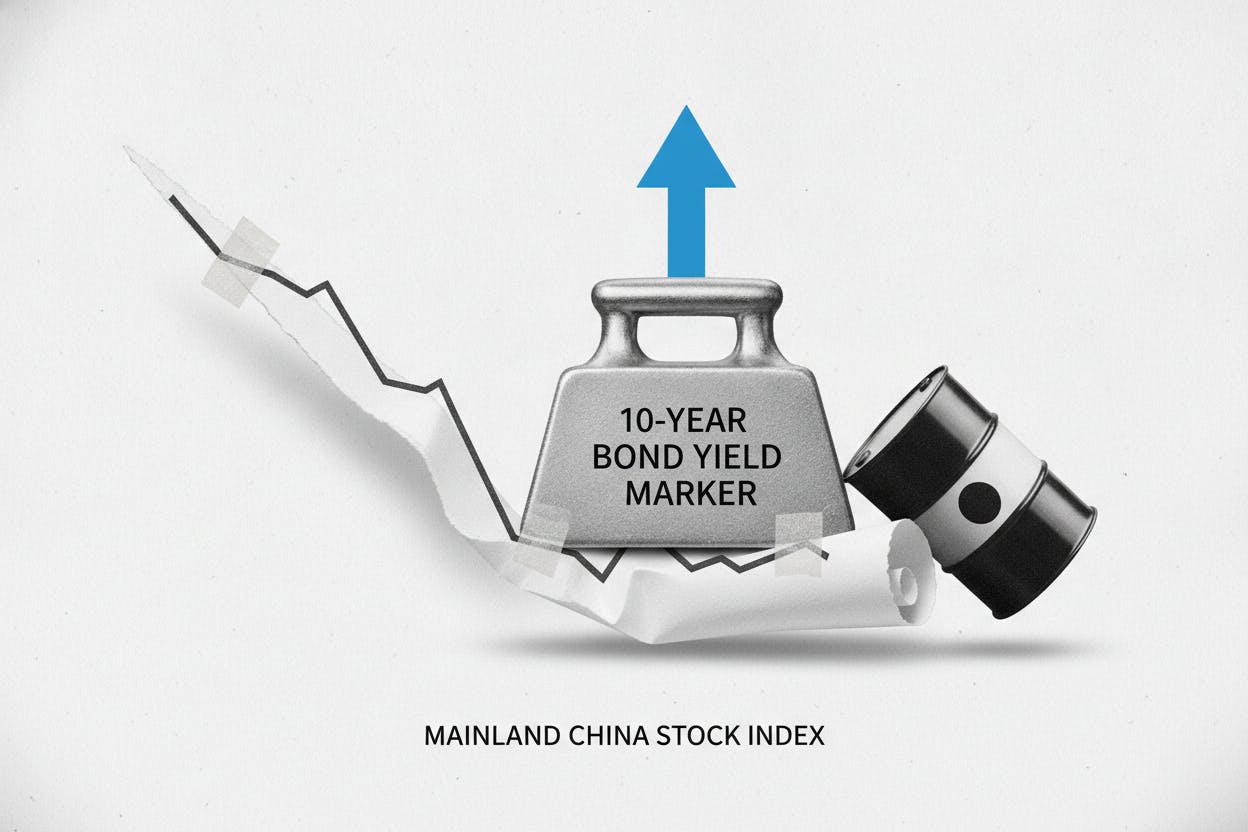
Mainland Chinese stocks took a hit on Tuesday, with the CSI 300 index falling 1.4% and the Shanghai Composite dropping 1%. In contrast, Hong Kong's Hang Seng index finished roughly flat, showing a divergence between the two markets.
The selloff came as global bond yields climbed and oil prices firmed, two forces that tend to cool investors' appetite for risk. The 10-year US Treasury yield rose to its highest level since 2023, as traders increased bets that the Federal Reserve could hike interest rates in September. Meanwhile, renewed Middle East tensions pushed oil prices higher, adding another layer of inflation worry that typically keeps yields elevated.
Why bond yields and oil matter for stocks
When bond yields rise, they make safer assets like government bonds more attractive relative to stocks. Higher yields also increase borrowing costs for companies, which can squeeze profit margins and reduce the present value of future earnings. For growth-oriented markets like China, where investors often pay a premium for expected future gains, rising yields can be particularly painful.
Oil prices, on the other hand, feed directly into inflation. When energy costs go up, businesses face higher input costs, and consumers have less to spend on other goods. Central banks, including the Fed, watch inflation closely. If oil keeps climbing, it could push inflation higher, prompting the Fed to keep rates higher for longer or even raise them again. That scenario is a headwind for stocks worldwide.
The moves in China and Hong Kong are part of a broader pattern. European stocks stalled as oil topped $95 and German yields hit a 2011 high, while South Korea's KOSPI dropped 3.13% on similar pressures. The dollar held steady as oil and Treasury yields rose on Middle East tensions.
What's driving the global bond selloff?
The recent rise in bond yields is not just a China story. It's a global phenomenon. The 10-year US Treasury yield, which serves as a benchmark for borrowing costs around the world, has been climbing as investors reassess the path of interest rates. Strong economic data and sticky inflation have led many to believe the Fed will keep rates higher for longer, or even resume hiking.
At the same time, geopolitical tensions in the Middle East have raised concerns about oil supply disruptions. That has pushed crude prices higher, which could feed into inflation and force central banks to act more aggressively. The combination of higher yields and higher oil prices is a classic recipe for market jitters.
For China specifically, the country's economy has been struggling to regain momentum after a slow post-pandemic recovery. Weak consumer confidence and a property market downturn have weighed on growth. Higher global yields can also put pressure on the yuan, making it more expensive for China to service its dollar-denominated debt and potentially prompting capital outflows.
What it means for investors
For everyday investors, the key takeaway is that rising bond yields and oil prices can ripple through global markets, affecting stock valuations everywhere. If you hold international stocks or funds, you may see volatility in the near term.
It's also worth noting that not all markets move in lockstep. While mainland Chinese stocks fell, Hong Kong's Hang Seng was flat, showing that different markets can react differently to the same global pressures. That's a reminder of the importance of diversification.
Investors should keep an eye on the Fed's next move. If the central bank signals another rate hike, yields could climb further, putting more pressure on stocks. On the other hand, if inflation cools and the Fed pivots to cutting rates, markets could get a boost.
Oil prices are another factor to watch. Oil and yields climbed on US-Iran tensions, leaving stock futures flat, and any further escalation could push prices higher. That would likely keep inflation concerns alive and weigh on risk assets.
For now, the message is clear: higher yields and higher oil prices are a headwind for stocks, and investors should be prepared for continued volatility.



