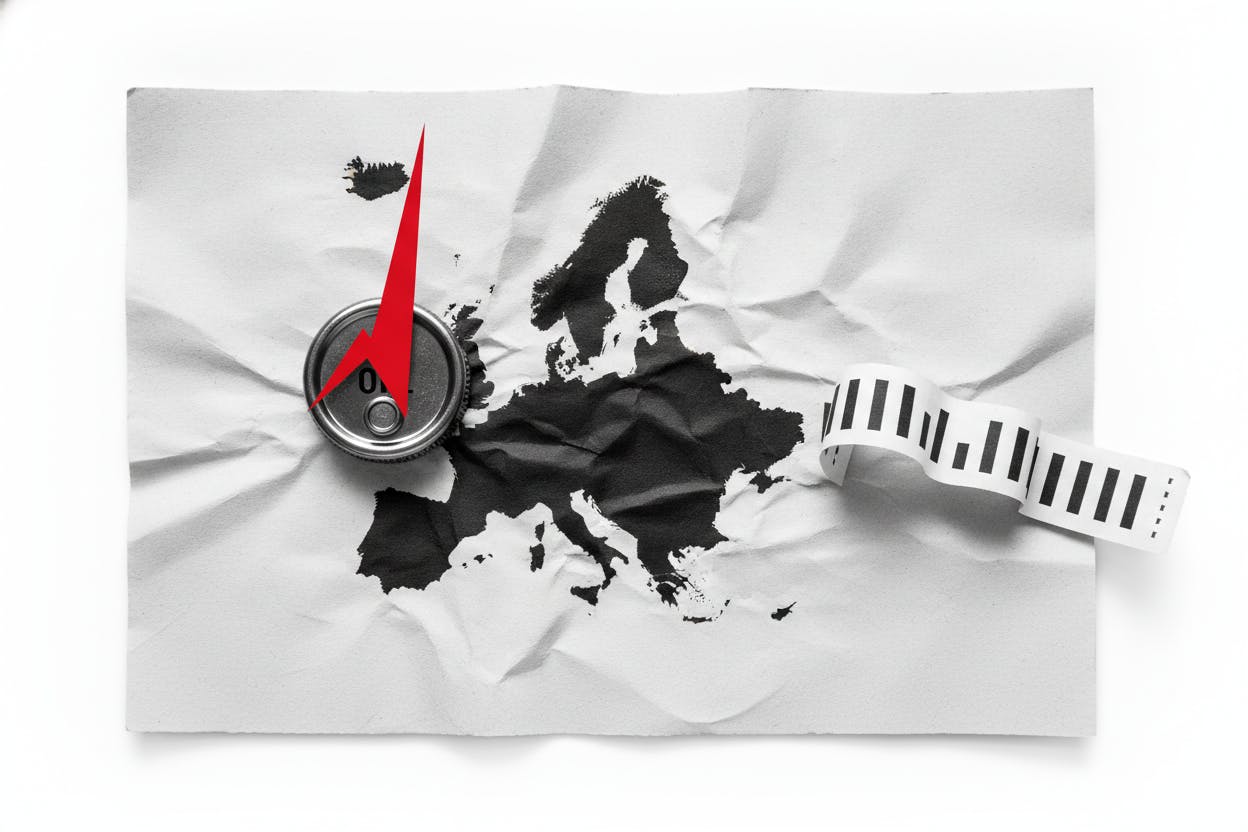
European stocks ended a choppy session on Tuesday as investors digested two competing signals: cooling inflation that could pave the way for lower interest rates, and a sharp rise in oil prices that threatens to reignite price pressures.
Data from Eurostat showed eurozone inflation eased to 2.8% in June, down from 3.2% in May. The decline was driven by lower energy costs and a slowdown in food price growth, though core inflation—which strips out volatile items—remained sticky at 5.4%.
At the same time, Brent crude oil climbed 2.4% to $86.28 a barrel, its highest level in over a month, as escalating tensions between the United States and Iran raised fears of supply disruptions in the Middle East. The region accounts for roughly a third of the world's seaborne oil trade.
Two forces pulling in opposite directions
The inflation data is welcome news for the European Central Bank, which has been raising rates aggressively to bring price growth back toward its 2% target. A lower headline number gives policymakers more room to pause or even reverse course later this year, which would reduce borrowing costs for businesses and households.
But the oil price jump complicates that picture. Higher energy costs feed directly into fuel, heating, and shipping expenses, which can push inflation back up. That leaves the ECB in a delicate position: if it cuts rates too soon, it risks undoing progress on inflation; if it waits too long, it could choke off economic growth.
“The market is trying to figure out which force wins out,” said one analyst. “Lower inflation is good for stocks, but higher oil is a headwind for both inflation and corporate profits.”
Geopolitical risk adds to uncertainty
The rise in oil prices comes amid renewed US-Iran tensions. Reports of increased military activity in the Persian Gulf have raised the risk of disruptions to tanker traffic through the Strait of Hormuz, a critical chokepoint for global oil supplies. Similar concerns have rattled markets in the Gulf region, with Dubai stocks hitting a five-week low and UAE stocks trading mixed as investors priced in a higher risk premium.
For European investors, the geopolitical backdrop adds another layer of uncertainty. Many European companies have exposure to Middle Eastern markets, and higher oil prices increase input costs across industries from airlines to chemicals.
What it means for everyday investors
For ordinary investors, the key takeaway is that markets are likely to remain volatile in the near term. The tug-of-war between falling inflation and rising oil prices means that different sectors will perform differently.
Energy stocks, for example, tend to benefit from higher crude prices, while consumer-facing companies and airlines could see their margins squeezed. Bond investors, meanwhile, are watching the ECB closely: if inflation continues to ease, bond yields could fall, boosting the value of existing bonds.
It's also worth remembering that one month's data does not make a trend. Inflation in the eurozone has been on a downward trajectory since late 2022, but it remains well above the ECB's target. Similarly, oil prices could retreat quickly if geopolitical tensions ease or if global demand weakens.
Investors should avoid making hasty moves based on a single data point or a short-term spike in oil. Instead, it's a good time to review portfolio diversification and ensure exposure to different asset classes and regions.
Broader market context
The mixed signals in Europe come against a backdrop of global uncertainty. In Asia, emerging market stocks fell 2.7% as the combination of Middle East tensions and a sell-off in chip stocks weighed on sentiment. In the US, the S&P 500 and Nasdaq have been volatile as investors weigh the path of Federal Reserve policy.
For European stocks, the coming weeks will be shaped by corporate earnings reports. Major companies like Ryanair, Novartis, SAP, and Volkswagen are set to report, and their results will provide a clearer picture of how businesses are navigating the current environment.
Ultimately, the story of the day is one of competing forces. Lower inflation gives the ECB room to ease, but higher oil prices remind everyone that the path back to stable prices is rarely a straight line.