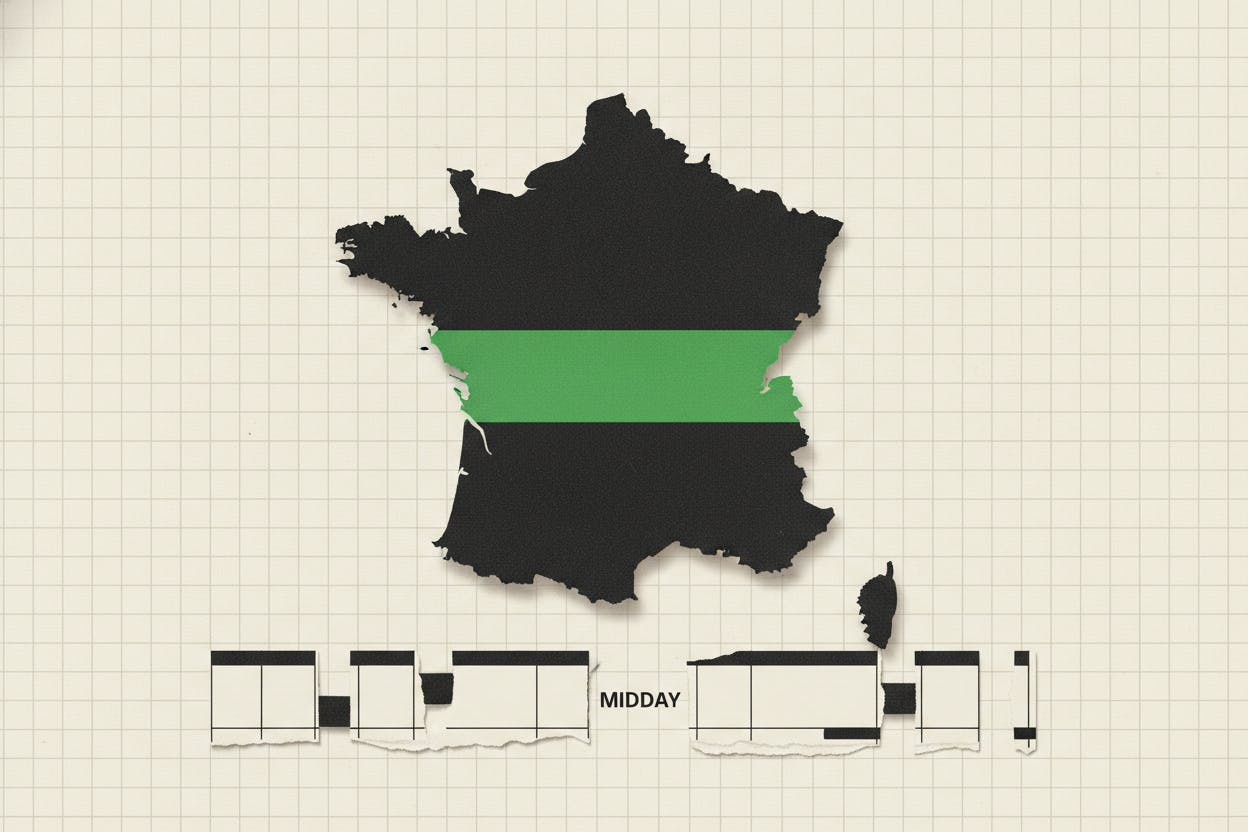
The Bank of France has revised up its estimate for the country's second-quarter economic growth to 0.2% from flat, citing resilience in the services sector and businesses' ability to adapt to a record-breaking heatwave in late June. The upgrade suggests that extreme weather, while disruptive, does not automatically derail the broader economy when companies can adjust.
What the data shows
France, the eurozone's second-largest economy, contracted 0.1% in the first quarter, so the 0.2% expansion marks a modest rebound. The central bank's monthly survey of about 8,500 firms found that many companies shifted working hours and factory schedules to avoid the hottest parts of the day. Some construction activity slowed, but overall disruption remained limited.
Services were the main driver of the upgrade. Consumer services, information and communication, hospitality, and transport all held up well. In some cases, demand actually increased as travelers sought air-conditioned hotels and businesses bought more cooling systems.
The bank also noted that supply-chain bottlenecks and pressure from raw material and energy prices have eased from earlier highs. Its uncertainty gauge fell back toward levels seen before the war in Ukraine, even though firms still cite geopolitical tensions and input costs as key worries.
Heatwave as a reshuffle, not a shutdown
The Banque de France's revised estimate challenges the old assumption that a major heatwave automatically punches a big hole in headline growth. Instead, the pattern looks more like a reshuffle: output shifts away from outdoor-heavy sectors like construction and toward indoor services, air-conditioned travel, and cooling equipment.
That "adaptation economy" has a clear flip side. Construction and other outdoor-dependent work can still lose days, while hospitality, transport, and cooling-related suppliers may see a temporary tailwind. This is a different dynamic from the 2003-era intuition that heatwaves mostly mean economy-wide disruption.
For investors, the key takeaway is that extreme weather events are increasingly being managed through operational flexibility, not just shutdowns. That resilience can help limit the damage to corporate earnings and GDP, but it also means sector-level winners and losers become more pronounced.
What it means for investors
For everyday investors, the French data is a reminder that economic growth can be more resilient than headlines suggest. A 0.2% quarterly expansion is modest, but it beats the flat reading that was expected just weeks ago. The ability of businesses to adapt to extreme weather is a positive sign for the broader European economy, which has been grappling with high inflation and geopolitical uncertainty.
Investors should watch how other countries in the eurozone handle similar weather events. If adaptation becomes the norm, it could reduce the risk of sharp GDP downgrades during heatwaves. On the flip side, sectors like construction and outdoor agriculture may face more frequent disruptions, while services tied to cooling, travel, and indoor entertainment could see steady demand.
The Bank of France's survey also points to easing supply-chain pressures and lower energy costs, which could help margins for many companies. However, geopolitical tensions and input costs remain concerns, so the recovery is not yet on solid ground.
For those tracking broader market trends, the French data aligns with recent signals from other economies. For example, US stocks rose as oil dipped despite US strikes on Iranian targets, suggesting markets are looking past geopolitical risks for now. Similarly, gold lifted the South African rand despite a 4.3% factory output drop, showing how commodity prices can offset weak industrial data.
In the end, the French economy's ability to grow through a record heatwave is a small but encouraging sign that businesses are learning to cope with climate-related disruptions. For investors, it means paying attention to which sectors adapt best—and which ones get left behind.