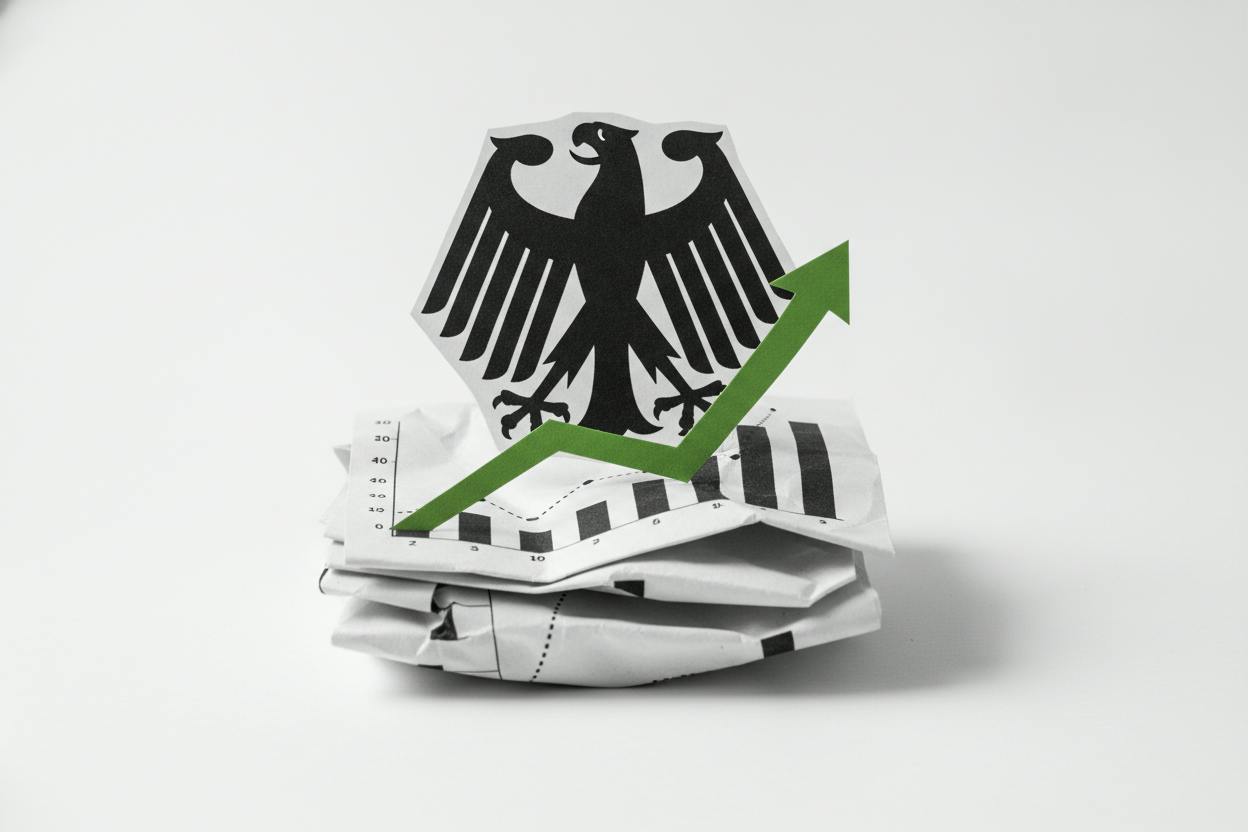
Germany's government has raised its economic growth forecast for 2026 to 1.3%, up from the 0.5% it predicted in April, after a stronger-than-expected first half of the year. The upgrade reflects improved momentum in Europe's largest economy, but officials are quick to point out that the recovery is not yet broad-based.
According to a government source cited by Reuters, the new projections also see growth of 1.1% in 2027, up from the previous 0.9% forecast. The revised numbers align closely with the latest projections from Germany's leading economic institutes, which have also become more optimistic about the near-term outlook.
Why the upgrade?
The main driver behind the brighter forecast is the better-than-anticipated performance in the first half of the year. Germany's economy, which has been struggling with high energy costs, weak global demand, and a manufacturing slowdown, appears to have found some footing. Stronger exports and a slight pickup in industrial activity have contributed to the improved picture.
However, the government's own statement is cautious. It notes that private consumption and business investment remain sluggish. Consumers are still holding back on spending, likely due to inflation eroding purchasing power and uncertainty about the future. Businesses, meanwhile, are hesitant to invest, citing what officials describe as "location" issues—such as high energy costs, bureaucratic red tape, and a shortage of skilled labor.
These structural challenges are not new. Germany has long been known for its industrial strength, but in recent years it has faced increasing competition from abroad and a slower transition to digital and green technologies. The government's reference to "location" issues is a nod to these deeper problems that won't be solved by a single quarter of growth.
What it means for investors
For everyday investors, this forecast upgrade is a mixed signal. On one hand, it suggests that the German economy—and by extension the broader European economy—is on a more solid footing than feared. That could be positive for European stocks, particularly those in cyclical sectors like manufacturing and autos, which are sensitive to economic growth.
On the other hand, the persistent weakness in consumption and investment is a reminder that the recovery is fragile. If consumers and businesses don't start spending more, the growth could fizzle out. Investors should watch for signs of improvement in these areas, such as rising retail sales or increased capital expenditure by companies.
The upgrade also comes at a time when other major economies are showing mixed signals. For instance, US factory growth cooled slightly in September, while Canada's factory growth also cooled as input costs hit a two-year high. These trends highlight that global manufacturing is still facing headwinds, which could affect Germany's export-driven economy.
Germany's growth outlook is also relevant for the European Central Bank (ECB), which has been raising interest rates to combat inflation. A stronger economy might give the ECB more room to keep rates higher for longer, which could impact bond yields and borrowing costs across Europe.
Looking ahead
The government's revised forecast is likely to be welcomed by policymakers, but it's not a reason for complacency. The sluggishness in consumption and investment suggests that the recovery is still uneven. The government may need to address the structural "location" issues to ensure sustainable growth in the long term.
For investors, the key takeaway is to remain diversified and not overreact to a single forecast. Germany's economy is a bellwether for Europe, and its performance will influence everything from corporate earnings to currency movements. Keeping an eye on upcoming economic data, such as GDP figures and business sentiment surveys, will be crucial.
In the meantime, the upgraded outlook is a small but positive sign. It shows that Germany is not stuck in a prolonged slump, even if the road to a full recovery remains bumpy.