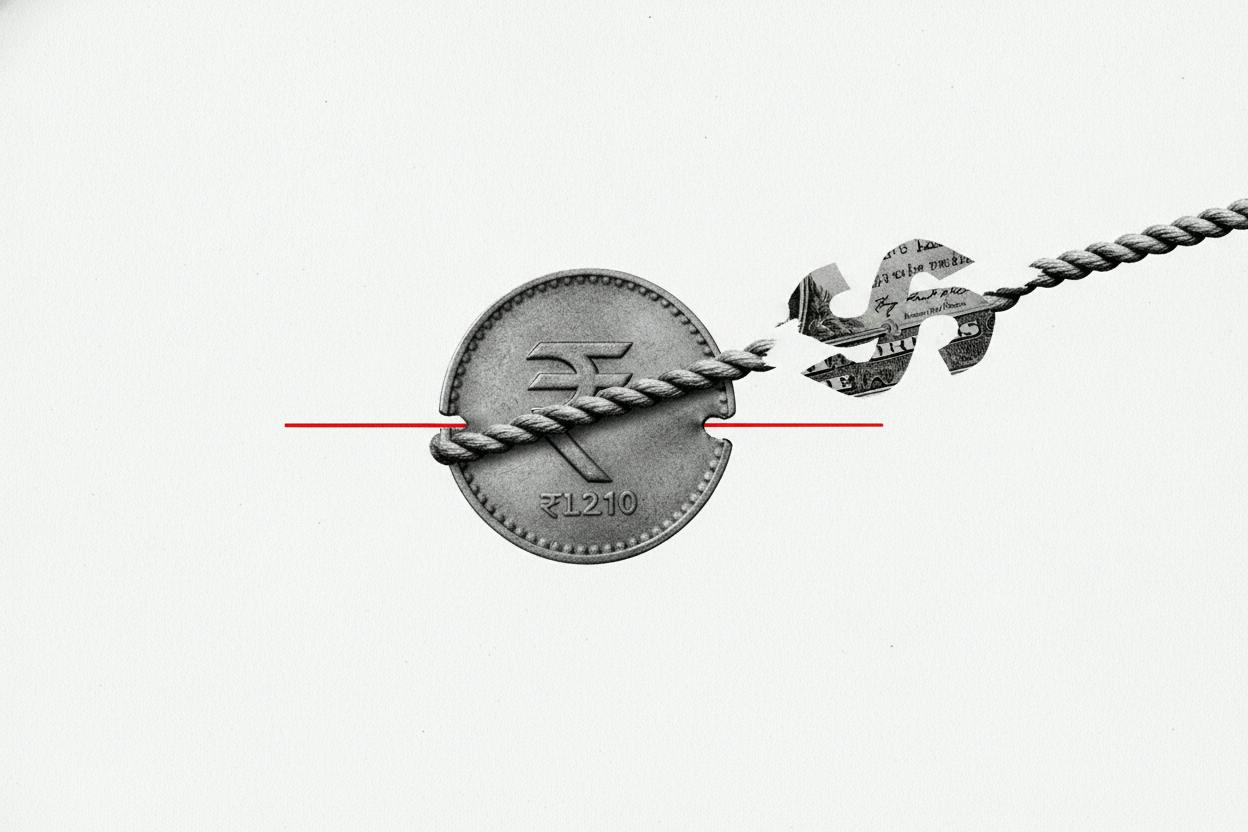
The Reserve Bank of India (RBI) is deploying its foreign-exchange reserves in a big way to keep the rupee from weakening too far. According to Reuters estimates, the central bank has sold or swapped roughly $75-80 billion worth of dollars since June 8, as traders closely watch how it behaves around the 97-rupees-per-dollar level.
When a currency comes under pressure, a central bank can step in to support it by selling dollars from its reserves and buying the local currency. The RBI has been doing this both in the spot market and through what are known as “sell/buy” dollar-rupee swaps. In a sell/buy swap, the central bank sells dollars to banks today and agrees to buy them back at a future date. This not only provides dollars to the market but also drains rupees from the banking system, which can help tighten liquidity.
Why the rupee is under pressure
Several forces are pushing the rupee lower. High oil prices are a key factor: India imports most of its crude oil, so when oil costs more, the country needs to buy more dollars to pay for it, increasing demand for the U.S. currency. That puts downward pressure on the rupee.
At the same time, global interest rates remain elevated, particularly in the United States. Higher U.S. rates make dollar-denominated assets more attractive, drawing capital away from emerging markets like India. This dynamic has been a recurring theme for many developing economies, and India is no exception.
The RBI’s intervention is aimed at smoothing the rupee’s decline rather than preventing it altogether. Central banks often prefer to avoid sharp, disorderly moves that can spook investors and disrupt trade. By selling dollars, the RBI can slow the pace of depreciation and give businesses and markets time to adjust.
What the 97-per-dollar level means
Traders are paying close attention to the 97-rupee mark. It appears to be a level the RBI is keen to defend, at least for now. When a central bank signals a clear tolerance level, market participants often test it, trying to see how much firepower the authorities are willing to commit.
The scale of the intervention—tens of billions of dollars—shows that the RBI is serious about holding the line. But it also raises questions about how long the central bank can keep this up. India’s foreign-exchange reserves are substantial, but they are not infinite. If the pressure on the rupee continues, the RBI may have to choose between letting the currency fall further or using even more of its reserves.
The RBI’s actions have also had knock-on effects in the derivatives market. Currency forward premiums have risen to multi-year highs, reflecting the cost of hedging against further rupee weakness. This is something importers and exporters watch closely, as it affects their costs and margins.
What it means for investors
For everyday investors, a weaker rupee has mixed implications. On one hand, it can make Indian exports more competitive, which could benefit companies that sell goods abroad. On the other hand, it makes imports more expensive, which can feed into inflation. That is a particular concern for a country that relies heavily on imported oil.
Inflation erodes purchasing power and can prompt the central bank to raise interest rates, which affects borrowing costs for mortgages and business loans. So while the RBI’s intervention is aimed at stabilizing the currency, it is also part of a broader balancing act between supporting growth and keeping prices in check.
For investors with international exposure, a weaker rupee means that returns from foreign investments, when converted back to rupees, may be lower. Conversely, Indian assets become cheaper for foreign investors, which could attract some inflows over time.
The RBI’s moves are also being watched in the context of other emerging markets. China’s central bank has similarly been managing the yuan, and the dollar’s recent pullback has provided some relief to currencies worldwide. But the underlying pressures—high oil prices and global rate differentials—remain.
The road ahead
Investors will be watching several things in the coming weeks. First, how much more the RBI is willing to spend to defend the rupee. Second, whether oil prices stay elevated or ease. Third, what the U.S. Federal Reserve does with interest rates, as that will influence the dollar’s strength.
If the rupee stabilizes, the RBI may be able to slow its intervention. But if pressures persist, the central bank could face a tough choice: let the currency slide to a new equilibrium or continue draining its reserves. Either path has consequences for the Indian economy and for investors.
For now, the RBI’s commitment to the 97 level is clear. But as with any central bank intervention, the market will keep testing the limits.