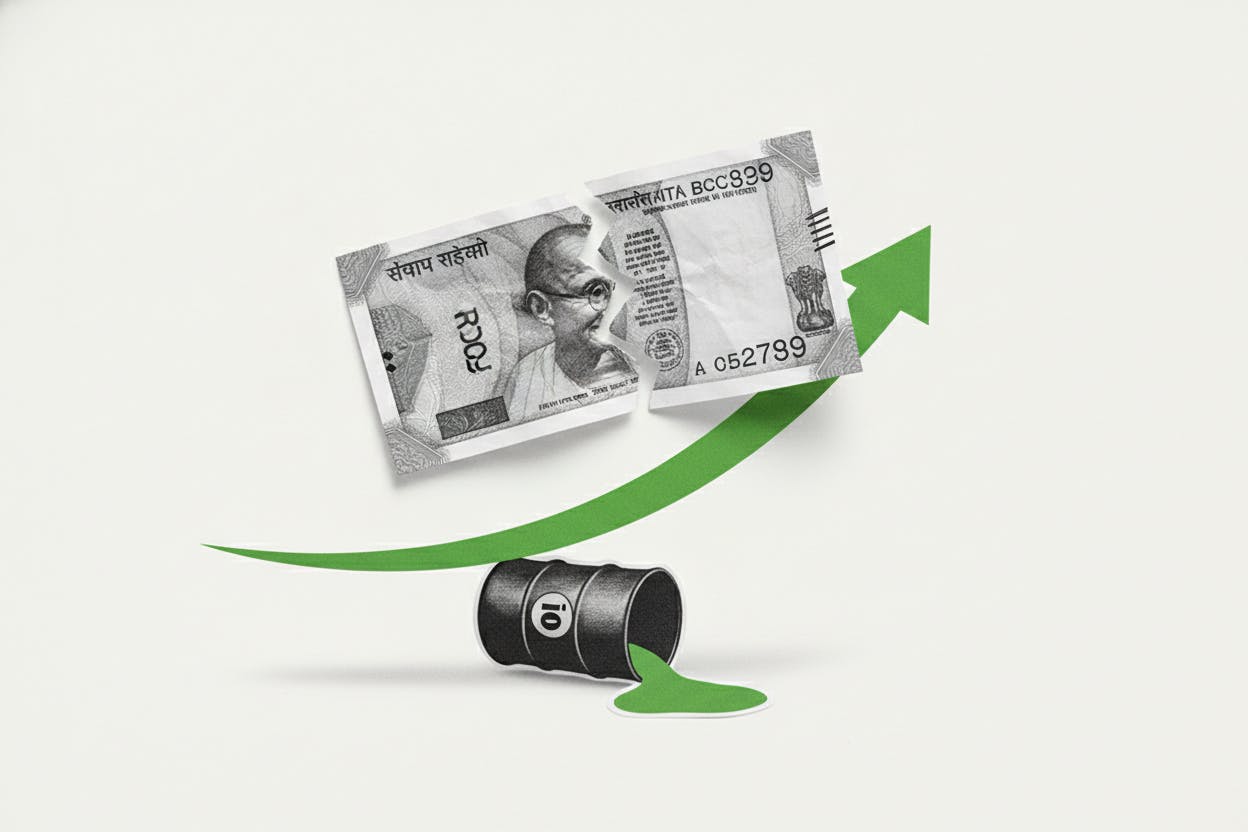
The Indian rupee opened slightly stronger on Thursday, benefiting from a fresh drop in global oil prices. Brent crude, the international benchmark, slipped below $71 a barrel in Asian trading after falling about 1% on Wednesday. For India, the world's third-largest oil importer, cheaper crude typically reduces the country's import bill and eases demand for US dollars, providing a natural lift to the rupee.
But traders caution that this relief may be fleeting. The dollar/rupee pair has already broken through the closely watched 94.80-95.00 support zone, settling at 95.2475 on Wednesday after a 0.6% drop. That breach signals that the underlying trend remains tilted toward a weaker rupee, even if oil prices provide occasional counter-pressure.
Why Oil Matters for the Rupee
India imports roughly 85% of its crude oil requirements, making the rupee highly sensitive to oil price movements. When oil prices fall, India's import bill shrinks, reducing the demand for dollars from oil refiners and traders. That dynamic can support the rupee, as seen in India's Rupee Posts First Quarterly Gain Since March 2025 on Cheaper Oil and Dollar Inflows.
However, the current oil price decline is tied to geopolitical developments. Reuters reported that signs of progress in indirect US-Iran talks related to shipping through the Strait of Hormuz have eased supply concerns. The Strait of Hormuz is a critical chokepoint for global oil shipments, and any reduction in tensions there tends to push prices lower. While that is positive for the rupee in the short term, the broader market remains focused on other forces.
Technical Breakdown and Trader Sentiment
The breach of the 94.80-95.00 support zone is a technical event that traders watch closely. Support zones are price levels where buying interest has historically been strong enough to prevent further declines. When a pair breaks below such a zone, it often signals that sellers have taken control, and the next move is likely lower for the rupee (higher for the dollar/rupee).
"Even with Brent slipping below $71 a barrel, traders see dollar/rupee staying biased higher after it broke through the 94.80-95.00 support zone," the source brief noted. This suggests that the oil-led bounce may be an opportunity for traders to sell the rupee rather than a reversal of the weakening trend.
The Reserve Bank of India (RBI) has historically intervened to smooth volatility, as highlighted in RBI's Record $106.7B Forward Position Keeps Rupee Steady Near 94.68. But the central bank's ability to defend a specific level may be limited if broader macroeconomic pressures persist.
What This Means for Investors
For everyday investors, a weaker rupee has mixed implications. On the positive side, companies that export goods or earn revenue in dollars—such as IT services firms and pharmaceutical companies—tend to benefit because their earnings are worth more when converted back to rupees. On the flip side, importers, including oil refiners and companies that rely on foreign raw materials, face higher costs.
Investors with exposure to Indian equities should also watch the rupee's trajectory. A sustained decline in the rupee can attract foreign portfolio inflows if it makes Indian assets cheaper for overseas buyers, but it can also trigger outflows if it signals broader economic weakness. The recent trend of foreign selling has been a headwind for Indian stocks, as noted in Indian Stocks Eye Higher Open as GIFT Nifty Rises, but Foreign Selling and Iran Tensions Cap Gains.
For now, the oil-led breather offers a temporary reprieve, but traders are watching for the next catalyst. Key levels to monitor include the 95.50 and 96.00 marks on the dollar/rupee pair. If the rupee fails to hold its gains and resumes its slide, it could add to inflationary pressures in India, potentially influencing the RBI's monetary policy stance.
In the broader context, the rupee's performance is also tied to global factors such as US interest rates and the strength of the dollar index. A strong US economy and higher Treasury yields tend to pull capital away from emerging markets like India, putting additional pressure on the rupee. Investors should keep an eye on upcoming US economic data and Federal Reserve commentary for clues on the dollar's direction.
Ultimately, while cheaper oil is a welcome development for India, the rupee's path depends on a complex mix of global and domestic forces. The current bounce may be a short-term trading opportunity, but the underlying trend remains cautious.