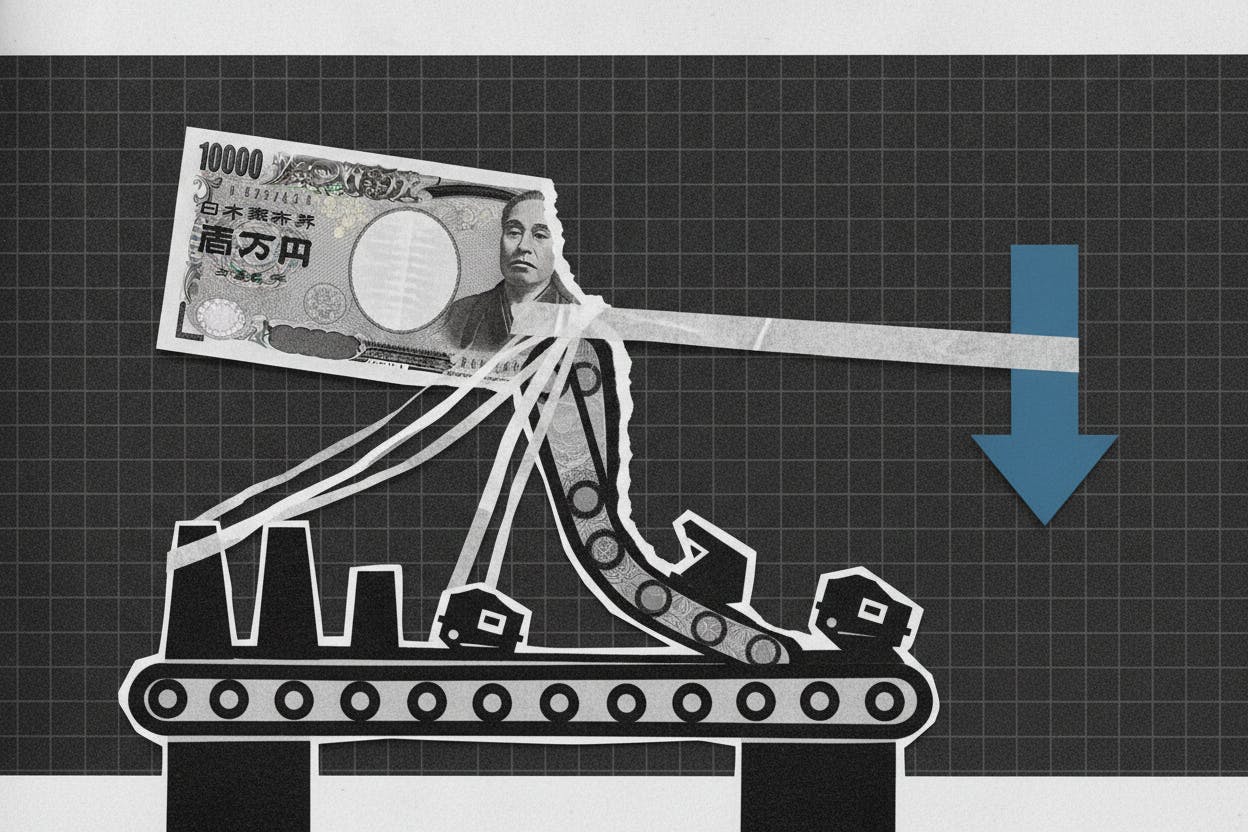
Japan's industrial production fell 1.7% in May compared to the same month last year, according to data from the Ministry of Economy, Trade and Industry. The decline, driven by weakness in machinery, electrical machinery, and information and communications electronics equipment, lands at a delicate moment for the Bank of Japan (BOJ) as it weighs further interest rate increases.
The yen also continued its slide, touching 162.41 per dollar, a level that keeps currency intervention on the table. Finance Minister Satsuki Katayama reiterated that the government is ready to respond 'appropriately at any time,' a phrase markets interpret as a warning that Tokyo could step into foreign exchange markets if the yen's moves become disorderly.
What's Behind the Factory Output Drop
Industrial production is a key measure of Japan's manufacturing sector, which accounts for a significant share of the country's economic output. The 1.7% year-over-year decline in May marks a slowdown from previous months, with the machinery and electronics sectors particularly weak. These industries are sensitive to global demand, and the data suggests that cooling overseas markets, especially in China and other parts of Asia, are weighing on Japanese exports.
The drop in factory output comes despite a recent recovery in some parts of the region. For example, China's factory activity returned to growth in June, driven by new orders, but Japan's manufacturing sector has not yet benefited from that rebound. The divergence highlights the uneven nature of the global economic recovery.
The BOJ's Policy Dilemma
The Bank of Japan has already raised its policy rate to 1.0%, a historic shift after years of ultra-loose monetary policy. The central bank has signaled that it could tighten further if inflation risks persist, but the weak factory output data complicates that calculus. Softer manufacturing points to cooling domestic demand, which could reduce the need for higher rates. However, the yen's weakness presents a countervailing force: a weaker currency makes imports like fuel and food more expensive, which can push up inflation even as the economy slows.
This tension between growth and inflation is a classic central bank challenge. The BOJ must decide whether to prioritize controlling inflation by raising rates, or supporting growth by keeping rates low. The yen's slide to 162.41 per dollar, a level not seen in decades, adds urgency to the decision. Japan's bond yields have already risen as the yen plunged to a 1986 low, stoking inflation fears and putting pressure on the BOJ to act.
Intervention Talk Returns
Finance Minister Katayama's comments are a reminder that the government has tools beyond interest rates to manage the currency. Japan has a history of intervening in foreign exchange markets to stabilize the yen, typically by selling dollars and buying yen. Such intervention is rare and usually reserved for moments of extreme volatility or disorderly moves. The current level of 162.41 per dollar is close to levels that have triggered intervention in the past, and markets are watching closely for any signs of action.
Investors should note that intervention is not a guaranteed solution. It can provide temporary relief but does not address the underlying economic factors driving the yen lower, such as the interest rate differential between Japan and the United States. The Federal Reserve's higher rates continue to attract capital to dollar-denominated assets, putting downward pressure on the yen.
What It Means for Investors
For everyday investors, the combination of weak factory output and a sliding yen creates a complex environment. Companies with significant exposure to Japan, especially multinationals in the machinery and electronics sectors, face a mixed picture. A weaker yen can boost the value of overseas profits when converted back into yen, but it also raises input costs for manufacturers that rely on imported raw materials. The machinery and electronics producers flagged in May's output report are particularly vulnerable to these cost pressures.
Currency volatility is also a factor to watch. When the yen moves sharply, it can affect the earnings of Japan-exposed stocks and exchange-traded funds (ETFs). Investors holding Japanese equities or funds should be aware that currency swings can amplify or offset returns. The uncertainty around whether the BOJ will hike rates or the government will intervene adds to the volatility, especially around data releases and central bank communications.
Meanwhile, Japanese retail investors are sitting on a record 16 trillion yen in cash, according to recent data, suggesting a cautious stance amid the market wobbles. This cash pile could provide a buffer if markets turn volatile, but it also indicates that many investors are waiting for clearer signals before committing to riskier assets.
Looking Ahead
The BOJ's next policy meeting will be closely watched for any hints on the rate path. If the central bank signals a willingness to hike despite the weak factory data, the yen could strengthen, providing relief to importers but potentially hurting exporters. If it holds steady, the yen may continue to slide, keeping intervention talk alive. Either way, investors should brace for continued volatility in Japanese markets and the yen.
For now, the data paints a picture of an economy at a crossroads: manufacturing is cooling, but inflation pressures from a weak currency remain. How the BOJ and the government navigate this tension will shape the outlook for Japanese assets in the months ahead.