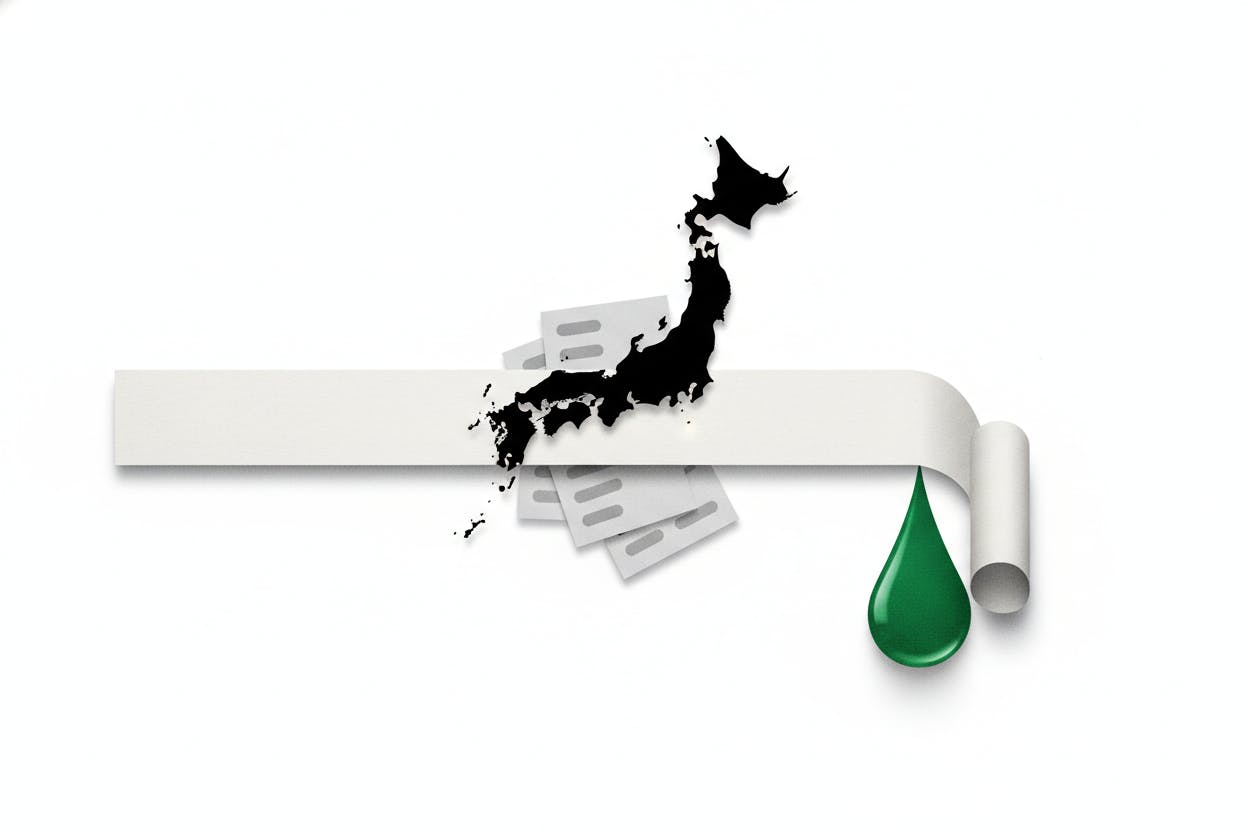
Japan's longest-dated government bonds fell on Thursday, pushing yields up as oil rose on renewed US-Iran tensions and a Bank of Japan survey showed households still expect higher prices.
What's Happening
Oil has climbed for four straight sessions after fresh US strikes on Iranian military installations, raising the risk of supply disruptions through the Strait of Hormuz. For Japan, pricier energy can seep into the inflation outlook, so investors demanded more return to hold long-term government debt. That pressure hit the 'long end' hardest: the 40-year Japanese government bond (JGB) yield rose 6 basis points to 3.815%, versus a much smaller 0.5-basis-point move on shorter-term bonds.
A basis point is one-hundredth of a percentage point, so a 6-basis-point rise is a notable shift for a bond market that usually moves in small increments. Bond yields move inversely to prices—when investors sell bonds, prices fall and yields rise.
Why Oil Matters for Japan
Japan imports nearly all of its oil, making it highly sensitive to global energy prices. The recent US strikes on Iranian targets have stoked fears of broader conflict in the Middle East, particularly around the Strait of Hormuz, a critical chokepoint for oil tankers. Any disruption there could send crude prices sharply higher, feeding into Japan's already elevated inflation.
This isn't just a Japan story. Geopolitical risks are looming over global markets, and central banks worldwide are watching energy costs closely. The Bank of Canada recently held its rate at 2.25% partly because oil prices keep inflation sticky.
Households Still See Higher Prices
Adding to the bond market's unease, the Bank of Japan's latest quarterly survey showed that most Japanese households expect prices to keep rising over the next year. That expectation matters because it can become self-fulfilling—if people think prices will go up, they may demand higher wages, and companies may raise prices in anticipation, fueling actual inflation.
The BOJ has been trying to nudge inflation toward its 2% target for years, but now that it's there, the challenge is keeping it from overshooting. Higher inflation expectations could force the central bank to tighten policy sooner than planned, which would push bond yields even higher.
What It Means for Investors
For everyday investors, the key takeaway is that Japan's bond market is signaling growing unease about inflation. When long-term bond yields rise faster than short-term yields, it often means investors are demanding a premium for the risk that inflation will erode their returns over time.
This matters for anyone holding Japanese government bonds or bond funds, as rising yields mean falling prices. It also has knock-on effects for global markets: Japan is a major holder of US Treasuries, and if Japanese investors start selling foreign bonds to buy domestic ones at higher yields, that could push up borrowing costs worldwide.
On the flip side, higher yields can be good news for savers. If the trend continues, Japanese banks may eventually offer better rates on savings accounts and certificates of deposit. But for now, the bond market is flashing a warning about inflation risks that could ripple through portfolios.
What to Watch Next
Investors will be watching oil prices closely in the coming days. If the US-Iran situation escalates further, crude could push above $90 a barrel, adding more pressure on JGBs. The BOJ's next policy meeting is also on the horizon, and any hints of a rate hike would likely send bond yields higher still.
For context, other central banks are grappling with similar dynamics. The Bank of Korea recently hiked rates as inflation hit 3.2%, showing how energy-driven price pressures are forcing policy action across Asia.
In the meantime, the bond market's wobble is a reminder that even in a low-inflation era, geopolitical shocks can quickly reignite price fears—and that has real consequences for the money in your portfolio.



