Kinder Morgan, one of the largest energy infrastructure companies in the United States, reported third-quarter results that topped Wall Street's expectations. But the company's outlook for 2026 and its decision to hold its dividend steady left some investors wanting more.
Quarterly results beat forecasts
The Houston-based pipeline operator posted adjusted earnings of $0.35 per share for the quarter, up from $0.29 a year earlier and ahead of the $0.32 that analysts surveyed by FactSet had expected. Revenue also came in strong at $4.53 billion, compared with $4.15 billion in the same period last year, and above the consensus forecast.
Those numbers reflect solid demand for moving natural gas, crude oil, and refined products across the company's vast network of pipelines and storage terminals. Kinder Morgan is a bellwether for the U.S. energy infrastructure sector, so its results are often seen as a gauge of broader activity in the industry.
Guidance and dividend disappoint
Despite the beat, the company reiterated its 2026 adjusted earnings-per-share target of $1.36, which is below the $1.54 that analysts were looking for. It also kept its quarterly dividend unchanged at $0.2975 per share.
For income-focused investors, a flat dividend can be a letdown, especially when the company is generating more cash than expected. But management may be choosing to hold back some cash to fund growth projects, rather than returning more to shareholders right now.
Permian Link project gets a timeline
The bigger story for the long term is the company's $4.2 billion Permian Link natural-gas pipeline. Management said the Natural Gas Pipeline Company of America, a Kinder Morgan subsidiary, has approved the project, which is designed to move up to 2.8 billion cubic feet of natural gas per day out of the Permian Basin, the prolific oil-and-gas region in West Texas and southeastern New Mexico.
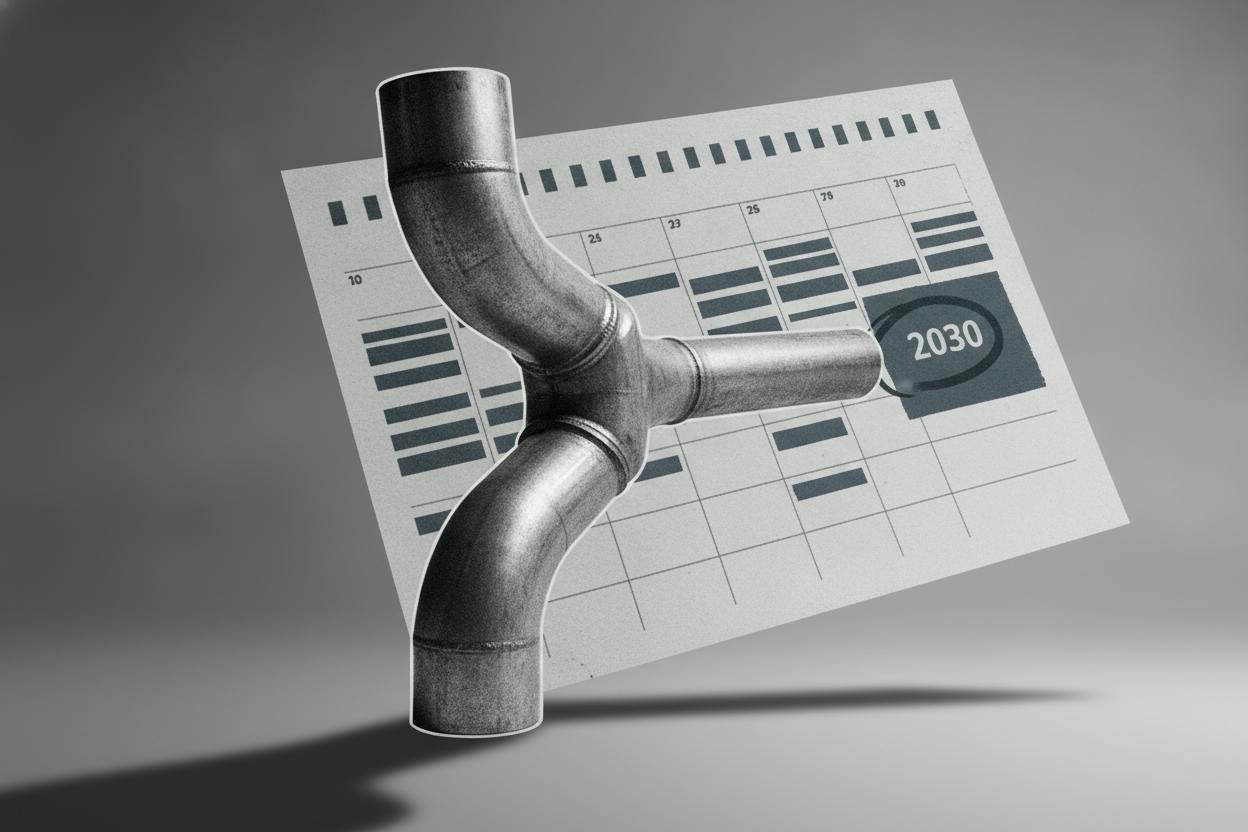
The approval reduces some of the uncertainty around the project, but it also confirms that the next major chunk of capacity won't come online until the third quarter of 2030. That's more than five years away, which means investors will have to wait a long time before the pipeline starts generating revenue.
What it means for investors
For markets, Permian Link's 2030 start makes Kinder Morgan's $4.2 billion project a long-duration cash flow story. A project that doesn't generate revenue until 2030 can trade like a long-duration asset: most of its value sits in cash flows far in the future. That makes the math more sensitive to interest rates and credit spreads, because a higher discount rate shrinks the present value of those later profits.
Meanwhile, the spending comes earlier. As build costs ramp before the pipeline earns a dollar, investors tend to scrutinize near-term free cash flow and whether the current dividend stays well covered, rather than giving full credit today for earnings that arrive near the end of the decade.
For everyday investors, this means the stock's near-term performance may hinge more on the company's ability to fund the project without stretching its balance sheet, and less on the eventual payoff. The company's decision to keep the dividend unchanged could be a sign that management wants to preserve cash for the build-out, which is a common approach for pipeline companies with large capital projects ahead.
Kinder Morgan's results come at a time when energy infrastructure is in focus, with other companies also making big bets on natural gas. For context, APA Group has faced investor pushback over its own pipeline disclosures, highlighting how sensitive investors can be to project details and timelines.
Looking ahead, investors will likely watch for updates on Permian Link's construction progress, any changes to the dividend policy, and whether the company can close the gap between its 2026 earnings target and what analysts expect. As with any long-duration project, patience will be key.