South Korea's main stock index opened with a jolt on Monday, falling more than 3% before recovering to a modest loss, as investors digested a rough week for AI-linked technology stocks. The KOSPI's early slide echoed Friday's selloff on Wall Street, where concerns about the durability of the artificial intelligence spending boom hit semiconductor shares hard.
By midday, the index had pared its decline to roughly 0.6%, helped by gains in other heavyweight names. Samsung Electronics, the country's largest company, steadied after an early drop, while SK Hynix, a key supplier of memory chips used in AI servers, remained under pressure. The rebound also drew support from LG Energy Solution, Hyundai Motor, and Samsung BioLogics, which softened the blow from the tech-led weakness.
Why the wobble?
The jitters follow the KOSPI's biggest weekly drop in 18 years, a slide led by chipmakers as investors began questioning how long the AI spending boom can last. That uncertainty has been building for weeks, as markets weigh whether the massive capital investments by tech giants into AI infrastructure will translate into sustainable profits or simply overshoot demand.
South Korea's semiconductor sector is particularly sensitive to these shifts. Samsung and SK Hynix are global leaders in memory chips, and their fortunes are closely tied to the AI trade. When investors worry about AI demand, these stocks often bear the brunt of the selling.
The broader context is a market that had rallied hard on AI optimism. After such a run, any hint of a slowdown can trigger sharp profit-taking. Friday's US slide, which hit AI-linked names, provided that trigger, and the KOSPI's opening drop reflected that spillover.
Foreign selling and the won
Overseas investors remained cautious, with foreigners net sellers of KRW 38.3 billion (about $28.7 million) of shares on Monday. That's a relatively modest amount, but it continues a trend of foreign outflows from Korean equities in recent weeks.
Interestingly, the won strengthened slightly to 1,334.5 per dollar despite the foreign selling. That's notable because when foreigners sell Korean stocks, they often convert the won proceeds back into dollars, which can put downward pressure on the currency. A weaker won mechanically reduces the foreign-currency value of Korean investments, which can encourage more risk-cutting.
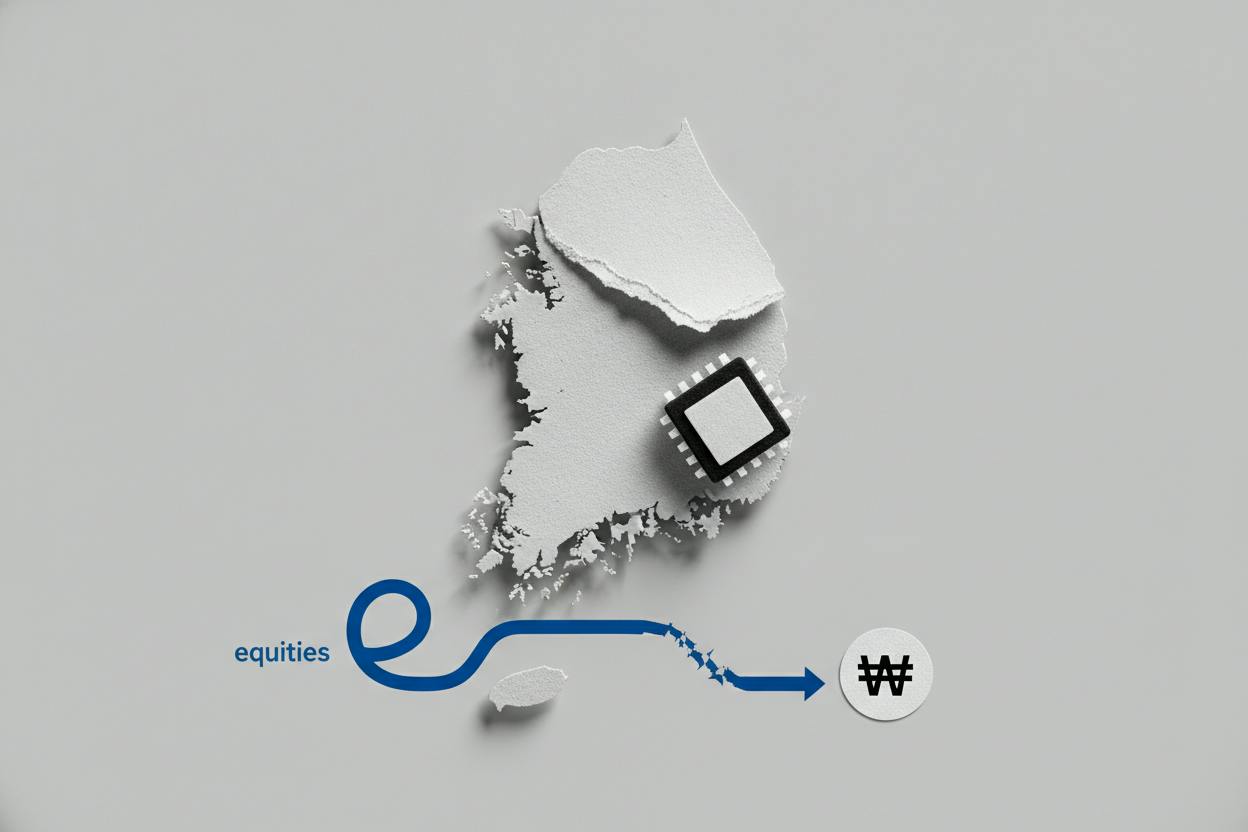
On Monday, the won's firmness suggested that the usual stock-to-currency feedback loop was muted. Either investors had hedged their currency exposure, or other demand for won—such as from exporters or foreign direct investment—offset the outflows. If that holds, the pullback is more likely to remain an "equities-only" wobble rather than turning into a broader risk-off move that pressures the currency and amplifies foreign selling.
What it means for investors
For everyday investors, the key takeaway is that the AI trade is showing signs of fragility. The KOSPI's recent volatility is a reminder that markets that have run up on a single theme—like AI—can correct sharply when sentiment shifts. The fact that the index trimmed its losses suggests some buyers are stepping in, but the underlying uncertainty remains.
Investors should watch whether foreign selling continues and whether the won stays stable. A stable currency would suggest the selling is contained to equities, not a broader flight from Korean assets. Also worth monitoring is whether chip stocks can find a floor, as they are the linchpin of the KOSPI's recent performance.
For those with exposure to Korean equities, diversification across sectors—like the autos, batteries, and biotech names that helped steady the index—can provide some buffer against tech-led swings. But the broader lesson is that AI-driven gains can reverse quickly, and it's wise to be prepared for volatility.
Related reading: KOSPI's worst week since 2008 and the won's safety net.