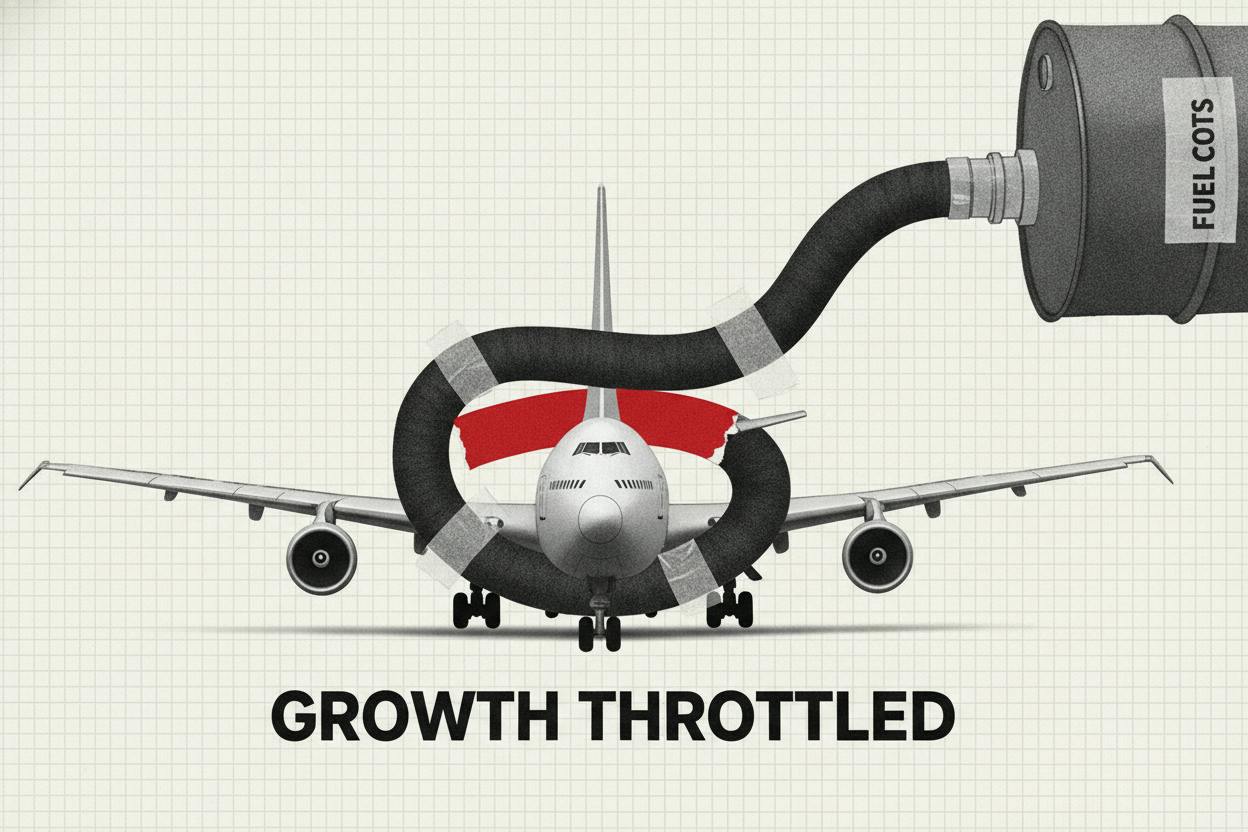
LATAM Airlines, Latin America's largest airline group, is scaling back its growth ambitions as jet fuel prices remain stubbornly high. CEO Roberto Alvo told Reuters that capacity—a measure of available seats and routes—should now land near the low end of the company's earlier 9%-10% growth forecast, after the airline canceled some flights in response to rising fuel costs.
The Santiago-based carrier had previously guided to capacity growth of 9%-10% and adjusted core earnings (EBITDA) of $4.1 billion to $4.4 billion for the year. Alvo's latest comments suggest that while the earnings target may still be within reach, the growth side of the equation is being trimmed to protect profitability.
Fuel: the biggest cost variable
For airlines, jet fuel is typically the largest single expense after labor, and swings in oil prices can quickly alter profit outlooks. LATAM burns roughly 36-38 million barrels of fuel per year, according to Alvo, meaning even a modest move in prices has an outsized impact. He noted that a $10-per-barrel change in jet fuel prices adds or subtracts about $370 million in annual costs.
Management said its current outlook already assumed around $1.7 billion in extra fuel expense compared with the previous year. But recent prices have run above that assumption, and ticket prices have not fully kept pace. That gap is what forced the airline to rethink its capacity plans.
The situation is not unique to LATAM. Airlines across the globe are grappling with elevated fuel costs, and several have warned of margin pressure. For example, United Airlines recently cautioned that higher fuel prices could erase $1 per share from its fourth-quarter profit. The industry's sensitivity to oil means that even small shifts in crude prices can ripple through earnings.
What this means for investors
For everyday investors, LATAM's announcement is a reminder that airlines operate on thin margins and are highly exposed to commodity prices. When fuel costs rise faster than an airline can raise fares, profitability suffers. In this case, LATAM is choosing to fly less rather than absorb the full cost hit, a strategy that can help protect cash flow but also limits revenue growth.
The company's decision to trim capacity suggests that demand remains solid—otherwise it would likely be cutting more aggressively—but that the cost environment is forcing discipline. Investors should watch whether LATAM can pass on higher costs through ticket prices in the coming months. If fuel prices stay elevated and fares lag, the airline may need to revise its earnings guidance further.
LATAM's situation also highlights a broader theme in the airline sector: the balance between growth and profitability. Airlines that expand too quickly during periods of high fuel costs risk eroding margins, while those that pull back too much may lose market share. LATAM's move to the low end of its capacity range suggests it is prioritizing financial stability over aggressive expansion.
For those holding airline stocks or considering them, the key metric to monitor is the spread between fuel costs and ticket prices. When that spread narrows, airlines feel the pinch; when it widens, they tend to thrive. LATAM's guidance cut is a signal that, at least for now, the pinch is winning.
As the year progresses, investors will be watching LATAM's quarterly results to see if the capacity trimming is enough to keep earnings within the $4.1-$4.4 billion range. The airline's ability to manage fuel costs—through hedging, surcharges, or route adjustments—will be critical. For now, the message from the cockpit is clear: high fuel prices are forcing a more cautious flight plan.