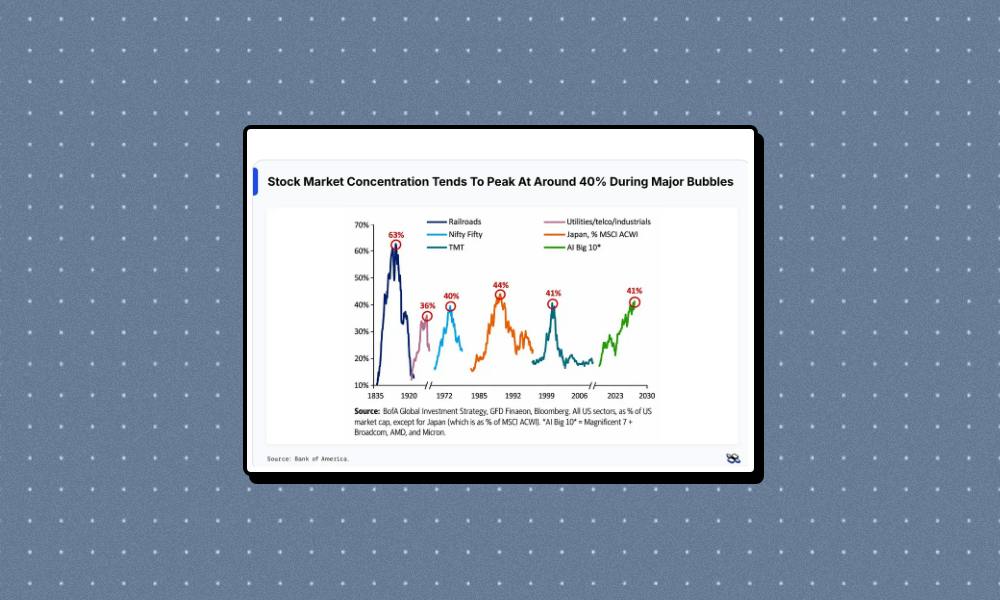
History doesn't repeat, but it often rhymes. Right now, the rhyme is about market concentration—and it's sounding familiar to anyone who remembers past bubbles.
From the Nifty Fifty stocks of the 1970s to Japan's late-1980s boom and the dot-com mania of the late 1990s, a small group of winners swelled to roughly 40% of the total market before things turned. Today, the so-called "AI Big 10"—the Magnificent Seven plus Broadcom, AMD, and Micron—are back in that neighborhood.
That doesn't mean stocks are about to crash. But it does mean there's less room for error, especially when the bond market is turning up the heat.
What is the AI Big 10?
The Magnificent Seven—Apple, Microsoft, Nvidia, Alphabet, Amazon, Meta, and Tesla—have been the engines of the recent bull market, driven by excitement over artificial intelligence. Add in chipmakers Broadcom, AMD, and Micron, and you have a group of companies that now command an outsized share of the entire U.S. stock market's value.
Concentration itself isn't a problem. When a handful of companies are growing fast and delivering strong profits, investors naturally bid up their prices. The issue is what happens when expectations get stretched.
At 40% of the market, these stocks carry enormous weight. If one or two stumble, the whole index feels it. And because so much of the market's gains are tied to these names, a setback for AI could ripple far beyond the tech sector.
Why the bond market matters
Stocks don't exist in a vacuum. When bond yields rise, they compete with stocks for investor dollars. Higher yields on safe government bonds make riskier assets like stocks less attractive, and they also raise borrowing costs for companies.
Recent moves in the bond market have been notable. Yields on long-term U.S. Treasuries have climbed to multi-year highs, with the 10-year yield hovering near 5.2% in recent sessions. That's a level that has historically made investors nervous, as higher yields put pressure on stock valuations.
For the AI Big 10, which trade at premium valuations, the math gets trickier. A higher discount rate means future earnings are worth less today. So even if companies deliver solid results, the market may not reward them as generously as it did when yields were lower.
What this means for everyday investors
For most people, the takeaway isn't to panic or try to time the market. It's to understand the risks.
If you own a broad index fund, you're already heavily exposed to these mega-cap tech names. That's been a great ride, but it also means your portfolio's fate is tied to a small group of companies. Diversification—spreading your money across different sectors, geographies, and asset classes—can help cushion the blow if concentration unwinds.
It's also worth remembering that past episodes of extreme concentration didn't end overnight. The Nifty Fifty took years to peak and then deflate. Japan's bubble persisted for years. The dot-com boom lasted longer than many expected. But when the correction came, it was sharp.
That's why the phrase "little room for error" is so apt. With valuations stretched and bond yields rising, any disappointment—a weak earnings report, a slowdown in AI spending, or a surprise inflation reading—could trigger outsized moves.
What to watch next
Investors will be watching several things closely. First, earnings from the AI Big 10. If they continue to beat expectations, the concentration may be justified. If they stumble, the fallout could be severe.
Second, the bond market. If yields keep climbing, it could force a reassessment of stock valuations across the board. Recent headlines show stocks steadying even as yields hover near 5.2%, but that calm may not last.
Third, the broader economy. With oil prices elevated and geopolitical tensions simmering, there are plenty of potential shocks. Asian markets have already wobbled as oil and Treasury yields climb.
None of this is a prediction of doom. Markets can stay concentrated for a long time, and these companies are genuinely profitable and innovative. But the historical record is clear: when a small group of stocks reaches about 40% of the market, the margin for error shrinks. For investors, that's a reason to stay diversified, keep expectations realistic, and avoid betting everything on the hottest names.