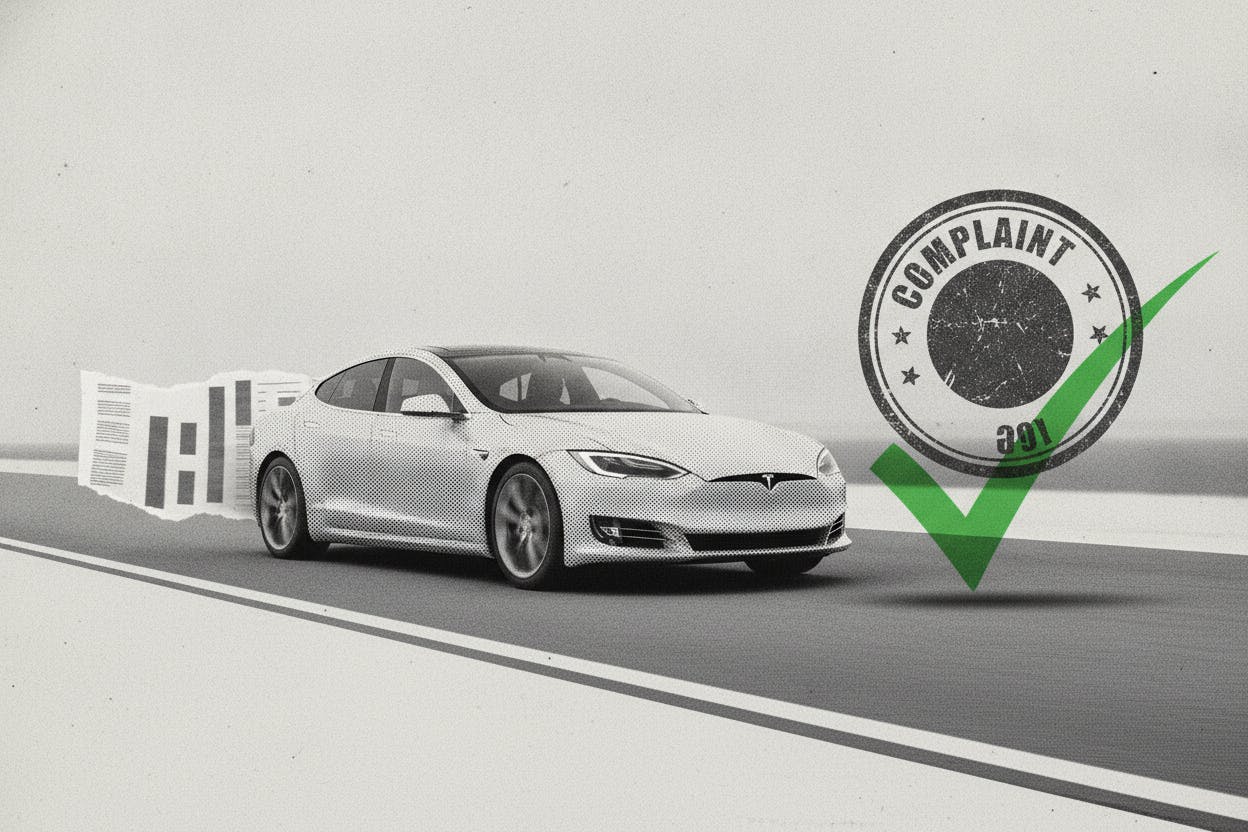
The National Highway Traffic Safety Administration (NHTSA) has closed its 2022 investigation into complaints that roughly 695,000 Tesla Model 3 and Model Y vehicles could decelerate unexpectedly. The decision removes a regulatory overhang that had weighed on the electric vehicle maker's stock, though other safety reviews remain open.
What the probe found
NHTSA opened the review after receiving reports that some Tesla vehicles would slow down without warning, potentially creating a hazard on the road. The agency examined data from the affected vehicles and concluded that the condition showed a low demonstrated safety risk. Crucially, the deceleration did not cause cars to drift out of their lane or meaningfully reduce following distances in a way that led to collisions.
The regulator also noted that complaints fell sharply after Tesla issued software updates in early 2022. According to Reuters, filings showed complaints dropped from roughly 300 when the review began to 45 in 2024, 19 in 2025, and just three so far in 2026. That steep decline supported the view that the issue was fading rather than spreading.
NHTSA typically escalates to a recall when a pattern appears both persistent and tied to real-world crash risk. In this case, the agency determined that neither condition was met, allowing it to close the probe without further action.
What it means for Tesla investors
An open safety review is an open-ended liability for any automaker. If regulators escalate, fixes can mean direct costs such as service time, warranty reserves, and parts, plus legal exposure and reputational damage. By ending the 2022 investigation, NHTSA is effectively lowering the odds of a forced recall or mandated hardware remedy tied to this specific deceleration issue.
That doesn't guarantee Tesla won't face other safety scrutiny. The company has faced multiple NHTSA investigations over the years, including probes into its Autopilot driver-assistance system. But the closure of this particular review removes one discrete regulatory overhang that can weigh on how investors price the company's future cash outflows.
For context, Tesla has been navigating a complex regulatory landscape globally. In Europe, the company has seen registrations surge in France, Denmark, and Sweden in June, while in China, Shanghai deliveries rose 24% in June even as rival BYD's Q2 EV sales topped 557,000. The company also recently launched a three-row Model Y L at $61,990 to boost US demand.
Broader implications for the EV sector
The closure of this probe is a reminder that regulatory risk is a normal part of the automotive industry. All major automakers face periodic safety reviews, and most are resolved without recalls. For Tesla, which has a history of pushing software updates to address issues remotely, the ability to fix problems over the air can reduce the cost and complexity of regulatory compliance.
Investors should note that Tesla's stock has been sensitive to regulatory news. Earlier this year, Tesla dropped 8% on a delivery beat without future outlook, while Rivian jumped 8.3% on a raised forecast. The company's Q2 deliveries beat forecasts as focus shifts to robotaxi and AI initiatives.
What to watch next
While this specific probe is closed, investors should keep an eye on other ongoing regulatory reviews involving Tesla, particularly those related to Autopilot and Full Self-Driving (FSD) systems. The company's valuation increasingly depends on its ability to deploy autonomous driving technology at scale, and any regulatory action in that area could have far greater financial implications than a deceleration issue affecting older models.
For now, the closure of the 2022 probe is a modest positive for Tesla shareholders. It removes one source of uncertainty and confirms that the software fix Tesla deployed appears to have worked. But with the stock trading at elevated multiples relative to traditional automakers, the company still faces plenty of other risks — from competition to demand to the pace of its autonomous driving rollout.