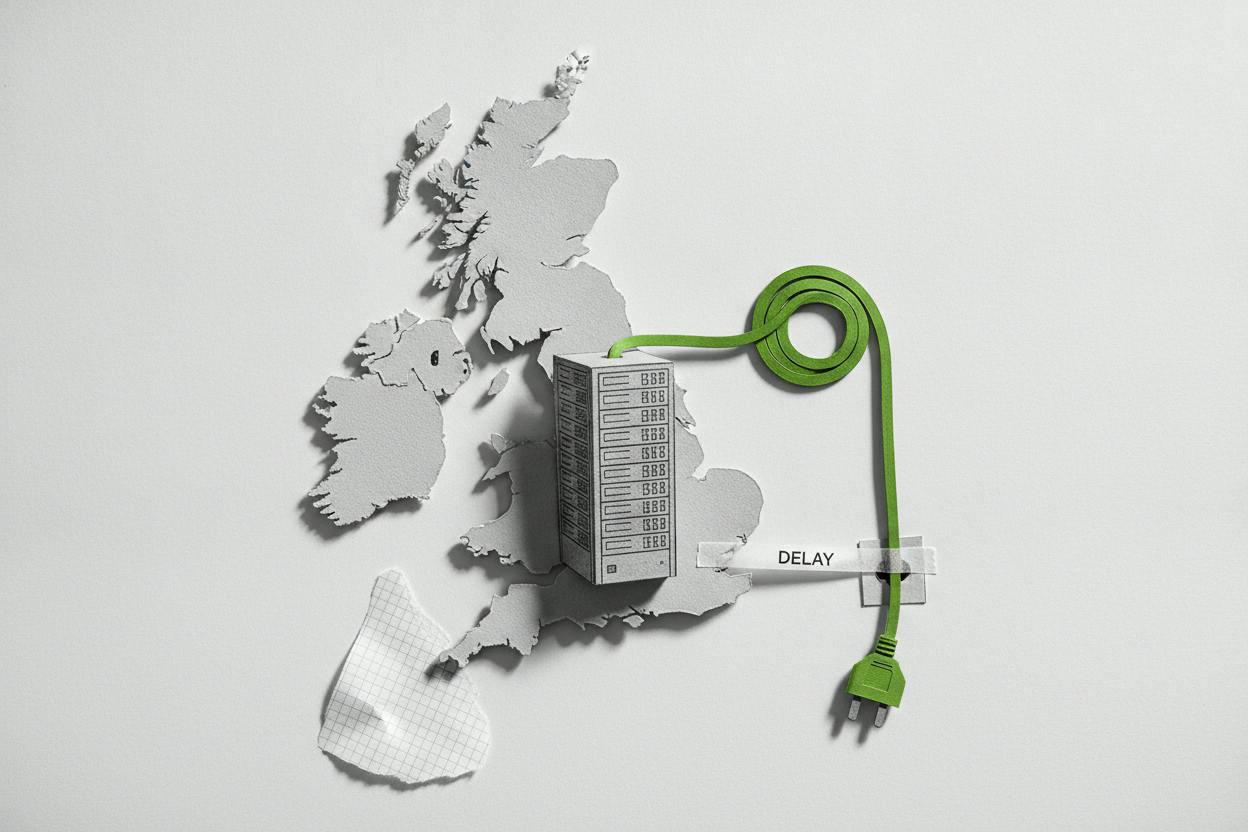
Nscale, a British cloud-computing and data-center developer with backing from Nvidia, is considering pushing its planned $35 billion initial public offering on the New York Stock Exchange into next year, according to a report from the Telegraph. The potential delay comes shortly after Reuters reported that Microsoft declined an option to expand an agreement for additional computing capacity at Nscale's Texas data center.
For a company preparing to ask public-market investors for tens of billions of dollars, that sequence matters. Data centers are among the most capital-hungry businesses in technology, and the companies that build them typically rely on long-term capacity contracts to make their future revenue easier to forecast. When a major customer like Microsoft chooses not to take extra space, it does not necessarily signal a broken relationship — but it does widen the range of possible outcomes for how full a facility will be and how quickly it will generate cash.
Why the Microsoft decision carries weight
Microsoft is what the industry calls a hyperscaler: one of a handful of enormous cloud providers whose computing needs are large enough to anchor entire data-center campuses. Hyperscaler contracts are the gold standard for developers because they convert huge upfront construction costs into steadier, more predictable cash flows. Investors evaluating a data-center IPO tend to focus less on the headline valuation and more on how much capacity is already spoken for under signed leases.
That is why the Texas decision can matter more to Nscale's listing math than Nvidia's involvement. Nvidia's backing is a strong signal about the company's technology and its position in the artificial-intelligence supply chain, but it is not the same as a customer committing to buy capacity for years. In IPO pricing, signed demand is what supports a premium valuation. Without it, underwriters and prospective shareholders may demand a higher expected return — which effectively means a lower valuation — or simply advise waiting until more contracts are in hand.
The distinction is subtle but important. A passed option is not a cancellation. It may reflect Microsoft's own shifting priorities, a timing mismatch, or a decision to spread its capacity across multiple providers. Still, for a company heading toward a public listing, the market reads it as one fewer piece of locked-in revenue to point to in a prospectus.
What it means for investors
The central question for Nscale is not whether it can list at all, but whether it can list anywhere near the $35 billion figure that has been discussed. That number implies a significant premium, and premiums in AI infrastructure are increasingly tied to contracted demand rather than brand-name backers alone. If the company pauses, it would underscore a broader rule in the sector: marquee investors help open doors, but pricing power comes from customers who have signed on the dotted line.
For everyday investors, the story is a reminder about how to read AI-related listings. When a data-center or cloud company goes public, the most useful details are often buried in the fine print — how much of its future capacity is under contract, how long those contracts run, and how concentrated its customer base is. A single large customer can make revenue look stable, but it also creates risk if that customer slows its spending or shifts to a competitor.
The timing also matters for the wider market. A string of AI-linked companies have been testing investor appetite, and each listing tends to be treated as a sentiment gauge for the group. A delayed or repriced Nscale IPO could cool enthusiasm for other AI infrastructure offerings, while a successful listing at a strong valuation could do the opposite. Investors watching this space should pay attention not just to whether deals get done, but to the terms they get done on.
There is also a macro backdrop to consider. Higher interest rates raise the cost of financing the enormous construction budgets that data centers require, which makes contracted revenue even more valuable to lenders and shareholders alike. In that environment, companies with visible, signed demand tend to be rewarded, while those still building out their customer base may face more skepticism.
Nscale has not confirmed the delay, and the Telegraph report cites people familiar with the matter. The company could still proceed with a listing this year, or it could wait for additional contract announcements that would strengthen its pitch. Either way, the episode highlights a theme that has been building across the AI trade: the market is increasingly distinguishing between companies with real, committed customers and those riding the broader wave of enthusiasm.
For investors, the takeaway is to watch the contracts, not just the backers. Nvidia's name carries weight, but in the end, the pricing of an AI infrastructure IPO rests on how much demand is already locked in — and that is the number that will determine whether Nscale's $35 billion ambition holds up.