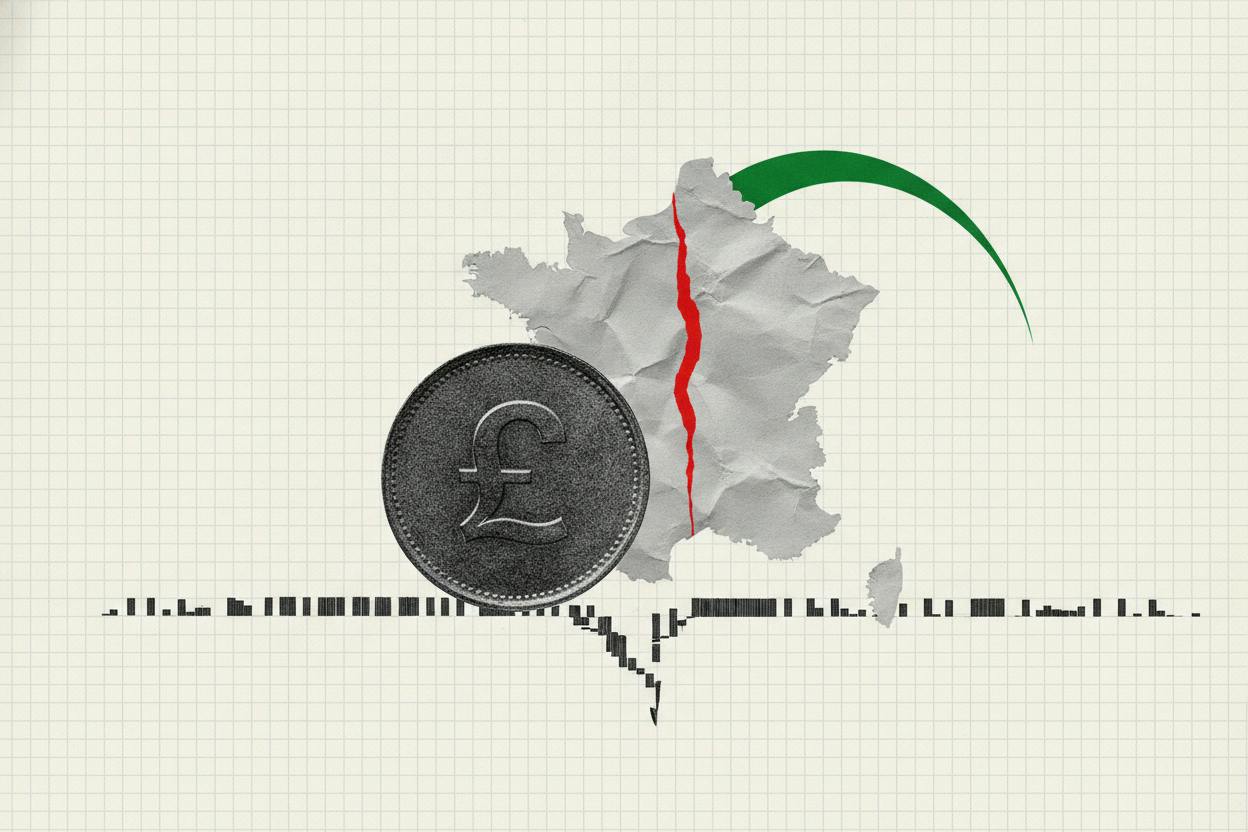
The pound has climbed to its strongest level against the euro in 17 months, as political unrest in France and a spike in energy prices weighed on the shared currency. Sterling traded at 84.11 pence per euro, after briefly touching 83.95, while the euro slipped across the board.
The move reflects a divergence in sentiment between the UK and the euro area. In France, protests have raised concerns about political stability and the government's ability to manage its budget, prompting investors to demand a higher premium to hold French government bonds. That premium, measured by the gap between French OAT yields and ultra-safe German Bund yields, is a quick gauge of perceived political and fiscal risk in the euro area's second-largest economy.
Why the euro is under pressure
The euro's weakness is not just about France. Natural gas prices have jumped to a four-year high, and because the euro area imports much of its energy, higher energy costs tend to hit the region's economy harder than the UK's. That dynamic has made investors more cautious about the euro, especially with the European Central Bank (ECB) facing a tricky balancing act between fighting inflation and supporting growth.
French unrest has added to the euro's troubles. French stocks have already been dragged lower by the protests, and the political uncertainty is spilling into currency markets. Investors are increasingly asking whether France can keep its fiscal house in order, and that question is pushing them to demand more yield to hold French debt.
The situation is fluid, and the euro has slipped as markets brace for upcoming central bank meetings. Both the ECB and the Bank of England are expected to make policy decisions soon, and their tone will be crucial for currency moves.
What's supporting the pound
On the UK side, the pound has been helped by a run of economic data that has been slightly better than expected. That has boosted confidence in the UK's growth prospects, even as the Bank of England navigates its own inflation challenge.
There is also a sense of fiscal confidence in the UK, with the government seen as more stable than its French counterpart. That contrast has made sterling an attractive alternative to the euro for investors looking for exposure to European assets without the political risk.
The pound's strength is also a reminder that currency markets are often driven by relative perceptions. It's not that the UK economy is booming—it's that the euro area is facing more immediate problems.
What it means for investors
For everyday investors, a stronger pound has mixed implications. If you're planning a holiday in Europe or buying goods priced in euros, a stronger pound means your money goes further. But for UK companies that earn a large share of their revenue in euros or dollars, a stronger pound can hurt profits when those earnings are converted back into sterling.
That's why the FTSE 100, which is full of multinational companies, often moves in the opposite direction to the pound. The FTSE 100 recently posted its best week in six months, but if the pound keeps rising, that could put pressure on the index's export-heavy constituents.
For bond investors, the widening gap between French and German yields is a signal to pay attention to political risk in the euro area. It's a reminder that even in a currency union, individual countries can face very different borrowing costs depending on how investors view their fiscal health.
Energy prices are another factor to watch. If gas prices stay high, that could keep inflation elevated in Europe and force the ECB to keep interest rates higher for longer. That would likely keep the euro under pressure, and could also have knock-on effects for global markets.
Ultimately, the pound's rise is a story about relative weakness rather than outright strength. The euro is struggling with political and energy headwinds, while the UK is seen as a relatively safer bet. But currency markets can turn quickly, and much will depend on how the central banks respond in the coming weeks.
For now, investors should keep an eye on the French political situation, gas prices, and any signals from the Bank of England and the ECB. Any of these could shift the balance and send the pound or the euro in a new direction.



