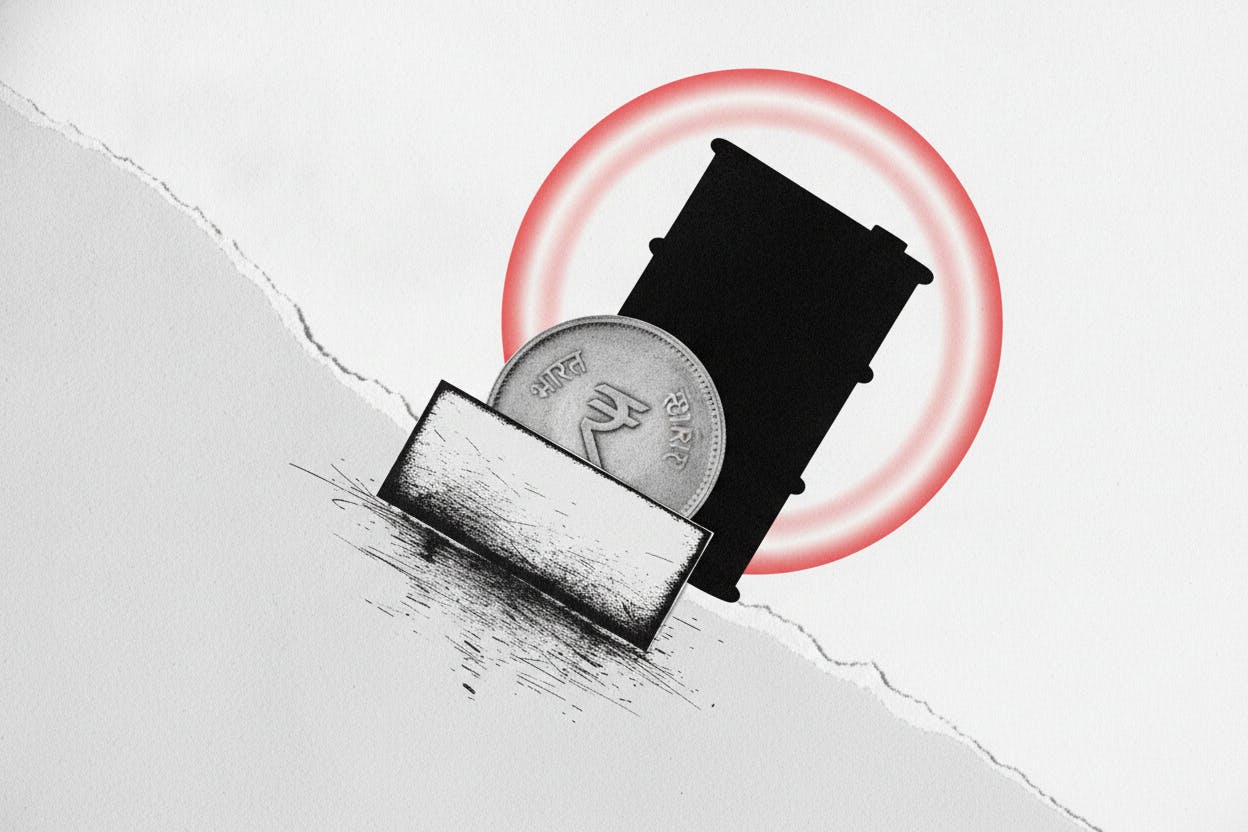
The Reserve Bank of India (RBI) appears to have stepped into currency markets on Tuesday after the Indian rupee weakened to near its all-time low and Brent crude oil surged past $100 a barrel, traders said.
State-run banks were seen selling dollars on behalf of the central bank around the local market open, helping the USDINR pair move back toward 96.50 after briefly testing 96.80. The rupee remains close to the record low it hit in May, underscoring the persistent pressure on Asia's third-largest economy from global commodity prices and geopolitical tensions.
Why Oil Matters for the Rupee
India imports nearly 90% of the crude oil it consumes, making it one of the world's most vulnerable major economies to oil price spikes. When Brent crude rises, Indian refiners and importers need to buy more dollars to pay for those shipments, increasing demand for the U.S. currency and pushing the rupee lower.
A weaker rupee, in turn, makes imports even more expensive, feeding into domestic inflation. That creates a difficult balancing act for the RBI, which must weigh supporting the currency against the risk of depleting foreign exchange reserves or tightening monetary policy too aggressively.
This latest bout of strength in Brent crude is tied to heightened security risks in the Middle East, a region that supplies a significant share of the world's oil. The combination of supply fears and robust demand has pushed prices back above the psychologically important $100 level, a threshold that historically has triggered volatility in emerging-market currencies.
How RBI Intervention Works
The RBI does not typically announce currency intervention in real time. Instead, it operates through state-run banks that act as its agents, buying or selling dollars in the foreign exchange market to influence the rupee's value. When the rupee is under selling pressure, the RBI sells dollars from its reserves to increase supply and support the currency.
This tool is effective in the short term but has limits. India's foreign exchange reserves, while substantial, are not infinite. Persistent intervention can also signal to markets that the central bank is uncomfortable with the rupee's level, sometimes inviting further speculation.
Traders said Tuesday's intervention helped stabilize the rupee after it briefly touched 96.80, but the currency remains under pressure. The broader trend for the rupee will depend on how long oil stays above $100 and whether the RBI is willing to continue defending specific levels.
What It Means for Investors
For everyday Indian investors, a weaker rupee has several implications. First, it makes imported goods more expensive, from electronics to machinery, which can feed into broader inflation. That erodes purchasing power and may prompt the RBI to keep interest rates higher for longer, affecting everything from home loans to corporate borrowing costs.
Second, companies that rely heavily on imported raw materials—such as oil refiners, airlines, and chemical manufacturers—see their costs rise when the rupee falls. That can squeeze profit margins and weigh on stock prices. On the other hand, export-oriented sectors like information technology and pharmaceuticals benefit because their revenues in dollars are worth more in rupee terms.
The broader Indian stock market has already felt the heat. The Nifty 50 index fell for a fourth straight day as oil above $98 stirred inflation fears, and the latest move past $100 adds to that anxiety. Investors are watching whether the RBI's intervention can provide lasting relief or if the rupee will test new lows.
For those with international exposure—whether through foreign stocks, mutual funds, or travel—the weaker rupee means that any investments denominated in dollars or other hard currencies become more valuable in rupee terms. But it also means that any future repatriation of funds from India to overseas accounts becomes more expensive.
Looking Ahead
The immediate focus for currency markets will be on the trajectory of oil prices and any further statements from the RBI. Central bank officials have repeatedly said they do not target a specific exchange rate but aim to prevent excessive volatility. That suggests the RBI will continue to intervene as needed, but may allow the rupee to gradually weaken if oil stays elevated.
Global factors also matter. The U.S. Federal Reserve's interest rate decisions, the strength of the dollar, and risk appetite for emerging-market assets all influence the rupee's path. If the Fed holds rates steady as inflation pressures mount from oil and tariffs, as some analysts expect, that could keep the dollar strong and add to pressure on the rupee.
For now, the RBI's intervention has bought some time, but the underlying pressures remain. Investors should keep an eye on oil prices and the central bank's next moves as key signals for the rupee's direction.