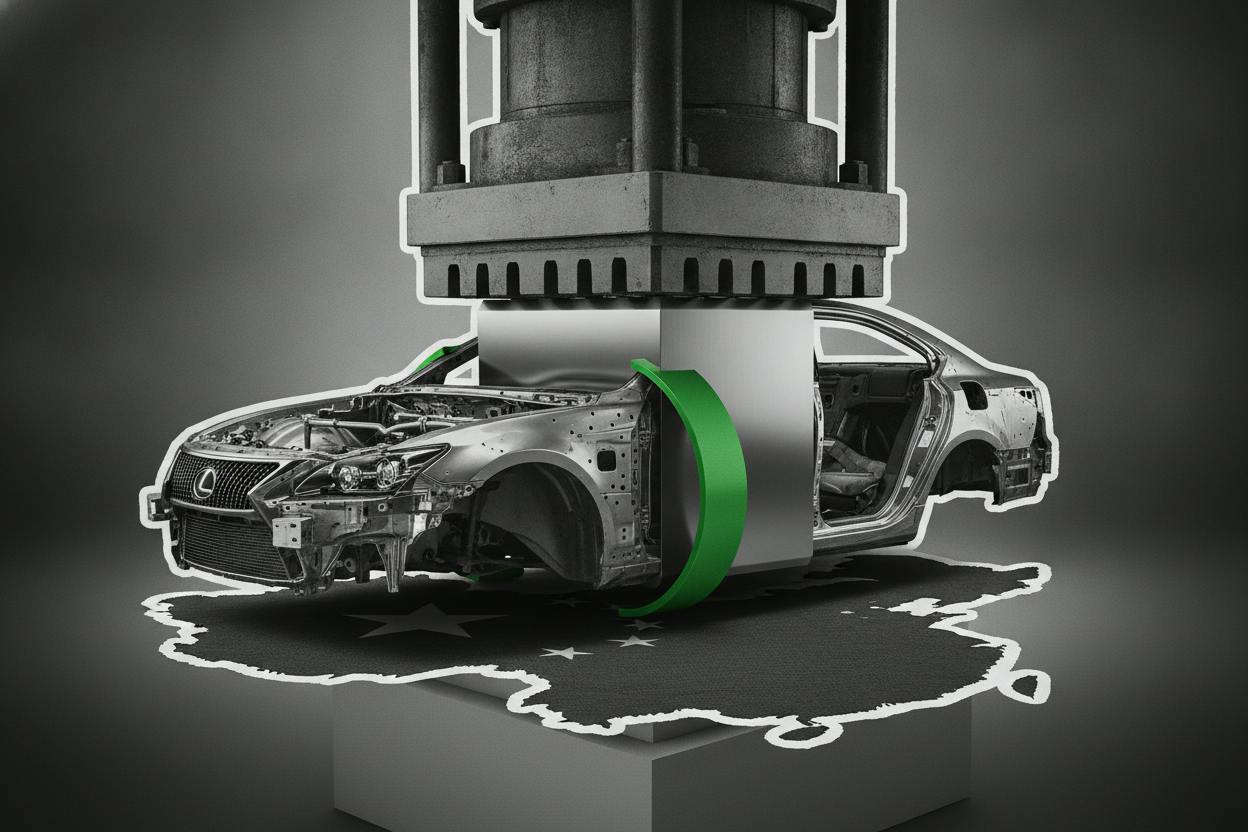
Toyota is quietly borrowing a page from Tesla's playbook. The Japanese automaker is developing its own version of "gigacasting" — the technique of casting large sections of a car's body in a single piece — and it plans to use it at a new Lexus electric vehicle plant in China, according to a Bloomberg report.
The company's chief technology officer, Hiroki Nakajima, told Bloomberg that trial runs of the new process are already underway in Japan. The equipment will be deployed at the Lexus EV plant in China, which is still under construction and is expected to begin production by next year.
What is gigacasting?
Gigacasting is a manufacturing method that uses enormous presses to form a vehicle's body structure in one piece, rather than welding together dozens of smaller stamped metal parts. The name comes from the "giga" presses that Tesla introduced, which can exert thousands of tons of pressure.
The appeal is straightforward: fewer parts, fewer welds, less assembly time, and lower costs. Instead of a complex jigsaw puzzle of components, a carmaker can produce a single, large casting that forms the backbone of the vehicle. This can also reduce the weight of the car, which is especially important for electric vehicles, where every kilogram affects range.
Toyota is not the only traditional automaker exploring this approach. Many in the industry are watching Tesla's manufacturing innovations closely, as the company has used gigacasting to cut production costs and speed up assembly. But Toyota's move is notable because it is developing the equipment in-house, rather than buying it from a supplier.
Why China matters for Lexus EVs
China is the world's largest market for electric vehicles, and it is also one of the most competitive. Domestic brands like BYD and Nio have been aggressive in pricing and technology, while global players like Tesla have built large factories there. For Toyota, which has been slower to embrace EVs than some rivals, the Lexus plant in China is a key part of its electrification push.
The new plant is expected to produce Lexus EVs for the Chinese market, where the brand has a strong reputation for quality and luxury. By adopting gigacasting, Toyota hopes to make its EVs more cost-competitive and profitable, even as price wars rage in the Chinese auto market.
The move also comes at a time when China's auto sector is drawing investor attention, with strong loan growth supporting the broader economy but automakers facing margin pressures. Toyota's decision to localize production in China is a bet that it can compete effectively in this environment.
What it means for investors
For everyday investors, this story is less about a single factory and more about the broader shift in how cars are made. Gigacasting is not just a cost-saving trick; it is a strategic advantage that could determine which automakers thrive in the EV era.
Toyota has long been known for its "lean manufacturing" system, which emphasizes efficiency and quality. By adopting gigacasting, it is signaling that it is willing to rethink its production methods to stay competitive. If successful, the technology could help Toyota improve margins on its EVs, which have been a drag on profitability compared with its hybrids and gasoline cars.
But there are risks. Gigacasting is a relatively new technique, and it is not without challenges. Large castings can be difficult to repair, and any defect in a single piece can be costly. Toyota's in-house approach also means it is taking on the development risk itself, rather than relying on established suppliers.
Investors should also keep an eye on the broader EV market. Global EV sales slipped 2% recently, with Europe hitting a record but the US and China retreating. That slowdown could pressure all automakers, including Toyota, to cut costs and prices.
For Toyota shareholders, the Lexus plant in China is a project worth watching. If gigacasting works as planned, it could be a template for future Toyota and Lexus factories worldwide. If it stumbles, it could delay the company's EV ambitions and add to costs.
For now, the news is a reminder that the EV race is not just about batteries and software — it is also about how efficiently cars are built. And Toyota, the world's largest automaker by sales, is clearly not content to let Tesla have the manufacturing edge all to itself.