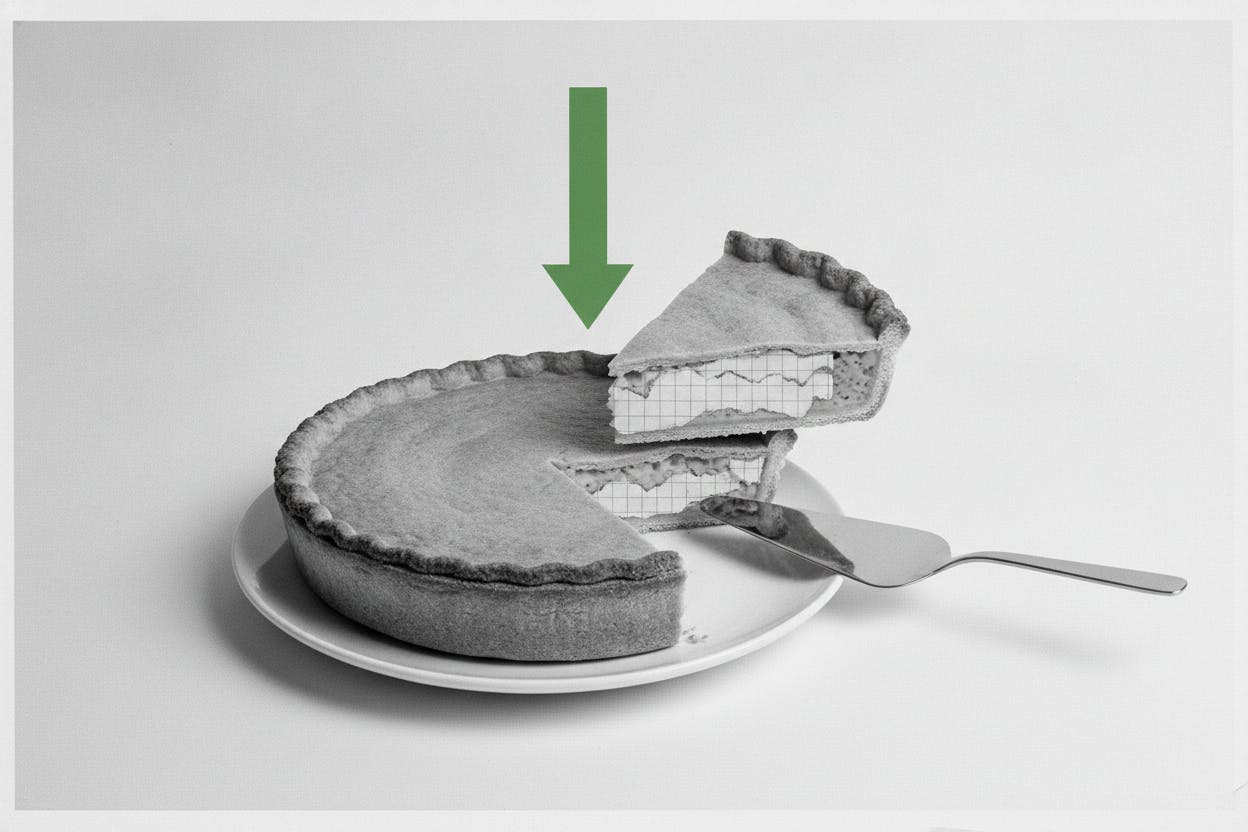
The share of the U.S. economy going to workers in wages and benefits fell to a record low in the second quarter, according to new data from the Bureau of Labor Statistics (BLS). Labor's share of output slipped to 52.9%, down from 53.7% in the first quarter, marking the lowest reading since the government began tracking the series in 1947.
The decline comes even as productivity—the amount of output produced per hour worked—grew faster than wages. In plain terms, the economy is producing more per worker, but workers aren't capturing a proportional share of that extra output. Instead, a larger slice is flowing to business owners, shareholders, and other capital holders.
What is labor's share of output?
Labor's share of output is a key measure of how the economic pie is divided. It represents the total compensation paid to employees—including wages, salaries, and benefits like health insurance and pensions—as a percentage of the nation's gross domestic product (GDP). When this share falls, it means a smaller portion of the value created by the economy is going to workers, with the rest going to profits, rents, and other forms of capital income.
The second-quarter drop is notable not just for its size but for its historical significance. The previous record low was set in the first quarter of 2024, when the share dipped to 53.1%. The new reading of 52.9% breaks that record, underscoring a long-term trend that has seen labor's share drift downward over recent decades, with occasional rebounds during recessions.
Economists watch this metric closely because it influences everything from consumer spending to corporate profit margins. When workers earn a smaller share, they have less money to spend, which can weigh on demand for goods and services. Conversely, a higher share for capital often boosts corporate earnings, at least in the short term.
Why productivity is outpacing wages
The BLS data shows that productivity growth has been robust, driven in part by investments in technology, automation, and more efficient business processes. At the same time, wage growth has been more moderate, even with a tight labor market in recent years. This gap means that while each hour of work produces more value, workers' pay hasn't kept pace.
Several factors contribute to this divergence. Companies have increasingly adopted labor-saving technologies, from software to robotics, which boost output per worker without requiring proportional increases in headcount or pay. Globalization and shifts in industry mix also play a role, as higher-productivity sectors like tech and finance tend to have lower labor shares than labor-intensive industries like retail or hospitality.
It's worth noting that the second-quarter data is preliminary and could be revised. But the trend is consistent with what many economists have observed: a structural shift in how income is distributed between labor and capital.
What it means for investors
For investors, a falling labor share is a double-edged sword. On one hand, it can be a tailwind for corporate profit margins. When companies keep a larger share of the revenue they generate, earnings tend to rise, which can support stock prices. This is one reason equity markets have remained resilient even as the economy has slowed.
On the other hand, if workers' purchasing power erodes over time, consumer demand could weaken, eventually hitting the top line of companies that rely on discretionary spending. Retailers, restaurants, and other consumer-facing businesses could feel the pinch if wage growth continues to lag productivity gains.
The data also has implications for monetary policy. The Federal Reserve pays close attention to wage inflation as it tries to bring price increases back to its 2% target. Slower wage growth could give the Fed more room to cut interest rates, which would be a positive for stocks and bonds. However, if productivity gains are not shared with workers, the political pressure for higher minimum wages or other redistributive policies could increase, potentially affecting corporate costs.
For everyday investors, the key takeaway is that the balance of power in the economy has shifted further toward capital. That's generally supportive for corporate earnings, but it also raises questions about the sustainability of consumer-led growth. As you evaluate your portfolio, consider how companies are positioned in this environment—those with strong pricing power and efficient operations may be better able to navigate a world where labor costs are a smaller share of the pie.
In the broader market context, this report adds to a mixed picture. While European stocks hit record highs on strong earnings, U.S. investors are weighing the implications of a cooling labor market. Some companies, like Datadog and Parker-Hannifin, have raised outlooks on strong demand, but others are cautious about the months ahead.
Ultimately, the record low in labor's share is a reminder that the benefits of economic growth are not evenly distributed. For investors, it's a signal to watch both corporate margins and consumer health as the year progresses.