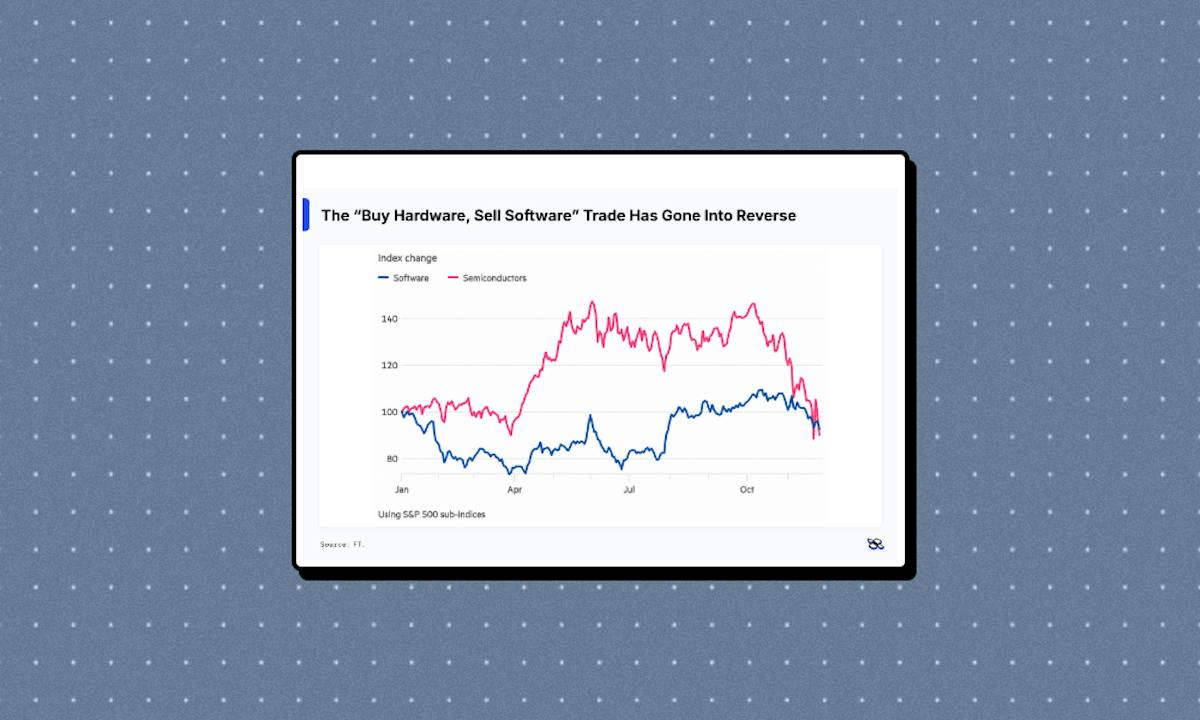
Wall Street's artificial intelligence trade has taken a sharp turn. After months of favoring chipmakers and dumping software stocks, investors are now reversing course. Software shares are staging a comeback, while once-beloved semiconductor companies are taking a beating.
Earlier this year, the narrative was simple: AI would make traditional software products obsolete. Investors worried that increasingly sophisticated AI tools—capable of writing code, generating content, and automating tasks—would eat into the revenues of established software firms. As a result, software stocks were sold off heavily.
At the same time, chipmakers were the darlings of the market. The logic was straightforward: AI requires massive computing power, and that means more chips. Investors piled into semiconductor stocks, betting on booming demand for AI infrastructure.
But the market has a way of humbling the crowd. According to the latest data, the S&P 500 indexes tracking the two sectors are now neck and neck, both slightly down for 2026. The gap that once seemed insurmountable has closed, and the trade has effectively flipped.
Why the reversal?
Several forces are at play. For one, the initial panic over software being rendered obsolete may have been overdone. Many software companies are adapting, integrating AI into their products rather than being displaced by it. Meanwhile, the chip sector, which had run up so dramatically, is now facing reality checks—whether it's concerns about valuation, supply chain issues, or simply profit-taking after a massive rally.
This dynamic is reminiscent of other market rotations where sentiment overshoots in one direction and then snaps back. The recent slide in Nvidia and hot inflation data have already signaled that the AI trade was not immune to broader market pressures.
Investors are also paying closer attention to interest rates. With the Federal Reserve signaling a potential pause or even a shift in policy, growth stocks—including both software and chips—are sensitive to changes in the discount rate. Higher rates tend to hurt high-valuation tech names more, and the market's anticipation of possible rate hikes is adding to the volatility.
What it means for everyday investors
For the average investor, this reversal is a reminder that sector rotations can be swift and unpredictable. Chasing last year's winners is no guarantee of future returns. The AI boom is still real, but the market is becoming more discerning about which companies will actually benefit in the long run.
If you hold a diversified portfolio, you're likely feeling the effects of this rotation in both directions. Your software holdings may be recovering, while your chip stocks might be dragging. The key is to focus on the fundamentals rather than the hype.
It's also worth noting that both sectors are still down for the year. This isn't a story of one sector winning and the other losing—it's a story of both correcting from earlier extremes. The broader market has been under pressure from tariff worries and economic uncertainty, and tech is not immune.
Looking ahead
Investors will be watching several key indicators in the coming weeks. Earnings reports from major software and chip companies will provide clarity on how AI is actually impacting their bottom lines. Any guidance about AI-related spending will be scrutinized.
Also on the radar: the Federal Reserve's next moves. If rates stay higher for longer, that could continue to weigh on tech valuations. Conversely, any hint of easing could give both sectors a boost.
The AI trade isn't over—it's just evolving. The days of blindly buying chipmakers and dumping software are likely behind us. Instead, investors are becoming more selective, rewarding companies that can demonstrate real AI-driven growth, whether they make the chips or the software that runs on them.
For now, the message is clear: in the world of AI investing, the pendulum can swing fast. Staying diversified and keeping a long-term perspective remains the most reliable strategy.