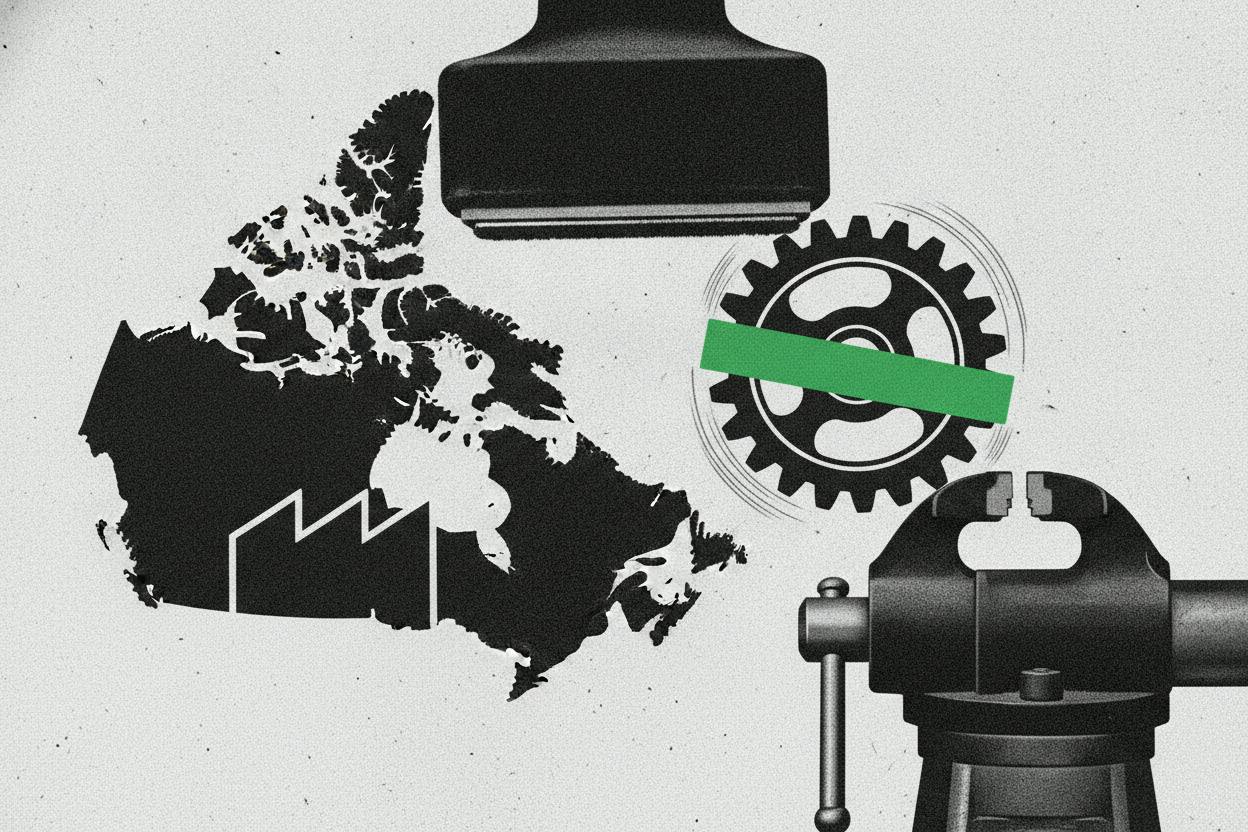
Canada's push to bring factories back home is running into a hard reality: the manufacturing base it's trying to rebuild has shrunk to a sliver of the economy. In a Wednesday note, National Bank of Canada said Ottawa's recent policy mix is finally tilting toward reindustrialization, but the country is starting from a much smaller and less competitive position than it once had.
What the bank is saying
National Bank of Canada, one of the country's major lenders, pointed to a combination of tax, regulatory, energy, and defense policies that are now designed to encourage domestic production. The shift reflects growing concerns about supply chain security and national resilience, themes that have gained traction globally since the pandemic disrupted trade.
Canada does have some natural advantages in this race. It boasts relatively clean electricity, which is increasingly valuable as companies and governments push for lower-carbon manufacturing. It also has a reputation for higher environmental and labor standards, which can appeal to consumers and investors who care about how goods are made.
But the bank's note highlights a sobering statistic: manufacturing now accounts for just 8% of Canada's economy. That's down significantly from past decades, when factories were a much larger engine of growth and employment. The decline is not unique to Canada—most advanced economies have seen manufacturing's share shrink as services have grown—but it means the base for any reindustrialization push is thin.
Productivity lag is the bigger problem
Perhaps more concerning than the size of the sector is its productivity. National Bank of Canada notes that productivity has lagged wage growth since 2000. In plain terms, Canadian workers are earning more, but they aren't producing proportionally more per hour. That gap can make it harder for domestic manufacturers to compete internationally, because higher wages without matching output push up unit costs.
This is a familiar challenge for Canada. Economists have long pointed to weak business investment in machinery, equipment, and technology as a key reason productivity lags. When companies don't invest in the tools that make workers more efficient, wage gains can outpace what the economy can sustainably support.
The bank's assessment suggests that policy changes alone won't be enough. Rebuilding manufacturing requires not just incentives to build factories, but also the productivity improvements that make those factories viable over the long term.
What it means for investors
For everyday investors, this story is less about picking a specific stock and more about understanding the backdrop for Canadian assets. A successful reindustrialization push could boost sectors like industrials, materials, and energy, and it could support the Canadian dollar. But the starting point matters: a manufacturing sector that is small and less productive will take time and sustained investment to turn around.
Investors should also watch how the policy mix evolves. The bank's note comes as Canada has been courting investment with measures like fast-tracked tax rulings for large projects and major bank commitments, such as TD's pledge to finance energy, AI, and defense. These are signs that the government and financial sector are serious about attracting capital.
There are also broader signals of momentum. Canada's investment summit recently drew CA$500 billion in pledges, and specific projects like Selkirk Copper's Minto project are landing on the country's deal radar. These developments suggest that the reindustrialization narrative is gaining traction, even if the manufacturing base remains small.
However, the productivity gap is a warning sign. If Canada can't improve how efficiently its factories operate, the reindustrialization push could stall. Investors should look for signs that companies are investing in automation, digital tools, and worker training—the kinds of investments that lift productivity and make higher wages sustainable.
The road ahead
National Bank of Canada's note is a reality check for anyone hoping that a few policy tweaks will quickly revive Canadian manufacturing. The country has the right ingredients in many ways—clean energy, strong institutions, and a skilled workforce—but the sector it's trying to rebuild is smaller and less competitive than it was a generation ago.
The next few years will be telling. If productivity starts to catch up with wages, and if the manufacturing share of the economy stabilizes or grows, then the reindustrialization push will be working. If not, Canada may find itself with more factories but still struggling to compete on the global stage.
For now, the message for investors is to watch the fundamentals, not just the headlines. Policy support is helpful, but it's the combination of investment, productivity, and global demand that will determine whether Canada's manufacturing revival is real or just a policy ambition.