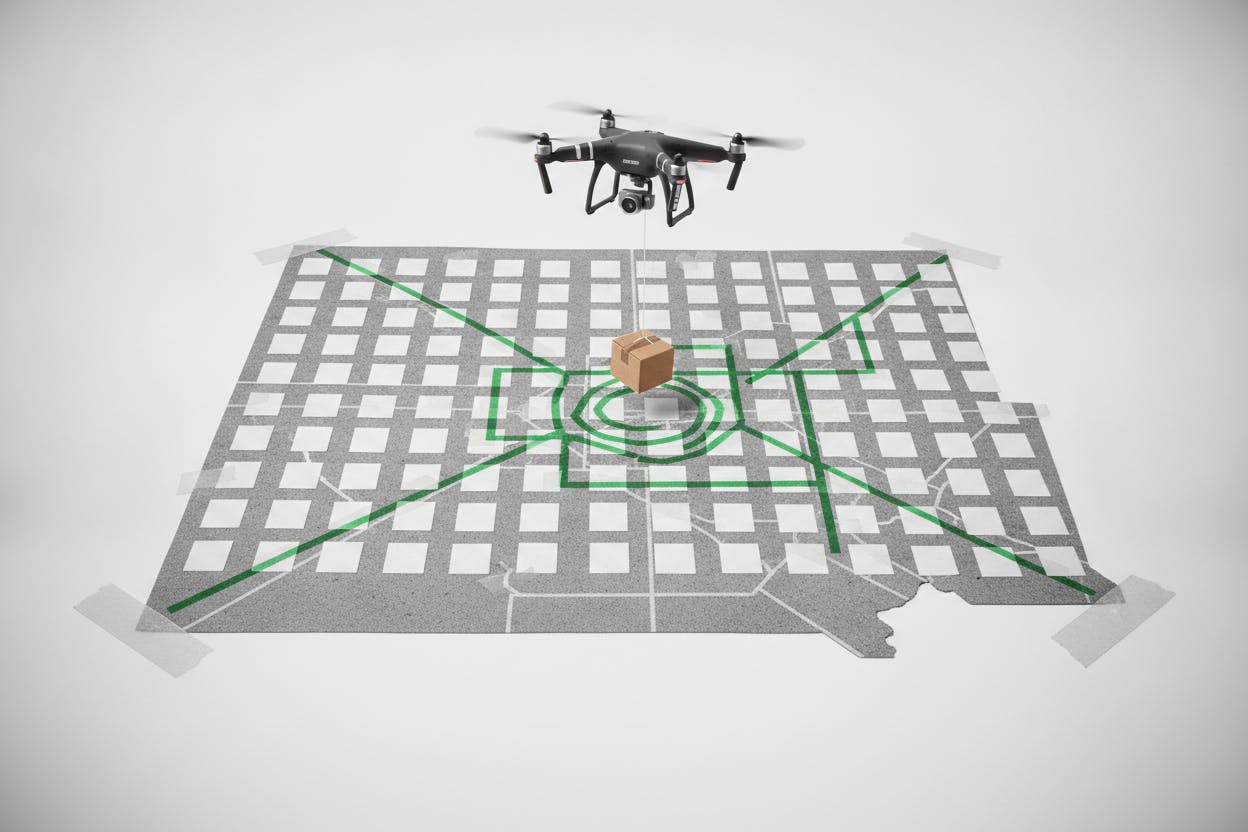
Drone delivery startup Manna has selected Tulsa, Oklahoma as the launchpad for its first full-scale US network, aiming to cover 90% of the city's residents with autonomous drop-offs within the next year. The Irish-founded company told Reuters it expects to begin flights for partners including DoorDash, McDonald's, and Uber Eats within two months, then expand to as many as 40 launch bases across Tulsa by mid-2027.
Why Tulsa?
Manna believes the US Southwest is where drone delivery can prove itself as a viable business, not just a flashy prototype. The company's pitch is that its network can remain relatively capital-light because each base needs only about four car parking spaces. That density matters in a crowded field: rivals like Zipline, Alphabet's Wing, and Amazon's Prime Air are all trying to turn pilot programs into repeatable delivery networks.
Manna has logged over 300,000 deliveries, mostly in Ireland, but recently paused service there due to unclear planning rules. Tulsa thus doubles as a regulatory test: can faster, more predictable local permitting allow the company to scale city-wide and then copy-paste the model into places like Texas or Arizona using its recent $50 million Series B funding?
What It Means for Investors
Manna's 40-base Tulsa plan is a unit economics test for last-mile delivery. City-wide coverage only pays off if drones stay busy. By sprinkling many small bases across Tulsa, Manna can shorten average flight distances and cut dead time between jobs, letting each drone complete more deliveries per hour. More drops per drone spreads fixed costs like equipment, monitoring staff, and maintenance over a larger number of orders, bringing the cost per delivery down.
If that math holds up, it's the kind of proof partners like DoorDash, McDonald's, and Uber Eats typically want before expanding beyond a single-city pilot. And it would raise the bar for rivals like Wing and Prime Air, shifting the contest from flight demos to who can build dense, permitted networks at scale.
For everyday investors, the key question is whether drone delivery can achieve the density and cost efficiency needed to compete with traditional delivery methods. Manna's Tulsa experiment will be closely watched as a bellwether for the industry's commercial viability. If successful, it could pave the way for broader adoption and potentially reshape last-mile logistics. However, the sector remains highly competitive, and regulatory hurdles could still slow progress.
In related news, dealmakers have been targeting drones and other sectors in a surge of cross-sector M&A, as reported in Dealmakers Target Drones, Drugs, and Gold in a Surge of Cross-Sector M&A. Meanwhile, Amazon's fastest growth now comes from Brazil's fresh food delivery, as noted in Amazon Now's Fastest Growth Comes from Brazil's Fresh Food Delivery.