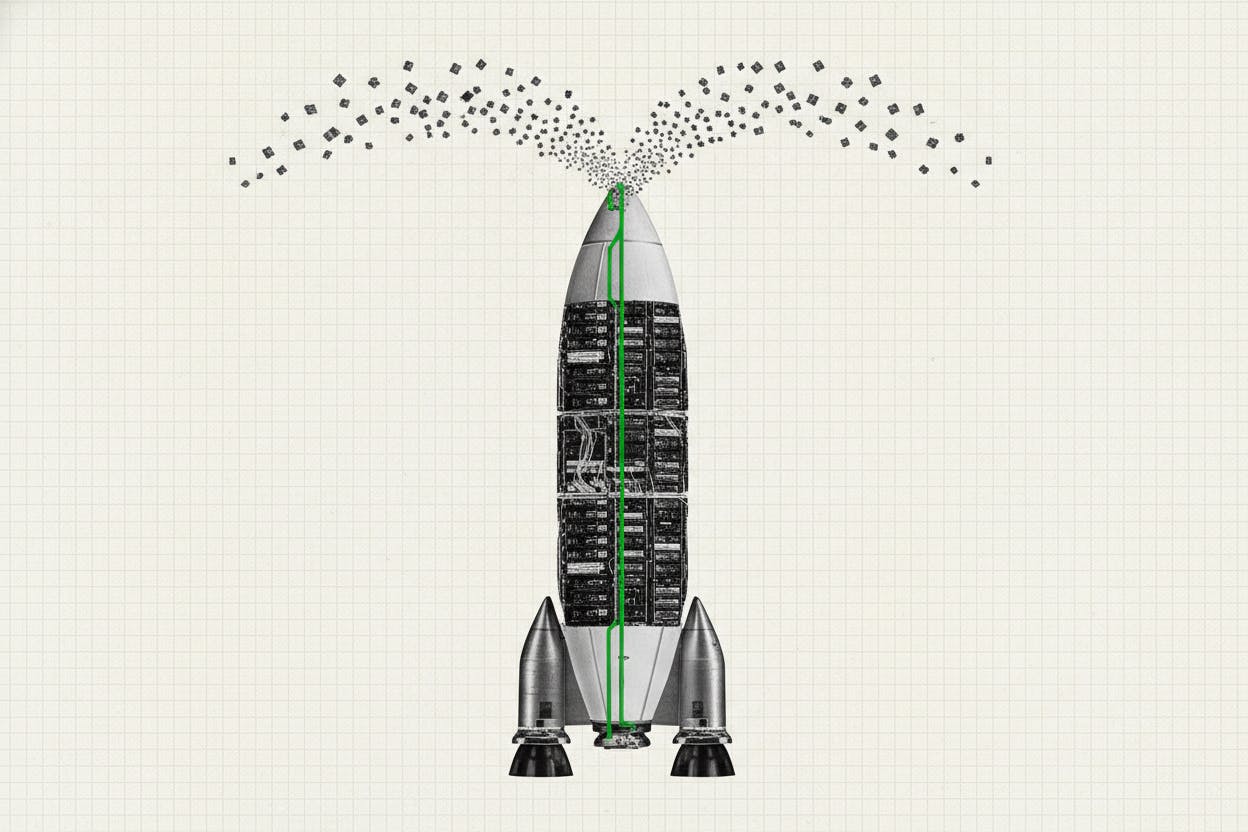
Investment bank UBS has initiated coverage of SpaceX with a bold thesis: the company's Starship rocket isn't just a next-generation launch vehicle—it's the technological linchpin that could transform SpaceX into a dominant player in artificial intelligence infrastructure.
In a note to clients Tuesday, UBS analysts argued that Starship's fully reusable design could unlock three major revenue streams: launch dominance, lower-cost upgrades to the Starlink satellite internet network, and a new category of orbital computing services. The bank estimates SpaceX's total revenue could reach approximately $660 billion by 2031, a figure that underscores the potential scale of these ambitions.
What UBS Sees in Starship
Starship, currently in development at SpaceX's Texas facility, is designed to be the most powerful rocket ever built. Its key innovation is full reusability—both the booster and the upper stage are meant to be flown multiple times, dramatically reducing the cost per launch. UBS believes this capability would give SpaceX a commanding lead in the commercial launch market, where it already dominates with the Falcon 9 rocket.
But the bank's analysis goes beyond launches. Lower launch costs would allow SpaceX to deploy newer, more capable Starlink satellites at a faster pace and lower expense. Starlink, which already provides broadband internet to over 4 million subscribers globally, could see its economics improve significantly, making it more competitive with terrestrial internet providers and opening new markets.
Perhaps most intriguingly, UBS suggests Starship could enable orbital computing—running data processing tasks in space. The idea is that satellites equipped with powerful processors could handle AI workloads that benefit from being in orbit, such as real-time Earth observation analysis or low-latency communications relay. While still speculative, the concept aligns with broader industry interest in space-based data centers, as highlighted by recent projects like Aegis and McMaster's fast-charge storage project for AI data centers.
SpaceX's Growing Financial Footprint
SpaceX has evolved from a private rocket company into a multifaceted business. Its launch services are used by NASA, the Pentagon, and commercial satellite operators. Starlink has become a major revenue driver, with millions of subscribers and growing enterprise contracts. The company also has a nascent space tourism business and is developing the Human Landing System for NASA's Artemis moon missions.
UBS's $660 billion revenue projection by 2031 implies a compound annual growth rate that would far outpace most companies. For context, SpaceX was valued at around $350 billion in its most recent funding round. The bank's estimate suggests the company could nearly double that valuation in revenue alone within a decade, assuming Starship delivers on its promises.
SpaceX's financial trajectory has already attracted significant investor attention. The company recently joined the Nasdaq-100 index, triggering $4.3 billion in index fund buying. However, some analysts remain cautious about the Starlink hype, with MoffettNathanson recently arguing that launch dominance is the real engine, while Starlink's valuation may be overdone.
What It Means for Investors
SpaceX remains a private company, so most everyday investors cannot buy shares directly. However, the UBS analysis has implications for publicly traded companies in related sectors.
First, if Starship succeeds, it could pressure legacy launch providers like United Launch Alliance (a joint venture of Boeing and Lockheed Martin) and international competitors like Arianespace. Lower launch costs would also benefit satellite operators and space-based services companies, potentially boosting stocks in those areas.
Second, the orbital computing concept ties into the broader AI infrastructure boom. Major tech companies are spending heavily on data centers and AI compute capacity, with Big Tech turning to debt markets as AI infrastructure spending nears $700 billion. If space-based computing becomes viable, it could create new opportunities for companies involved in satellite manufacturing, space-grade semiconductors, and data center design.
Third, the UBS note highlights the growing intersection of space and AI. While SpaceX is not an AI company per se, its assets—launch capability, satellite network, and potential orbital compute—position it to benefit from AI-driven demand for data processing and connectivity. This theme is echoed in other developments, such as SpaceXAI and Cursor's joint AI model release.
The Risks Ahead
UBS's optimistic scenario depends on Starship achieving its technical goals. The rocket has completed several test flights but has not yet reached orbit with a payload. Regulatory hurdles, technical delays, and competition from other reusable rocket developers (such as Blue Origin's New Glenn) could slow progress.
Additionally, the $660 billion revenue figure assumes successful execution across multiple business lines, each with its own risks. Starlink faces competition from terrestrial 5G and fiber networks, as well as other satellite constellations. Orbital computing is unproven and would require significant investment in new hardware and software.
For now, the UBS note adds to a growing chorus of analysts who see SpaceX as more than a rocket company. Whether Starship delivers on its promise will determine if that vision becomes reality.