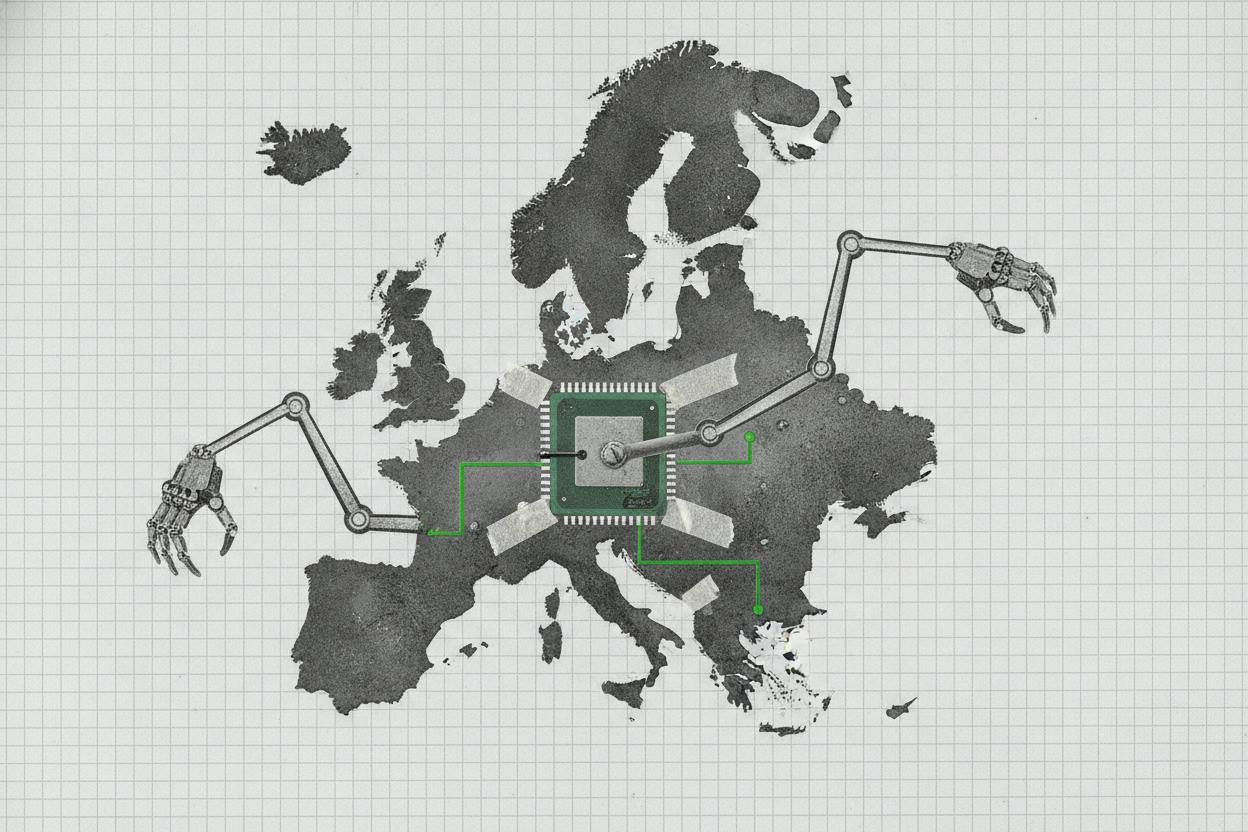
Europe's biggest chipmakers are making a case that the future of artificial intelligence isn't just in the cloud—it's on the factory floor, in cars, and inside robots. At an industry event in Munich, the CEOs of Infineon, STMicroelectronics, and NXP argued that "physical AI"—AI that operates in the real world—is a "must win" for the region.
The pitch is simple: while US tech giants dominate data-center AI, Europe's strength lies in the chips that go into machines that must work reliably under harsh conditions. These companies supply the power management chips, sensors, and microcontrollers that let equipment sense its environment, make decisions, and act. That's a different game from the high-performance processors that power chatbots and image generators.
Why physical AI is different
Data-center AI runs in controlled environments with steady power and cooling. Physical AI, by contrast, has to function in the real world—where temperatures swing, machines vibrate, and power surges happen. A chip that fails in a factory robot or a car's braking system isn't just an inconvenience; it can be a safety hazard.
That's where European chipmakers say they have an edge. They've spent decades building components for automotive and industrial applications, where reliability is non-negotiable. Their chips are designed to last for years, even decades, in tough conditions. This is a different skill set from the cutting-edge process technology that companies like Nvidia use for AI training.
But the shift to physical AI is still in its early stages. STMicroelectronics, for example, said it has installed an Oversonic humanoid robot at its semiconductor plant in Malta. It's a tangible demonstration, but Reuters notes that the broader adoption is mostly pilots rather than mass deployments.
The competitive landscape
Europe's chipmakers aren't alone in chasing these opportunities. US rivals like Texas Instruments and onsemi are also targeting the same "sockets" inside long-lived industrial and automotive platforms. These are the connectors and slots where chips get designed into a system, and once a chip is qualified, it's hard to replace.
That's both a challenge and an opportunity. The challenge is that getting a chip designed into a new platform takes time—customers require extensive testing and validation before they trust a component with safety-critical functions. The opportunity is that once a chip is in, it tends to stay in for years, providing a steady stream of revenue.
For investors, this means the AI cycle for these companies could look very different from the rapid growth seen in data-center AI. Instead of a quick spike, expect a slower ramp that could stretch over multiple years. The key metric to watch isn't just quarterly revenue, but how many new design wins these companies secure in robotics, vehicles, and factory automation.
What it means for investors
If you own shares in Infineon, STMicroelectronics, or NXP, or if you're considering them, the physical AI story is worth understanding. The long-term potential is real—robots and smart factories are likely to become more common, and these companies are well-positioned to supply the chips they need. But the timeline is uncertain.
Adoption will likely be gradual. Before a factory robot or a self-driving vehicle can make real-world decisions, it must undergo rigorous testing in simulated environments, plus reliability and safety checks that can take months or years. That can delay the initial sales ramp, even if the eventual payoff is substantial.
On the other hand, once a chip is qualified and designed into a platform, switching to a competitor is costly and disruptive. That can lock in revenue for years, making these businesses more predictable over the long term. So the question for earnings isn't just whether AI demand spikes quickly, but whether these firms can turn today's trials into durable design wins faster than their US competitors.
For now, the market is watching closely. European stocks have been volatile recently, with oil price swings and broader risk sentiment affecting the region. But the physical AI narrative could give these chipmakers a distinct story to tell investors, one that's less about hype and more about steady, reliable growth.
As with any emerging technology, there's a risk that the promise outpaces the reality. But for Europe's chip industry, physical AI isn't just a trend—it's a bet on the region's industrial heritage. Whether it pays off will depend on how quickly the world's factories and roads fill with machines that can think for themselves.