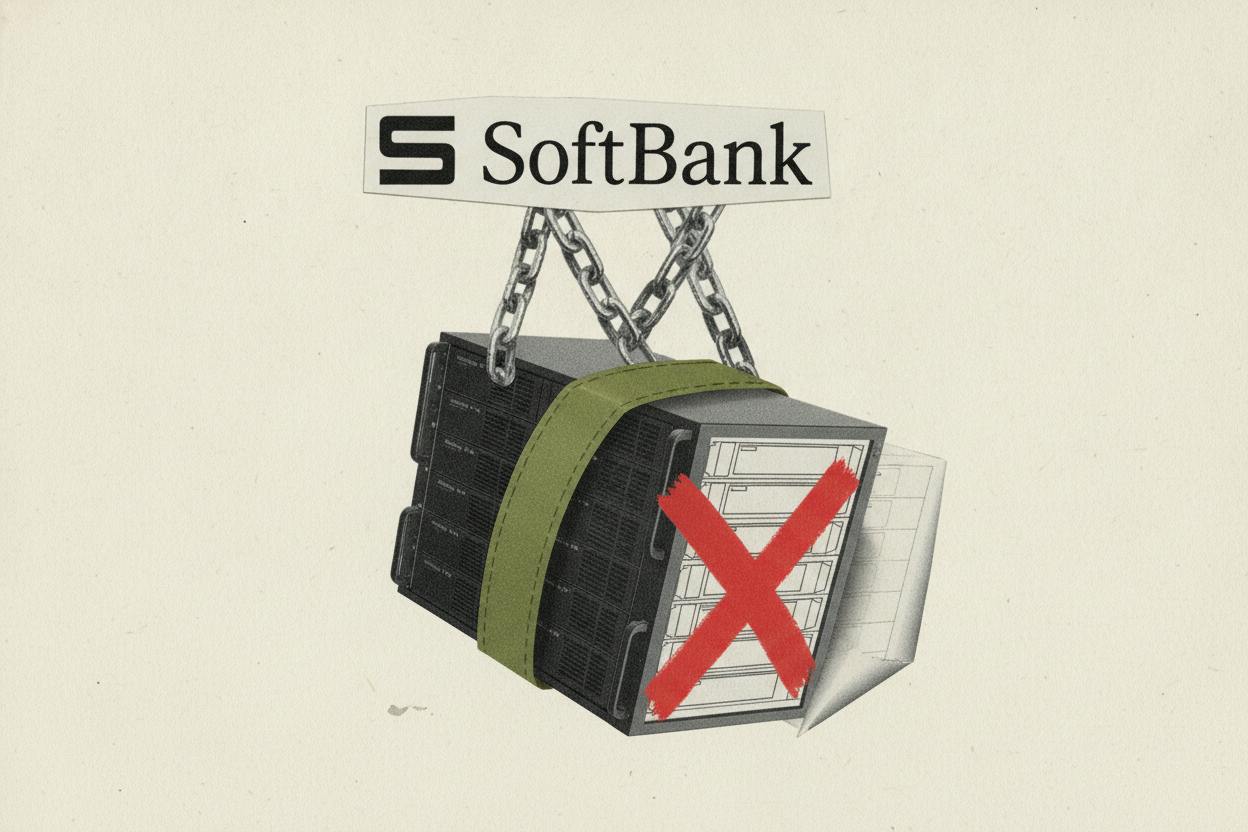
SoftBank Group on Tuesday reported a net loss of 1.1 trillion yen (about $7 billion) for the July-September quarter, a sharp reversal from the 2.5 trillion yen profit it posted a year earlier. The swing underscores the heavy financial toll of the company's aggressive push into artificial intelligence infrastructure.
The loss was driven by two main factors: large prepayments for US data center capacity and a $3.7 billion write-down tied to revised AI infrastructure plans. At the same time, SoftBank's financing costs more than doubled to 462 billion yen, reflecting higher borrowing expenses as it funds long-term commitments.
What happened?
A year ago, SoftBank's bottom line got a big boost from investment gains, including the rising value of its stake in OpenAI. This quarter, the picture was different. The company paid upfront to secure data-center capacity—a move that can lock in scarce resources but also ties up cash before any revenue flows in. When those plans changed, SoftBank had to mark down the value of equipment investments, resulting in the $3.7 billion charge.
That combination—early cash outlays, shifting plans, and climbing borrowing costs—turns a thematic bet on AI into a balance-sheet challenge. When money is committed early and projects get revised later, capital gets trapped, and the risk of further write-downs increases. Meanwhile, higher financing costs make holding those long-term positions more expensive, which can squeeze returns even if AI demand remains strong.
The OpenAI stake and the IPO question
SoftBank's most significant AI investment is its reported $64.6 billion purchase of a 13% stake in OpenAI. That deal, announced earlier this year, positions SoftBank as a major backer of one of the most prominent AI companies. But with OpenAI's initial public offering now pushed to next year, a potential source of liquidity is delayed.
Investors are increasingly focused on how long SoftBank can carry these costs. The 462 billion yen financing bill in a single quarter makes the timing of an OpenAI IPO more important. If the listing slips further, SoftBank could look more like a leveraged bet on AI spending, making its shares more volatile than day-to-day changes in AI sentiment.
What it means for investors
For everyday investors, SoftBank's results highlight a less glamorous side of the AI boom. Building out AI infrastructure requires enormous upfront spending, and companies like SoftBank are taking on significant financial risk to secure a position in the space.
Prepaying for data centers can secure scarce capacity, but it also locks up cash before revenue shows up. When plans get revised, those early commitments can turn into losses, as the $3.7 billion charge shows. Add financing costs of 462 billion yen in a single quarter, and the story becomes as much about funding as it is about AI.
That's when investors tend to apply a bigger “holding-company discount”—a markdown for complex groups whose assets are hard to value and not easily sold. SoftBank's sprawling portfolio, which includes stakes in numerous tech companies, makes it difficult to assess its true worth. If the OpenAI listing timeline keeps slipping, that discount could widen, causing SoftBank's shares to swing more than the underlying AI sentiment would suggest.
For context, SoftBank has been a major player in the AI infrastructure buildout, with recent commitments including a $1.85 billion investment in Malaysian data centers alongside Grab and PETROS. That deal, announced earlier this year, is part of a broader push to expand AI capacity across Asia.
Analysts have noted that while tighter permits may slow AI data center construction, they are unlikely to stop it, as UBS pointed out in a recent report. That suggests the demand for AI infrastructure remains strong, but the financial strain on companies like SoftBank could persist.
For investors, the key takeaway is that AI's promise comes with real costs. SoftBank's quarter is a reminder that even the most enthusiastic backers of AI must manage their balance sheets carefully. As the company waits for an OpenAI IPO, it will need to keep financing costs under control and avoid further write-downs to reassure shareholders.
In the meantime, SoftBank's shares are likely to remain sensitive to news about its AI investments and the broader tech market. The Nikkei's recent rebound, driven partly by SoftBank and chip stocks, shows how closely the company's fortunes are tied to market sentiment.
Ultimately, SoftBank's AI gamble is a high-stakes bet that could pay off handsomely if AI demand continues to grow. But as this quarter shows, the path to profits is not smooth, and the costs of the buildout are real. Investors should watch how SoftBank manages its cash flow and debt, and whether the OpenAI IPO materializes as expected.