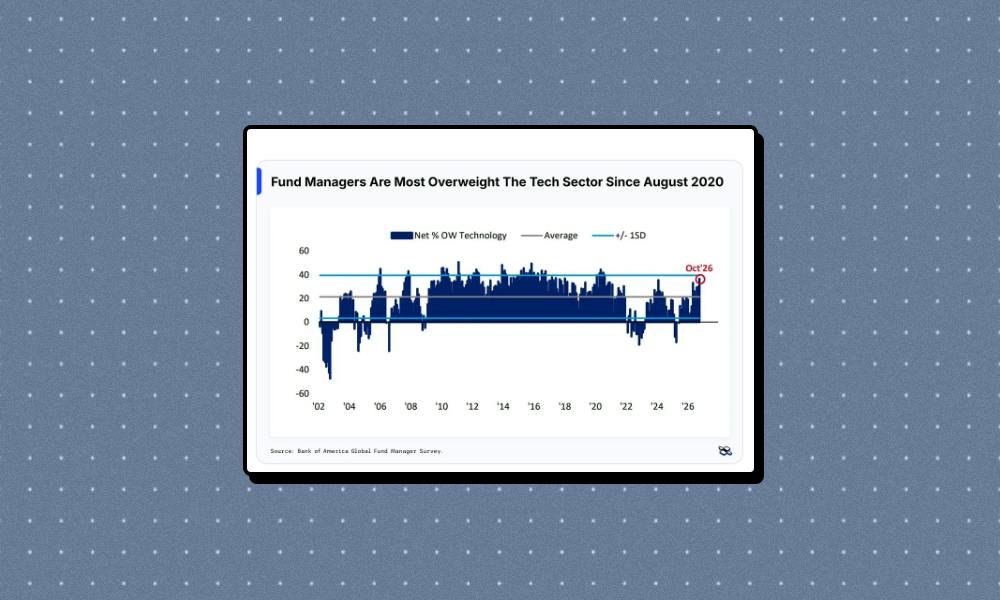
Fund managers are piling into technology stocks at a pace not seen since the height of the pandemic-era rally, according to Bank of America's latest monthly survey. A net 37% of fund managers now say they are overweight tech stocks, up from 30% last month and the highest reading since August 2020.
The surge in enthusiasm comes as artificial intelligence continues to power a remarkable bull market. The S&P 500 has climbed nearly 120% over its four-year run, with AI-related companies leading the charge. But beneath the optimism, a growing number of investors are questioning whether the technology's hefty price tag will translate into equally impressive returns.
AI bubble fears are rising
The survey reveals a notable split in sentiment. Some 45% of fund managers expect an AI bubble to form by 2027, while 42% disagree. That's a narrow margin, but it signals that doubts are creeping in even as allocations hit record highs.
"It's a classic tension," said one strategist familiar with the survey. "Investors don't want to miss out on the AI trade, but they're also wary of getting burned if expectations outpace reality."
The pattern echoes the late-1990s dot-com boom, when investors kept pouring money into tech stocks even as valuations stretched to extremes. While AI is widely seen as a transformative technology, the gap between current valuations and near-term earnings remains a concern for many.
What's driving the enthusiasm?
AI's potential to reshape industries—from software and cloud computing to healthcare and manufacturing—has made it the dominant theme in equity markets. Companies that develop AI chips, models, and applications have seen their share prices soar, and fund managers are eager to stay exposed.
The survey's findings also reflect a broader market dynamic: with interest rates still elevated and economic growth uncertain, investors are gravitating toward companies with strong growth prospects. Tech, and AI in particular, offers that growth, even if it comes with higher risk.
At the same time, the rally has been remarkably broad. The S&P 500's four-year bull run has lifted nearly every sector, but tech has been the clear leader. That concentration has prompted some analysts to warn that a pullback in AI stocks could have outsized effects on the broader market.
What it means for everyday investors
For ordinary investors, the survey is a reminder that even professional money managers are wrestling with the same questions about AI's long-term value. The fact that allocations are at multi-year highs suggests that the market is pricing in a lot of optimism.
History shows that when sentiment gets this stretched, volatility often follows. That doesn't mean the AI trade is doomed—many experts believe the technology will deliver real productivity gains—but it does mean investors should be prepared for swings.
Diversification remains a key tool. While it's tempting to chase the hottest sector, spreading investments across different asset classes and industries can help cushion the blow if AI stocks stumble. For those already heavily exposed to tech, it may be worth reviewing whether their portfolio aligns with their risk tolerance.
The survey also comes as investors are awaiting fresh US inflation data, which could influence the Federal Reserve's next moves. Higher-for-longer interest rates would put additional pressure on high-valuation tech stocks, while cooling inflation could provide a tailwind.
In the meantime, the debate over AI's price tag is unlikely to fade. As one fund manager put it, "The question isn't whether AI will change the world—it's whether the market has gotten ahead of itself."
For now, the answer appears to be a cautious yes, with a growing minority bracing for a bubble. But as the survey shows, that hasn't stopped anyone from piling in.