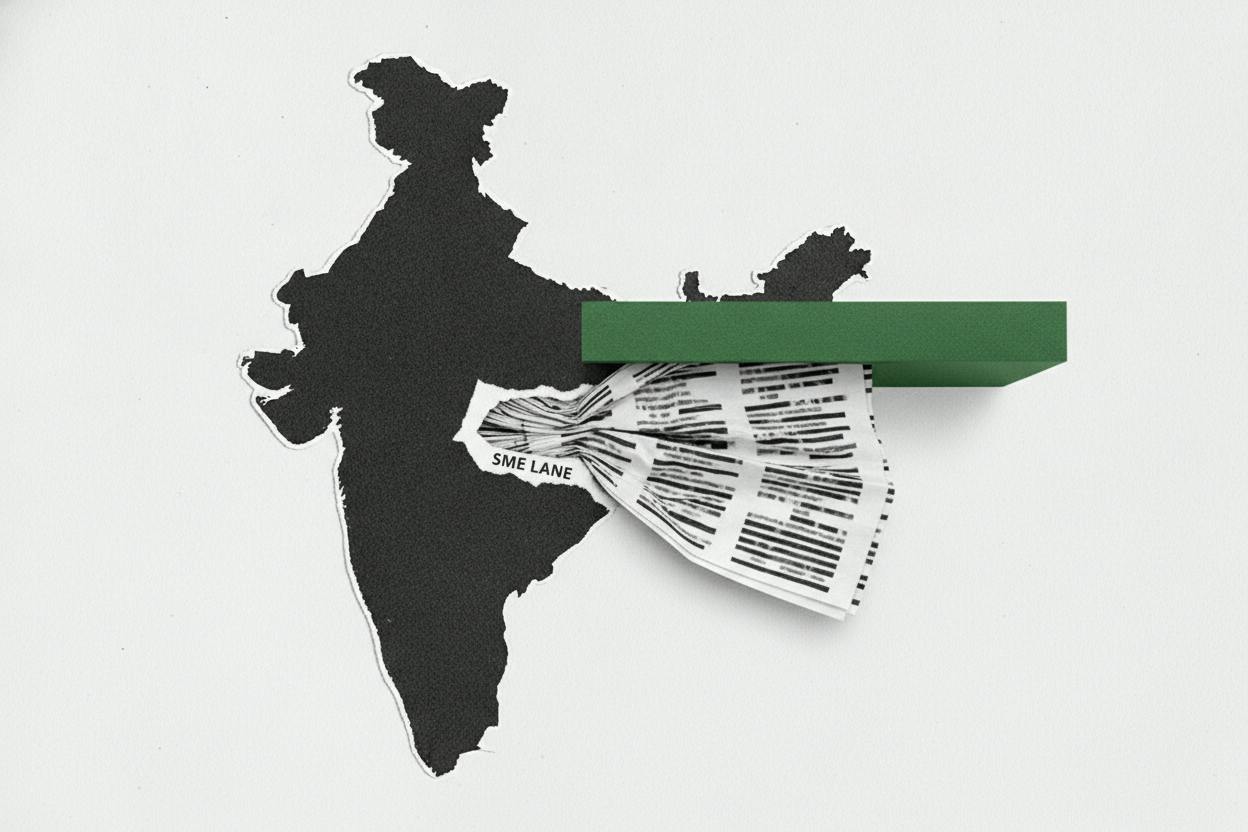
India's securities regulator, the Securities and Exchange Board of India (SEBI), is moving to tighten the rules for small and medium-sized enterprise (SME) initial public offerings (IPOs). The proposed changes come after a wave of smaller-company listings that have drawn scrutiny over pricing and investor protection.
Under the plan, SEBI would raise the profit bar for companies seeking to list on the SME platform. Currently, a company needs an average operating profit of 10 million rupees (about $120,000) in two of the past three financial years. The new rule would require an average operating profit of 30 million rupees across all three prior financial years.
But the proposal also offers an alternative: companies that don't meet the higher profit threshold could still list if at least 75% of the net offer is sold to qualified institutional buyers (QIBs), with up to 60% of that portion going to anchor investors—large institutions that commit to buying before the IPO opens to the public.
Redrawing the lanes for SME listings
SEBI's working group is also proposing to redraw the boundaries between the SME platform and the main board, based on the company's value after the IPO. Firms worth up to 10 billion rupees would be required to use the SME platform. Those valued between 10 billion and 40 billion rupees could choose either route. Companies worth more than 40 billion rupees would have to list on the main board.
The aim, according to the regulator, is to make the SME segment less of a free-for-all and more of a genuine stepping stone to the main board. In recent years, the SME IPO market has seen a surge in listings, some of which have been criticized for weak fundamentals and volatile trading.
SEBI is also consulting on related guardrails, such as disclosure requirements and lock-in periods, with feedback due by November 4.
What the 75% QIB route means for pricing
For companies that don't clear the new profit test, the 75%-to-QIB pathway could significantly change how SME IPOs are priced. In a typical retail-heavy IPO, the final price is often set by a broad base of small investors, which can lead to aggressive pricing and a sharp first-day pop. With institutions as the main buyers, price discovery—the process of determining what investors will pay—tends to be more rigorous.
Professional investors usually push harder on valuation and demand better disclosures. That could mean fewer extreme first-day jumps and less of the 'air-pocket' effect, where a stock surges on a tiny float and then drops sharply when early buyers exit. Instead, the stock's post-listing performance would be more sensitive to the decisions of a relatively concentrated group of institutions.
For everyday investors, this could reduce the lottery-like nature of some SME IPOs, but it also means that if institutions decide to sell, the impact could be more pronounced.
What it means for investors
For investors considering SME IPOs, the proposed changes could bring both benefits and risks. On the plus side, higher profit thresholds and institutional involvement could mean fewer weak companies reaching the market, and potentially more realistic pricing. On the downside, the 75% QIB route could concentrate ownership in a few large players, which might lead to more volatility if those institutions change their minds.
The proposals are still open for public comment, and SEBI could modify them before finalizing. Investors should watch for the final rules, as they could affect the risk profile of future SME listings.
In the broader context, Indian markets have seen a flurry of activity, with HDB Financial reporting a 34% profit jump and Tata Technologies posting strong revenue growth. Meanwhile, wholesale inflation hit a record high, adding to the economic backdrop that could influence investor appetite for riskier assets.
For now, the SME IPO segment remains a high-risk, high-reward corner of the market. SEBI's proposals, if adopted, could make it a more disciplined—and potentially safer—place for investors to participate.