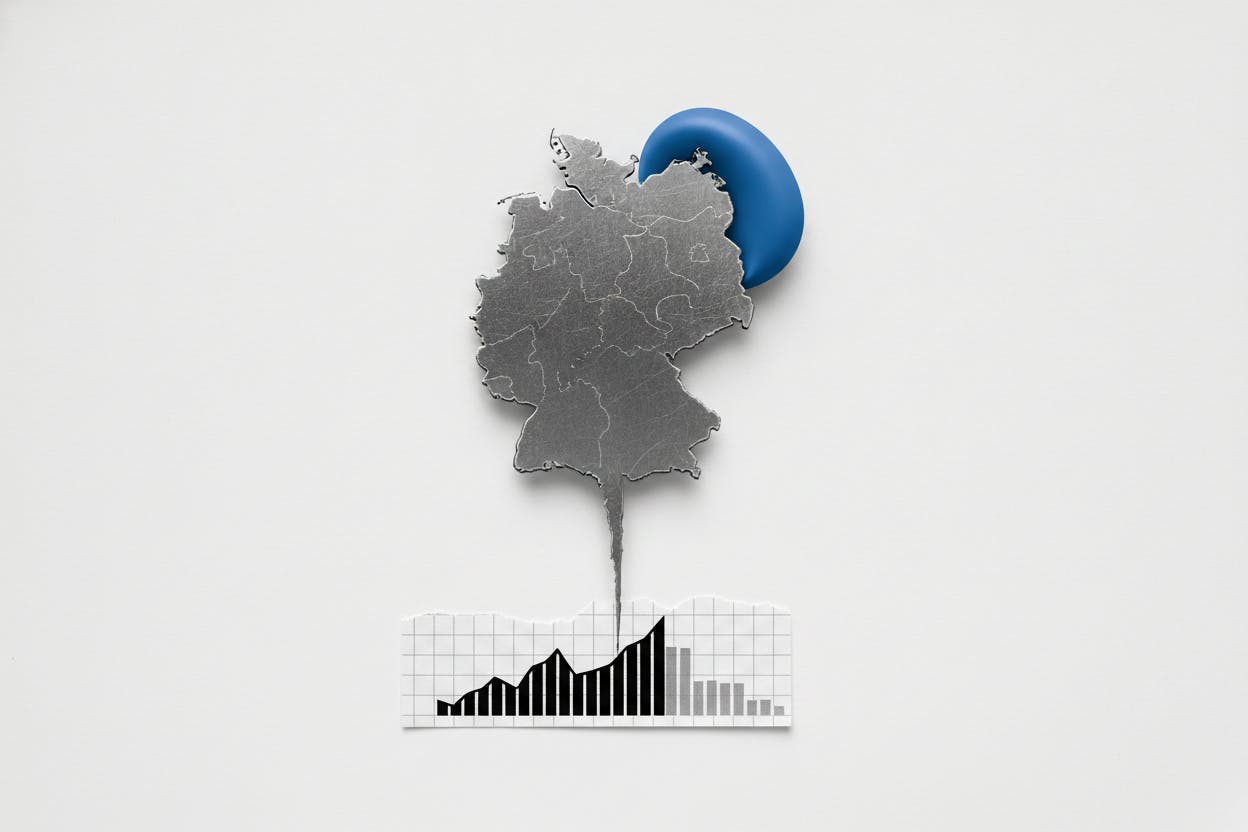
Germany's economic outlook is brightening, but the recovery may be short-lived. The Kiel Institute for the World Economy, one of the country's leading economic research groups, has raised its growth forecast for Europe's largest economy to 1.3% this year, up from a previous estimate of 0.8%. The upgrade reflects improving activity and business sentiment, suggesting the downturn has passed its low point.
However, the institute's optimism comes with a clear warning: the recovery is fragile and is expected to lose momentum in the coming years. By 2028, growth is projected to slow to just 0.5%, as government support measures fade and structural headwinds persist. The Kiel Institute argues that Germany's problems are not just cyclical—they are also deeply structural.
What's behind the brighter near-term view?
The Kiel Institute's revised forecast points to a modest rebound in economic activity and a pickup in business confidence. After a period of stagnation and contraction, the German economy appears to be stabilizing. The institute's economists note that the worst of the slump is likely behind, with domestic demand and exports showing signs of life.
Yet the recovery is not expected to be robust. The institute's projection of 1.3% growth this year is still below Germany's long-term average, and the pace is set to decelerate sharply. The slowdown to 0.5% by 2028 suggests that the economy will struggle to sustain momentum once temporary supports, such as government spending and stimulus measures, are withdrawn.
Germany's economic challenges are well-documented. The country has faced headwinds from high energy costs, a slowdown in global trade, and the ongoing transition to greener industries. These factors have weighed on its manufacturing sector, which is a key driver of the economy. The Kiel Institute's warning that the recovery could lose steam highlights the risk that these structural issues remain unresolved.
Why does this matter for investors?
For everyday investors, Germany's growth trajectory is important because it is the backbone of the eurozone economy. When Germany struggles, the entire region feels the impact, and that can ripple through global markets. A stronger-than-expected recovery could boost European stocks and the euro, while a weaker outlook could weigh on investor sentiment.
The Kiel Institute's forecast suggests that the near-term improvement may be a temporary reprieve rather than a sustained turnaround. Investors should be cautious about expecting a rapid acceleration in German growth. The projected slowdown to 0.5% by 2028 indicates that the economy may remain in a low-growth phase for years, which could limit corporate earnings growth and keep interest rates relatively low.
That said, the revised forecast is a positive signal. It suggests that the worst of the downturn may be over, and that the economy is on a path to recovery, albeit a slow one. For investors, this could mean opportunities in sectors that are sensitive to economic cycles, such as industrials and consumer goods, but also a need for patience.
Broader European context
Germany's outlook is not isolated. Across Europe, economies are showing mixed signals. For instance, Germany's services sector remains in contraction, with a PMI reading of 49.7, indicating that the recovery is not yet broad-based. Meanwhile, other European economies are performing differently: Switzerland posted its strongest growth since 2021, driven by a rebound in pharmaceuticals, while Spain's services growth is cooling but remains strong.
These divergences highlight the uneven nature of the European recovery. Germany, as the largest economy, will play a critical role in determining the region's overall momentum. If Germany's growth fades as the Kiel Institute predicts, it could drag on the eurozone as a whole, affecting everything from trade to monetary policy.
What to watch next
Investors will be watching for further economic data from Germany, including GDP figures, business sentiment surveys, and industrial production numbers. The Kiel Institute's forecast is just one of many, and other institutions may have different views. But the key takeaway is that while the immediate outlook has improved, the medium-term picture remains subdued.
Government policy will also be crucial. The Kiel Institute's warning that growth will slow as government support fades suggests that fiscal policy could be a determining factor. If Berlin introduces new stimulus or structural reforms, the recovery could be stronger than projected. Conversely, if support is withdrawn too quickly, the economy could stall.
For now, the message is clear: Germany is emerging from its slump, but the road ahead is likely to be bumpy. Investors should keep an eye on the data and be prepared for a period of modest, uneven growth.