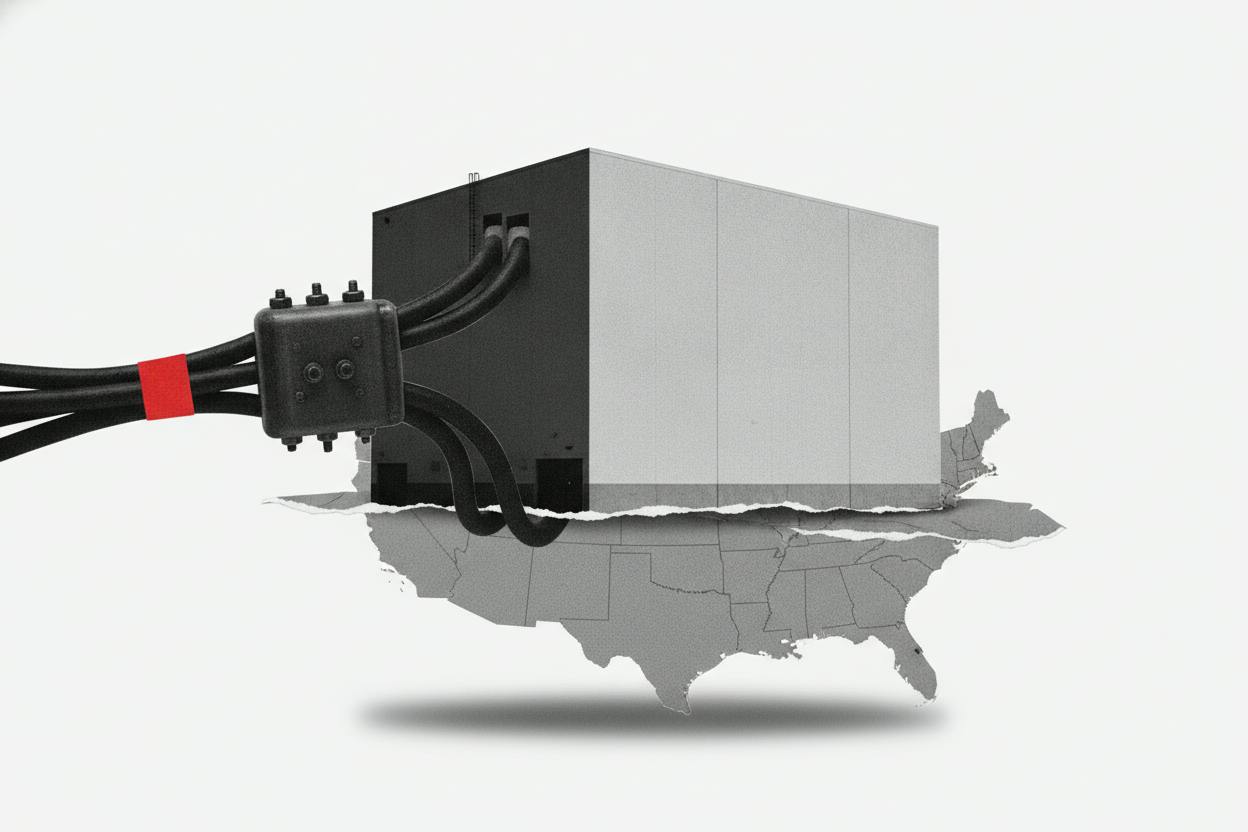
Goldman Sachs, one of Wall Street's most influential investment banks, is betting that the US data-center boom will keep humming along even as more communities push back against the massive facilities. In a new report, the bank raised its forecast for US data center capacity at the end of 2026 to 64 gigawatts (GW), up 5 GW from its previous estimate, while trimming its end-2027 outlook by the same amount to 90 GW.
Data centers are the warehouse-sized computer farms that train and run artificial intelligence models. They consume enormous amounts of electricity, and their rapid spread has sparked concerns in towns and cities about strain on local power grids, noise, and water use. Despite that opposition, Goldman said its tracking of individual projects still points to a “largely unchanged” buildout pace through 2027.
What's driving the numbers?
The revised figures reflect a nuanced view of the sector. The bank's upgrade for 2026 suggests that near-term projects are coming online faster than previously expected, likely because of advances in construction and equipment delivery. The slight cut for 2027 may reflect some delays from permitting battles or grid connection queues, but the overall trajectory remains steep.
To put the numbers in perspective: 64 GW is enough to power roughly 48 million average US homes, based on typical consumption. The projected 90 GW by 2027 would be a massive leap from current levels, underscoring how central AI has become to the country's electricity demand growth.
Goldman's outlook is closely watched because the bank's analysts track data center projects in detail, and their forecasts often move market sentiment. The firm has been bullish on AI infrastructure for years, and this report reinforces that stance.
Why local pushback matters
Community opposition has become a real headwind for the industry. Towns and counties have raised concerns about everything from noise and visual blight to the strain on aging power infrastructure. In some cases, local governments have imposed moratoriums or required lengthy environmental reviews, which can delay projects by months or even years.
But Goldman's analysis suggests these hurdles are not enough to derail the overall buildout. The bank points to the sheer scale of committed investment from tech giants and utilities, which are already ordering transformers, turbines, and other equipment years in advance. That forward planning makes it harder for local resistance to stop projects once they are underway.
Still, the issue is not going away. As data centers multiply, more communities will likely push back, and grid connection queues could lengthen. Investors should watch for signs that delays are becoming more frequent, as that could eventually slow the pace of capacity additions.
What it means for investors
For everyday investors, the key takeaway is that the AI-driven demand for electricity and infrastructure remains robust, even if it is not without friction. Companies that build, equip, or power data centers — from utilities to equipment makers to chip designers — could continue to see strong demand for their products and services.
Goldman's forecast also highlights the importance of electricity as a bottleneck. The bank has previously noted that power availability is one of the biggest constraints on data center growth. That is why securing reliable grid connections is so critical for projects, and why utilities are racing to expand capacity.
Investors should also keep an eye on the broader economic backdrop. Data center construction is a major driver of commercial construction spending and can boost local economies, but it also competes for resources like skilled labor and materials. If the buildout continues as Goldman expects, it could provide a steady tailwind for the industrial and energy sectors.
At the same time, the slight cut to 2027 is a reminder that forecasts are not set in stone. Delays from permitting, grid upgrades, or even a slowdown in AI investment could change the picture. As with any growth story, it pays to monitor the actual pace of project completions rather than relying solely on projections.
For now, Goldman's message is clear: the data center boom has legs, and local pushback is unlikely to stop it. That is a positive sign for the many companies and investors tied to the AI infrastructure buildout.