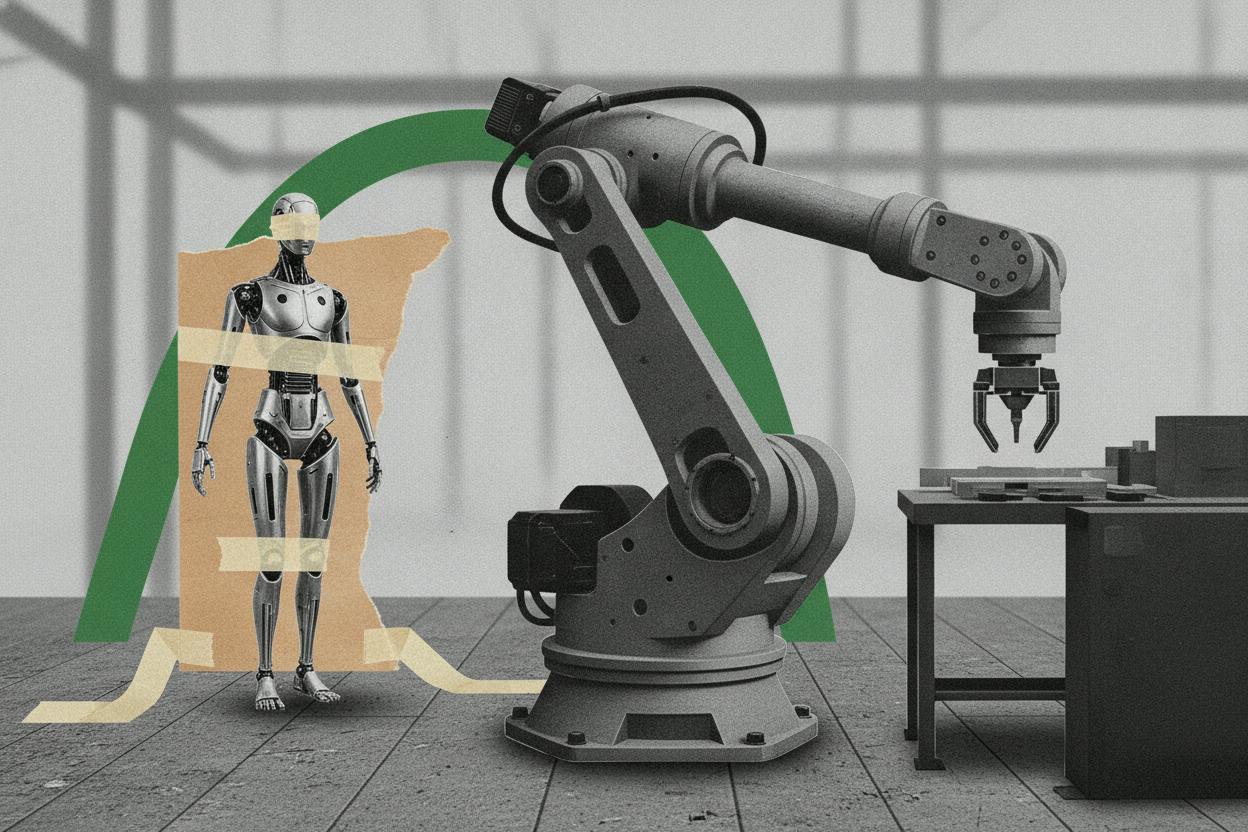
Humanoid robots are generating plenty of headlines, but on factory floors they remain a rare sight. According to the International Federation of Robotics (IFR), only about 7,000 humanoid robots were sold worldwide last year for industrial and professional service work. That compares with 542,000 traditional industrial robots installed in 2024 — a gap of more than 75 to one.
The numbers underscore a simple reality: despite the buzz around humanoid robots from companies like Figure AI and others, the technology is still in its infancy when it comes to real-world deployment. Traditional industrial robots — the fixed-arm machines that have been assembling cars and electronics for decades — continue to dominate factory automation.
Why the gap is so wide
Humanoid robots are designed to work in spaces built for humans, which could make them useful in warehouses, hospitals, and other settings where traditional robots can't easily operate. But they are also complex, expensive, and still learning to perform basic tasks reliably. Most are in pilot programs or small-scale deployments, not mass production.
Traditional industrial robots, by contrast, are a mature technology. They are fast, precise, and have been optimized for specific jobs like welding, painting, and assembly. Companies know exactly what they cost and what they can do. That predictability is a big reason why factories continue to buy them in the hundreds of thousands each year.
The IFR's figures also reflect a broader trend: while humanoid robots are advancing quickly in the lab, the path to commercial scale is long. Recent developments like Figure AI's Helix 2.5, which lets robots learn by watching humans, are promising, but they are still far from replacing the workhorses of modern manufacturing.
What this means for investors
For everyday investors, the takeaway is about managing expectations. The hype around humanoid robots has driven interest in robotics stocks and startups, but the actual market is still tiny. That doesn't mean the opportunity isn't real — forecasts call for much faster growth in the coming years — but it does mean the transition will likely be gradual.
Investors should also consider the broader factory automation landscape. Traditional industrial robots are a proven, profitable business. Companies that make those robots, or the software that runs them, are likely to benefit from continued automation demand. Factory output in the US has been uneven, but the long-term trend toward automation remains intact.
Humanoid robots, on the other hand, are more speculative. They could open up entirely new markets — like elder care or household chores — but those applications are years away. For now, the numbers suggest that humanoid robots are a niche, not a mainstream product.
Looking ahead
The IFR's data is a useful reality check. It doesn't mean humanoid robots will fail; it just means they are early. The technology is improving rapidly, and costs are likely to fall as production scales up. But investors should be cautious about expecting immediate returns from a sector that is still finding its footing.
One thing to watch is how quickly humanoid robots move from pilot projects to real deployments. Experts note that the 'brains' of these robots need better real-world data to improve, which takes time and money. Another is whether traditional robot makers start incorporating humanoid features into their own products, blurring the line between the two categories.
For now, the message is clear: humanoid robots are an exciting frontier, but they are not yet a major force in the factory. Investors should weigh the hype against the hard numbers — and remember that the industrial robot market, while less flashy, is where the real money is being made today.