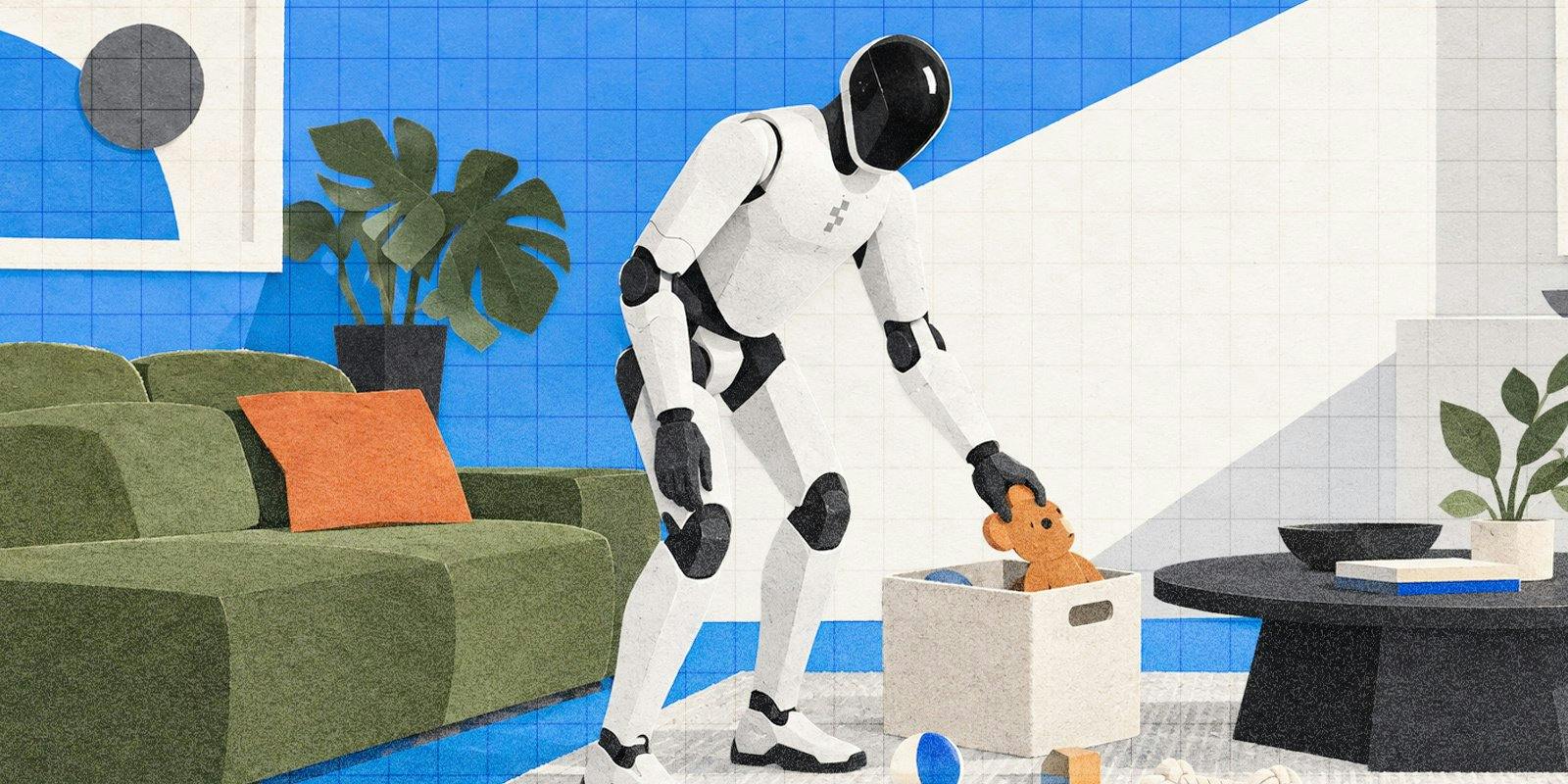
Walking into a stranger's home and immediately knowing how to tidy up, fold towels, or make a bed is second nature for most people. For humanoid robots, it has been a stubborn barrier. But this week, robotics company Figure AI unveiled Helix 2.5, a new neural network that controls its humanoid robot, and the company says it marks a significant step toward robots that can handle the messy, unpredictable reality of everyday life.
Unlike earlier systems that were programmed with fixed instructions for a specific environment, Helix 2.5 was pretrained on Figure's dataset of human behavior. That means the robot learns by observing how people perform tasks, rather than being told exactly what to do in every possible scenario. The result, according to the company, is a robot that can generalize—applying what it has learned to new settings it has never encountered before.
Testing in the real world
To put that claim to the test, Figure sent its robot into 30 different homes it had never seen before. The robot was asked to try three different chores: tidying living rooms, folding towels, and making beds. Its completed-task success rate came in at 56%.
That number may not sound impressive at first glance, but for a robot operating in completely unfamiliar environments, it represents a meaningful leap. In the past, humanoid robots often struggled outside tightly controlled labs or factory floors, where every object and obstacle is known in advance. The ability to walk into a new home and complete more than half of the assigned tasks suggests that the technology is moving from research curiosity toward something that could eventually be useful in real households.
The approach also highlights a broader shift in the robotics industry. Many companies are moving away from hand-coded rules and toward machine learning models trained on large datasets, similar to how large language models like ChatGPT learn from text. For robots, the equivalent is training on human behavior—watching people perform tasks, then mimicking those actions in new contexts. This is a trend that industry observers have been watching closely, as humanoid robot 'brains' need better real-world data to improve.
Why this matters for investors
For everyday investors, the significance of Helix 2.5 is not about one company's product demo. It's about the pace at which humanoid robotics is becoming commercially viable. If robots can learn to operate in unstructured environments like homes, the potential market expands dramatically—from factory floors to elder care, hospitality, and domestic chores.
That potential has attracted heavy investment across the sector. Companies like Figure AI are racing against well-funded rivals, including Tesla's Optimus and Boston Dynamics, as well as a wave of startups. The competition is pushing the technology forward quickly, but it also means that no single player has yet established a clear lead.
Investors should also consider the broader ecosystem. Humanoid robots rely on advances in batteries, sensors, and artificial intelligence. For example, new battery cells designed for drones and robotics could help extend the operating time of these machines, a critical factor for real-world use. And as robots move from labs to streets and homes, regulatory frameworks will play a role—just as they are for autonomous vehicles, such as Waymo's expansion of robotaxis.
What to watch next
The 56% success rate, while encouraging, also highlights how far the technology still has to go. A robot that fails nearly half the time is not yet ready for prime time in most households. But the trajectory is what matters. Each new model, each larger dataset, and each additional home test brings the technology closer to the point where it becomes reliable enough for commercial use.
Investors should watch for several signals in the coming months: improvements in task completion rates, expansion of training datasets, partnerships with consumer or service companies, and any signs of regulatory approval for home or public use. The companies that can demonstrate consistent, safe performance in real-world settings will be the ones best positioned to capitalize on the growing interest in embodied AI.
For now, Helix 2.5 is a reminder that the path to useful humanoid robots is not a single breakthrough but a series of incremental steps. Each step, like this one, brings the industry closer to a future where robots are not just factory workers but helpers in our homes. For investors, that future may still be a few years away, but the direction is becoming clearer.