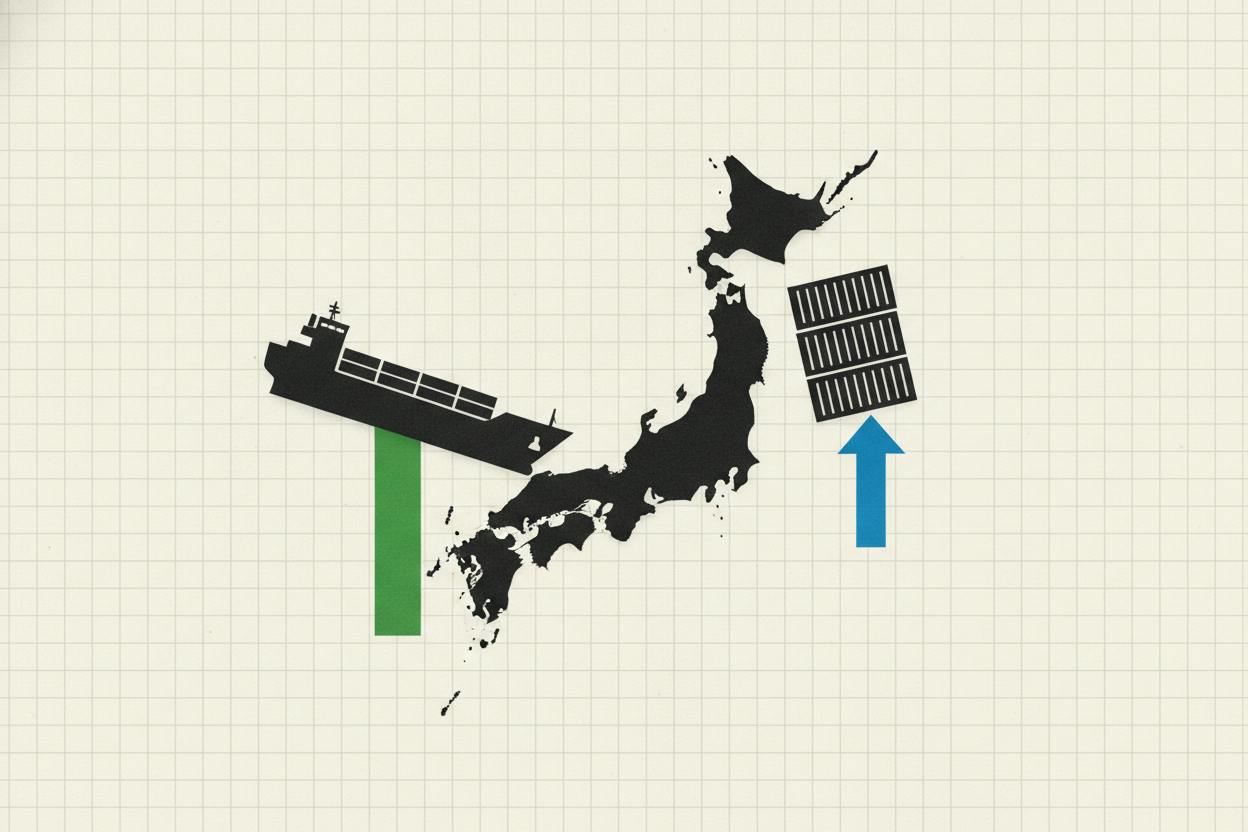
Japan's trade deficit narrowed in September, but the improvement was far smaller than economists had hoped, as imports continued to outpace exports for another month. The Ministry of Finance reported a deficit of 536.6 billion yen ($3.6 billion), a sharp improvement from the previous month but still well above the 181 billion yen gap that analysts had penciled in.
Exports rose 16.7% year over year to 10.972 trillion yen, marking the 13th consecutive month of growth. The gains were led by electrical machinery, including semiconductors and integrated circuits, as well as strong demand for motor vehicles. Shipments to Taiwan, ASEAN countries, and the United States grew strongly, while exports to China rose more modestly.
But imports climbed even faster, up 18.9% to 11.509 trillion yen. That kept Japan in the red, meaning the country is still paying out more for goods coming in—including energy and other inputs—than it earns from goods going out.
Why the deficit matters for the Bank of Japan
The timing is awkward for the Bank of Japan (BOJ). The central bank has already pushed its policy rate up to 1.25%, and officials have been arguing that inflation is shifting from being driven by higher import costs to being supported more by wage growth. A bigger-than-expected trade deficit can signal a softer near-term growth contribution from trade, which makes it harder for markets to judge how much further the BOJ can tighten without leaning too hard on the economy.
In plain terms, when imports run ahead of exports, net exports subtract from economic growth in the GDP math. If that drag shows up just as the BOJ is trying to keep inflation under control, traders have to balance two forces that point in different directions: weaker growth argues for fewer rate hikes, while sticky inflation argues for staying restrictive.
The result is more two-way risk in the yen and in short-dated Japanese government bonds, where expectations about “how many more moves” can shift quickly with each trade, inflation, and wage update. The yen has been sensitive to the BOJ's policy path, and any hint that the central bank might pause could weaken the currency, while a more hawkish stance could strengthen it.
What it means for investors
For everyday investors, the trade deficit is a reminder that Japan's economic recovery is still uneven. While exports are growing, the country remains heavily dependent on imported energy and raw materials, which keeps the trade balance in the red. That dynamic can weigh on corporate profits, especially for companies that rely on imported inputs, and it can also influence the yen's value.
A weaker yen can be a double-edged sword: it makes Japanese exports more competitive, but it also raises the cost of imports, which can feed into domestic inflation. For investors holding Japanese stocks, the recent rally in the Nikkei has been partly driven by strong export demand, especially for chips and electronics. But if the trade deficit persists, it could signal that the economy is not growing as robustly as hoped, which might temper that enthusiasm.
For those with exposure to Japanese bonds, the BOJ's rate path is the key variable. The central bank has been gradually normalizing policy, but a weak trade picture could make it more cautious. That would keep bond yields low, which is good for bond prices but not for savers looking for income.
Investors should also keep an eye on the broader Asian trade picture. Japan's strong exports to Taiwan and ASEAN suggest that regional demand remains solid, which is a positive sign for the global tech supply chain. But the modest growth in exports to China highlights the ongoing challenges in that market, as China's own growth has been increasingly reliant on exports.
The road ahead
The BOJ's next policy meeting will be closely watched for any signals on the rate path. The central bank has been walking a tightrope between supporting growth and containing inflation, and the trade data adds another layer of uncertainty. If the deficit continues to narrow, it could ease some of the pressure on the BOJ to act. But if imports keep surging, the central bank may have to weigh the risk of a prolonged trade drag against the need to keep inflation in check.
For now, the message for investors is to expect more volatility in the yen and Japanese bonds. The trade data is just one piece of the puzzle, but it's a reminder that Japan's economic recovery is still a work in progress.