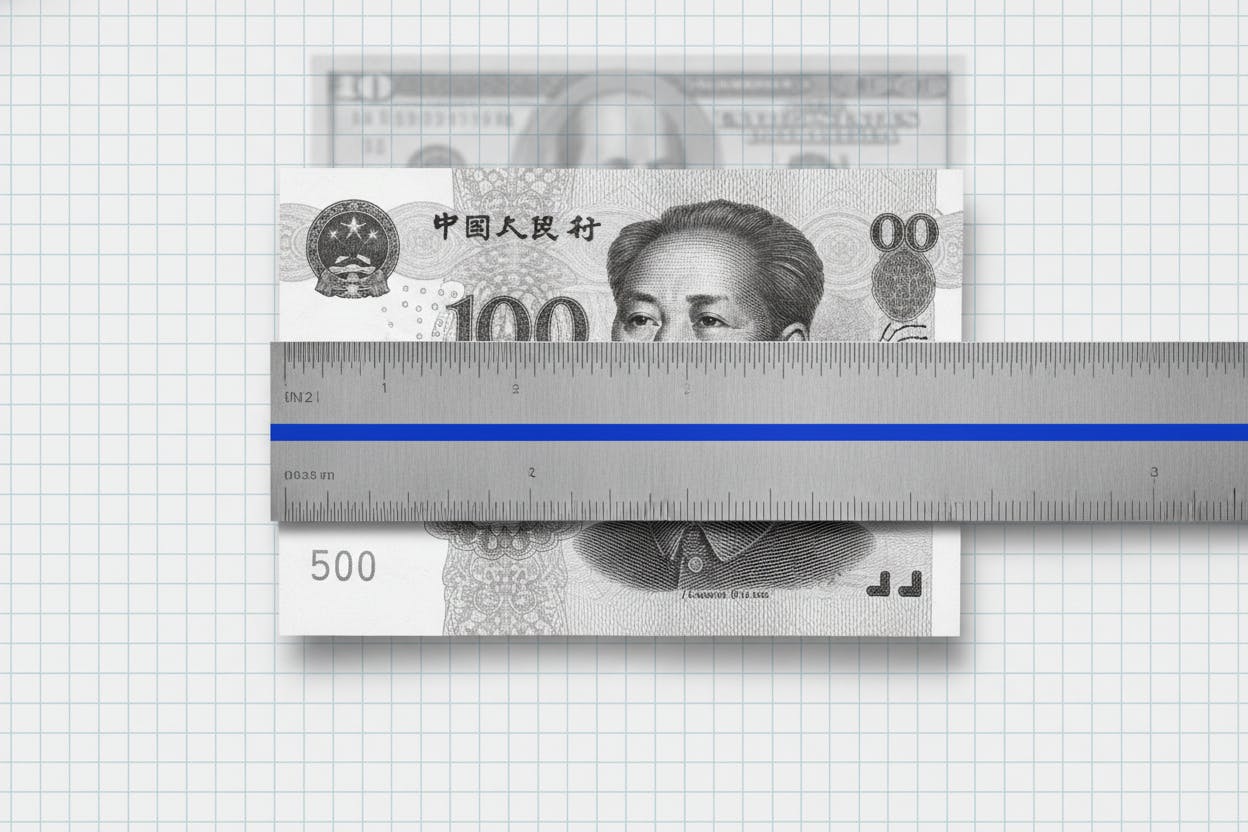
China's currency stabilized on Tuesday after the People's Bank of China (PBOC) set its strongest daily midpoint since February 10, 2023, a clear signal that Beijing is drawing a line under the yuan's recent weakness. The move comes even as safe-haven demand kept the U.S. dollar firm, highlighting the central bank's willingness to push back against depreciation pressures.
What Happened
Each morning, the PBOC sets a daily midpoint, or "fix," for the onshore yuan. The currency is then allowed to trade within a 2% band above or below that level. On Tuesday, the central bank set the fix at 6.8036 per dollar, its strongest level in over a year. This was notably stronger than market expectations, which had been leaning toward a weaker fix given the dollar's recent strength.
According to Reuters, the "fixing gap" — the difference between the official fix and where models based on market conditions suggest it should land — has narrowed sharply from the 500-plus pips seen at times last month. That narrowing suggests the PBOC is actively intervening to guide the yuan higher, rather than letting market forces dictate the currency's path.
Why It Matters
The yuan has been under pressure for much of 2023, weighed down by a slowing Chinese economy, weak consumer demand, and a strong dollar. The PBOC's latest move signals that it is willing to use its tools to prevent a disorderly depreciation, which could destabilize financial markets and fuel capital outflows.
For everyday investors, a stable yuan is important for several reasons. A weaker yuan makes Chinese exports cheaper, but it also raises the cost of imported goods and can fuel inflation. More broadly, a sharp yuan decline can roil global markets, as it did in 2015 when China's devaluation sparked a worldwide sell-off. By setting a strong fix, the PBOC is trying to avoid that scenario.
The dollar, meanwhile, has been buoyed by safe-haven demand amid geopolitical tensions and uncertainty over global growth. That has put pressure on many emerging-market currencies, not just the yuan. The PBOC's action is a reminder that central banks in the developing world are pushing back against dollar strength, often by raising interest rates or intervening in currency markets.
What It Means for Investors
For investors with exposure to Chinese assets, the PBOC's move is a positive sign. A stable yuan reduces uncertainty for companies that do business in China and for investors holding Chinese stocks or bonds. It also makes it easier for the PBOC to manage monetary policy without worrying about currency instability.
However, the PBOC's ability to defend the yuan is not unlimited. If the dollar continues to strengthen or if China's economic data weakens further, the central bank may have to let the yuan fall again. Investors should watch for further PBOC signals, such as changes to the fixing gap or new policy measures.
In the broader context, China's economy is facing headwinds from a property slump, weak consumer spending, and rising factory costs. Recent data showed that China's factory costs rose 4.1% in June, but consumer demand remains weak, complicating the PBOC's task. Meanwhile, other commodities like iron ore prices have stayed flat as a strike threat at a major port offsets weak demand from China.
The PBOC's strong fix also comes amid a broader rally in risk assets, with oil prices surging on an Iran deal collapse and chip stocks rebounding on hopes for China's H200 chips. That suggests investors are cautiously optimistic about China's growth prospects, even as the dollar remains strong.
The Bottom Line
The PBOC has drawn a line under the yuan with its strongest fix in over a year, signaling that it will not tolerate a disorderly depreciation. For investors, this is a reminder that central banks still have tools to manage currency markets, even in the face of a strong dollar. But the yuan's fate ultimately depends on China's economic recovery and global risk sentiment. Investors should stay tuned for further PBOC moves and economic data that could shift the balance.